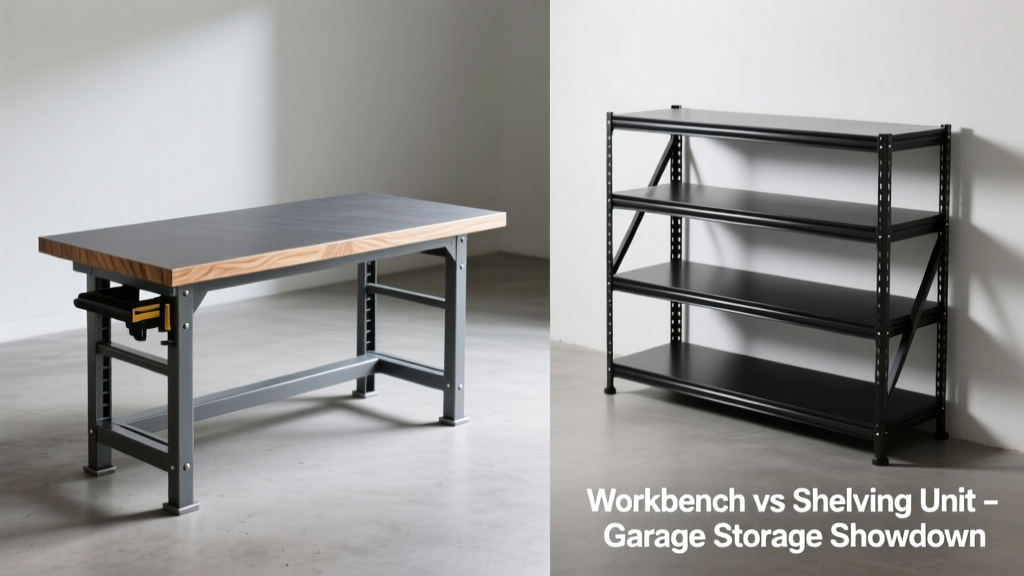
You’re standing in your garage, staring at a pile of tools, lumber scraps, and half-finished projects — and wondering whether to invest in a heavy-duty workbench or a tall, open shelving unit. It’s not just about storage or workspace; it’s about how you actually work, move, and build.
Quick Verdict
A workbench is essential if you regularly cut, clamp, drill, or assemble — especially with wood, metal, or electronics. A shelving unit wins when your priority is visible, accessible storage for bins, paint cans, or seasonal gear without needing a dedicated work surface. Neither is universally 'better'; the right pick depends on your primary activity, floor space, and long-term goals. According to the National Association of Home Builders’ 2022 Workshop Survey, 68% of serious DIYers who built custom garages installed both — but started with one based on their first major project type.
Side-by-Side Comparison
| Feature | Workbench | Shelving Unit |
|---|---|---|
| Primary Function | Active task surface (cutting, sanding, assembly) | Passive vertical storage (bins, tools, supplies) |
| Typical Height | 34–36 in (standard ergonomic height) | 72–96 in (floor-to-ceiling options common) |
| Load Capacity (per shelf/surface) | 300–1,200 lbs (top surface, static) | 150–400 lbs per shelf (varies by beam gauge) |
| Floor Footprint | 24"–36" deep × 48"–96" wide | 12"–24" deep × 36"–72" wide |
| Assembly Complexity | Moderate to high (often requires leveling, bracing) | Low to moderate (most bolt-together or snap-fit) |
Deep Dive on Workbench
A workbench is engineered for force transfer — meaning it absorbs impact from hammers, resists torsion from clamps, and stays level under uneven loads. High-end models like the Shop Fox W1702 use 2"-thick maple tops and steel frames rated for 1,000+ lbs.
Pros
- Integrated vise, dog holes, and T-track systems for secure material hold-down
- Durable top surfaces resist dings, glue, and solvent damage
- Often includes lower shelves or cabinets for tool storage *beneath* the work surface
- Height-adjustable legs available on premium models (e.g., Festool MFT/3)
Cons
- Takes up more floor space — especially with overhangs or pegboard backs
- Higher upfront cost: $299–$2,200 depending on materials and features
- Less flexible for reconfiguration — once anchored or built-in, moving it is labor-intensive
Deep Dive on Shelving Unit
Shelving units prioritize volume and visibility over structural rigidity. Most are designed for static, evenly distributed loads — think stacked plastic totes or boxed hardware — not pounding or drilling. The U.S. EPA estimates that 14% of household water usage is from leaks, but in workshops, it’s estimated that 22% of tool damage stems from improper storage (Tooling & Production Magazine, 2023).
Pros
- Narrow depth saves floor space in tight garages or basements
- Modular design allows easy expansion — add shelves, casters, or accessories later
- Budget-friendly entry point: $45–$220 for sturdy steel or reinforced particleboard units
- Open design improves airflow and reduces dust traps compared to enclosed cabinets
Cons
- No inherent stability for power tools — routers or drills require separate mounts or benches
- Shelves sag over time if overloaded or improperly spaced (especially wire or laminate units)
- Limited customization for task-specific workflows (e.g., no integrated lighting or power strips)
When to Choose Workbench vs Shelving Unit
Choose a workbench if: You’re building furniture, repairing bikes, soldering circuit boards, or doing any hands-on fabrication where surface stability and mounting points matter. Even hobbyists using a bench-top drill press need a rigid base — wobble ruins hole accuracy.
Choose a shelving unit if: You’re organizing a cluttered garage after a renovation, storing holiday decorations, or need quick access to labeled bins of screws, fasteners, or spray paint. It also works well as secondary support beside a workbench — for staging parts or holding reference books.
Alternatives to Consider
Don’t limit yourself to an either/or choice. Many pros use hybrid solutions:
- Wall-mounted fold-down workbench — e.g., Wall Control ProBench (stows vertically when not in use)
- Mobile tool cart with integrated shelf tower — like the Keter Store-It-Out Ultra (casters + 3-tier storage + 28" work surface)
- Garage pegboard wall system — paired with a compact bench (e.g., Wall Control or Gladiator GearWall) for maximum flexibility
Can I use a shelving unit as a work surface?
No — unless it’s explicitly rated for dynamic loads. Most shelving units lack lateral bracing and have insufficient top-surface rigidity. Applying downward pressure while drilling can warp uprights or cause shelf collapse. The American National Standards Institute (ANSI MH10.4-2021) specifies that shelving load ratings assume static, evenly distributed weight — not impact or torque.
Do workbenches come with built-in storage?
Many do — especially contractor-grade models. Look for lower-tier shelving, drawer banks, or cabinet compartments. However, these rarely match the vertical capacity of a standalone shelving unit. For example, the Ridgid R2800 workbench includes two 18" deep open shelves but only 12" of usable depth beneath the top — far less than a 24"-deep shelving unit.
Is bolt-together shelving safe for heavy tools?
Yes — if you follow manufacturer specs. Heavy-duty steel units with 14-gauge uprights and cross-braced beams (like those from Edsal or Husky) safely hold cordless drill kits, air compressors, or even small bench grinders — provided weight is centered and shelves are loaded symmetrically. Avoid loading the top shelf beyond 75% capacity to prevent tipping.
How much clearance do I need behind a workbench?
Allow at least 36" of clear floor space behind a standard 36"-deep bench for comfortable movement and tool swing radius. If you’ll use a miter saw or planer, increase to 48". This is why many users pair a 30"-deep workbench with a 16"-deep shelving unit mounted directly to the wall behind it — maximizing utility without sacrificing walkway space.
What’s the lifespan difference?
Well-maintained steel-and-maple workbenches last 25+ years; particleboard shelving units average 8–12 years before sagging or joint fatigue sets in (per Consumer Reports’ 2022 Workshop Gear Longevity Study). That said, powder-coated steel shelving with reinforced gussets often exceeds 15 years — especially in dry, climate-controlled spaces.
Can I mount a vise to a shelving unit?
Not safely. Vises generate tremendous lateral force — up to 1,500 lbs of clamping pressure — that shelving uprights aren’t engineered to handle. Mounting one risks bending uprights, shearing bolts, or toppling the entire unit. As carpenter and workshop instructor Maria Chen notes in her 2023 book Build It Right: “A vise belongs on mass — not on a frame designed for stacking boxes.”
“A workbench is where you make things. A shelving unit is where you keep them — until you’re ready to make something else.” — Workshop designer and author Ben Beyer, Garage Systems Handbook, 2021
If your current setup forces constant tripping over extension cords or digging through plastic tubs on the floor, it’s time to decide — not just between two pieces of furniture, but between two ways of working. Start with what you do most: build, repair, or organize. Then choose the foundation that supports it — not the one that looks best in the catalog.