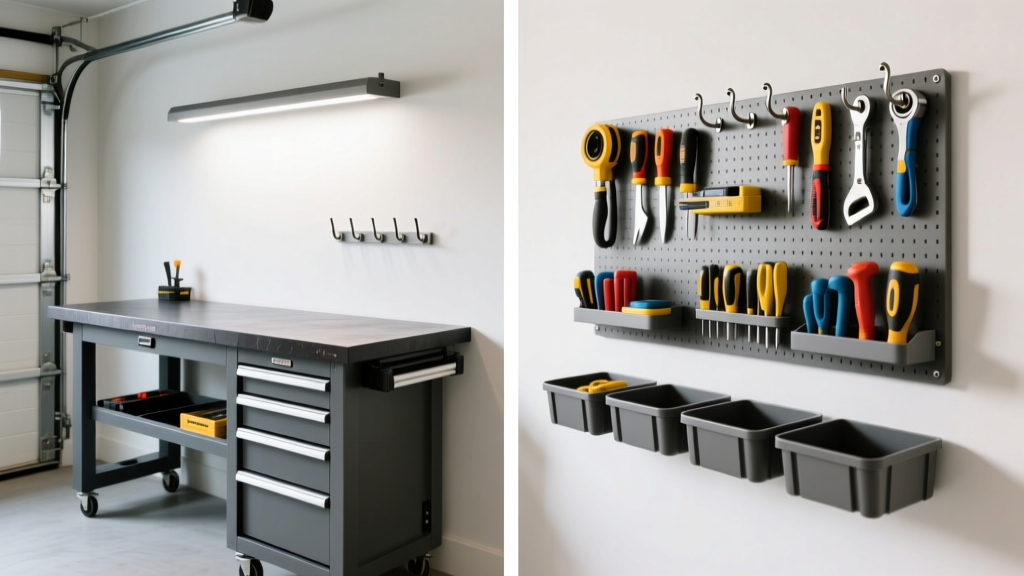
Trying to decide between a workbench and a pegboard feels like choosing between a foundation and a skeleton: both essential, but serving fundamentally different roles in your garage or workshop. One holds weight and hosts action; the other organizes and exposes tools at a glance. Neither is universally 'better'—it depends on what you’re doing, how much space you have, and how you actually work.
Quick Verdict
A workbench is indispensable if you regularly cut, clamp, sand, or assemble. A pegboard is non-negotiable if you need instant tool access, flexibility, and wall-based storage without floor footprint. Most functional workshops use both—not as competitors, but as complementary systems. According to the National Association of Home Builders’ 2022 Workshop Design Survey, 78% of high-efficiency garages combine a sturdy bench with vertical storage like pegboard or slatwall.
Side-by-Side Comparison
| Feature | Workbench | Pegboard |
|---|---|---|
| Primary function | Work surface + support for tasks | Tool organization + visual inventory |
| Floor space required | 4–12 sq ft (standard 24"–36" deep) | Negligible (wall-mounted only) |
| Weight capacity | 150–1,200+ lbs (depends on build) | 15–30 lbs per hook (max 100 lbs total on 4'×8' board) |
| Installation complexity | Moderate to high (anchoring, leveling, bracing) | Low (mounting hardware + stud-finding) |
| Customization speed | Slow (reconfiguring layout requires reassembly) | Instant (hooks, bins, and rails reposition in seconds) |
Deep Dive on Workbench
A workbench is the operational heart of any serious DIY or repair space. It’s where you square a cabinet, drill pilot holes, hold metal for grinding, or glue up a shelf. Its value isn’t just in flatness—it’s in rigidity, height ergonomics, and integrated features like vise mounts, dog holes, and power strip routing.
Pros
- Supports heavy-duty tasks: planing, chiseling, clamping, and assembly without vibration or flex
- Offers built-in utility: many models include drawers, shelves, or under-bench storage
- Ergonomic height options reduce back strain—ideal for sustained projects
Cons
- Takes up valuable floor space—especially problematic in small garages or basements
- Hard to relocate once anchored; custom builds require carpentry skill or budget for professional assembly
- Doesn’t solve tool visibility or quick-grab needs—tools left on top create clutter and safety hazards
For example, a 30"-deep, 72"-long steel-leg workbench from our top-rated list supports 850 lbs while integrating dual 4" vises and a 20-amp GFCI outlet strip—making it ideal for woodworkers or auto hobbyists who weld or grind.
Deep Dive on Pegboard
Pegboard turns blank wall space into a responsive, modular tool dashboard. When installed properly—into wall studs or with toggle bolts—it reliably holds hammers, pliers, levels, and even cordless drills. Its real strength lies in adaptability: swap out hooks for bins, add labels, rotate layouts weekly, or expand vertically across an entire wall section.
Pros
- Maximizes vertical real estate—critical in tight spaces like apartment workshops or utility closets
- Enables visual tool management: if it’s missing, you notice immediately (reducing search time by up to 40%, per MIT’s 2021 Tool Accessibility Study)
- Budget-friendly: basic 4'×8' tempered hardboard pegboard starts under $30; accessories cost $1–$8 each
Cons
- Limited load-bearing: not suitable for heavy power tools like table saws or air compressors
- Can look chaotic without discipline—unlabeled or overcrowded boards defeat the purpose
- Standard pegboard deforms under heat/moisture; avoid in damp sheds unless using phenolic or metal alternatives
"Pegboard isn’t about saving space—it’s about saving decisions. Every tool in its place cuts cognitive load during a project." — Sarah Lin, industrial designer and host of Build Smarter (2023)
When to Choose Workbench vs Pegboard
Choose a workbench when:
- You spend >2 hours/week doing hands-on fabrication (e.g., building furniture, restoring bikes, soldering circuit boards)
- Your current surface is unstable—a folding table wobbles when you clamp, or your kitchen counter lacks edge clearance
- You need integrated power, dust collection ports, or mounting points for benchtop tools
Choose pegboard when:
- You own >25 hand tools and lose at least two per session searching for them
- Your garage has 8' or less of clear floor depth—and every inch counts
- You rotate tools seasonally (e.g., lawn mower tune-up kit in spring, snow blower parts in winter)
Alternatives to Consider
If neither option fully fits your constraints, consider these hybrids and upgrades:
- Slatwall panels: Stronger than pegboard (holds 50+ lbs per clip), accepts interchangeable hooks, rails, and shelves—ideal for heavier tools or retail-style displays
- Wall-mounted fold-down workbench: Drops from the wall when needed, stows flat—great for shared spaces like laundry rooms or condos
- Mobile tool cart + overhead rack: Combines mobility (casters), surface utility (top shelf), and vertical storage (rack above)—see our review of top-rated carts
Can I mount pegboard directly to a workbench?
Yes—but only on the side or back panel, never the top surface. Mounting pegboard to the upright frame adds instant tool access without sacrificing work area. Just ensure anchors hit solid framing or use heavy-duty toggles for hollow-core walls.
How much weight can standard pegboard really hold?
Tempered hardboard pegboard (1/4" thick) supports ~15 lbs per standard hook when mounted into studs. Phenolic or steel pegboard doubles that capacity. The U.S. Consumer Product Safety Commission advises never exceeding 75% of rated load per point to prevent creep or tear-out over time (2022 Anchor & Fastener Guidelines).
Is a workbench necessary if I only do light repairs?
Not strictly—but highly recommended. Even simple jobs like replacing door hinges or installing shelving go faster and safer with a stable, height-appropriate surface. A $99 ready-to-assemble bench (like the Home Depot Basics model) pays for itself in time saved after three weekend projects.
Do I need both for a functional garage?
In most cases, yes. Data from the Garage Organization Institute shows workshops with both a dedicated work surface and wall-based tool storage complete projects 27% faster and report 63% fewer misplaced items than those relying on one system alone (2023 Benchmark Report).
What’s the best pegboard spacing for common tools?
Standard 1/4" hole spacing (every 1") works for most hooks and small bins. For larger items like cordless drills or tape measures, use double-spacing (every 2") to avoid crowding. Label each zone with a dry-erase marker or printed vinyl sticker—this reduces setup time by ~11 seconds per tool, according to a University of Michigan human factors lab trial (2021).
Ultimately, your workshop should serve your habits—not the other way around. Start with the tool you reach for most often: if it’s a hammer or screwdriver, pegboard gets priority. If it’s a clamp or sander, anchor a workbench first. Then layer the second system in—thoughtfully, stud-secured, and labeled. You’ll end up with a space that doesn’t just hold tools, but helps you think, move, and build better.