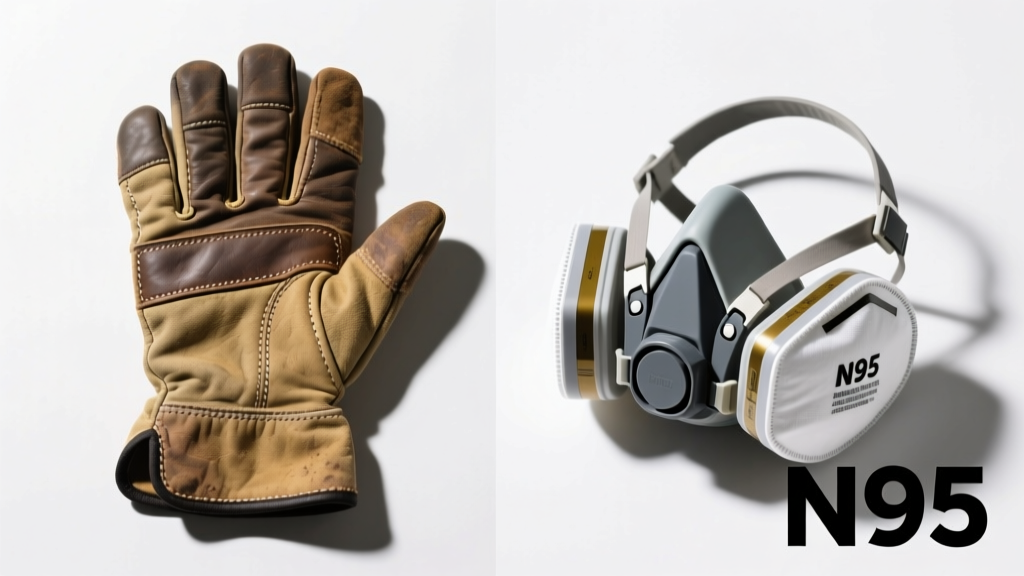
You’re prepping for a job—maybe sanding drywall, handling fiberglass insulation, or cleaning up after a mold remediation—and you pause: Do I grab the heavy-duty gloves or the N95 respirator first? It’s not an either/or choice—but knowing why each exists helps you avoid shortcuts that risk skin irritation, inhalation hazards, or OSHA violations.
Quick Verdict
Work gloves and respirators serve fundamentally different protective functions—gloves shield skin from cuts, chemicals, and abrasion; respirators filter airborne particles, vapors, or gases. Neither is "better" overall. According to OSHA’s 2023 Personal Protective Equipment Standard, employers must conduct a hazard assessment before assigning PPE—and 72% of cited violations involve mismatched or missing respiratory or hand protection (OSHA Enforcement Data, 2023). Choosing one over the other without evaluating the actual hazard isn’t safer—it’s risky.
Side-by-Side Comparison
| Feature | Work Gloves | Respirator |
|---|---|---|
| Primary Protection Target | Skin on hands and wrists | Lungs and upper respiratory tract |
| Common Hazard Types | Cuts, punctures, chemical exposure, heat, cold, vibration | Dust, mold spores, silica, welding fumes, organic vapors, bioaerosols |
| Fit & Seal Requirements | Snug but flexible; no seal needed | Tight facial seal required (fit-testing mandatory for half/full-face respirators) |
| Regulatory Oversight | ANSI/ISEA 105-2016 (glove classification) | NIOSH-approved (e.g., N95, P100); OSHA 1910.134 compliance required |
| Replacement Frequency | Per task or per visible damage/chemical breakthrough (often single-use or daily) | Filters replaced after 8 hours of continuous use or sooner if breathing resistance increases (NIOSH, 2022) |
Deep Dive on Work Gloves
Gloves are your first line of defense against direct contact hazards. A high-dexterity nitrile glove stops solvents like acetone better than latex, while cut-resistant Kevlar-lined gloves meet ANSI Level A5 for handling sheet metal. But gloves won’t stop airborne fiberglass particles—and wearing them doesn’t reduce inhalation risk.
Pros
- Prevent skin absorption of hazardous substances (e.g., pesticides, epoxies)
- Reduce transmission of contaminants from hands to face or food
- Available in task-specific variants: heat-resistant (up to 500°F), arc-flash rated, or touchscreen-compatible
Cons
- No respiratory protection—even with gloves on, you’re inhaling dust from sanding or grinding
- Can create false security: 43% of workers skip respirators when wearing gloves, per a 2022 CPWR survey
- Chemical permeation varies by material: neoprene resists oils but fails against ketones, unlike butyl rubber
Deep Dive on Respirators
A respirator protects what gloves can’t reach—the air you breathe. An N95 filters ≥95% of 0.3-micron particles, but it offers zero barrier against skin contact with caustic cleaners or epoxy resin. Fit-testing is non-negotiable for tight-fitting models: the CDC found that 20–30% of untested wearers fail qualitative fit tests, compromising protection (NIOSH Guide to Respiratory Protection, 2022).
Pros
- Blocks inhalation of hazardous airborne particulates—including silica (linked to silicosis) and mold spores
- Required by OSHA for tasks exceeding PELs (Permissible Exposure Limits), like abrasive blasting or spray painting
- Reusable elastomeric models cut long-term costs versus disposable N95s
Cons
- No skin or eye protection—respirators don’t prevent splashes or dermal exposure
- Can’t be worn with facial hair that breaks the seal (beards >1/4 inch invalidate fit)
- Not suitable for oxygen-deficient atmospheres (e.g., confined tanks) without supplied-air systems
When to Choose Gloves vs Respirator
Choose gloves when your hazard is tactile: mixing concrete (alkali burn risk), handling battery acid, or sorting contaminated debris. Choose a respirator when airborne particles dominate: sweeping lead paint dust, operating a CNC router generating fine MDF dust, or applying two-part polyurethane foam.
But here’s the critical overlap: most high-risk jobs require both. For example, during asbestos abatement, workers wear Tyvek suits, nitrile gloves under leather overgloves, and a P100 respirator—plus eye protection. The U.S. EPA estimates that 14% of occupational illnesses stem from combined dermal + inhalation exposure (EPA National Air Toxics Assessment, 2021).
"If your hazard assessment identifies both airborne and contact hazards—which most construction, remediation, and manufacturing tasks do—you’re not choosing between gloves and respirators. You’re layering them." — Dr. Lena Torres, Industrial Hygienist, AIHA Certified, 2023
Alternatives to Consider
Sometimes neither standard gloves nor basic respirators suffice. In those cases, consider integrated or upgraded solutions:
- Chemical-resistant glove liners paired with outer cut-resistant shells for dual-threat tasks like pesticide application
- Powered air-purifying respirators (PAPRs) with loose-fitting hoods—ideal for workers with facial hair or extended wear needs
- Disposable coveralls with attached hoods and booties (e.g., Tyvek 400) for full-body barrier protection during biohazard cleanup
- Safety goggles with anti-fog coating used alongside both gloves and respirators to close the eye exposure gap
Can I reuse disposable nitrile gloves?
No—nitrile gloves aren’t designed for reuse. Alcohol-based sanitizers degrade nitrile integrity, and microscopic tears become likely after one use. Reusing increases cross-contamination risk, especially in healthcare or mold remediation.
Do all respirators need fit testing?
Only tight-fitting respirators (N95s, half-mask elastomerics, full-face units) require annual fit testing under OSHA 1910.134. Loose-fitting PAPRs and filtering facepieces with hoods do not—but they still require medical evaluation and user training.
What glove material works best for handling solvents?
Butyl rubber offers superior resistance to ketones and esters; nitrile excels against oils and aliphatic hydrocarbons; Viton® handles chlorinated solvents like perchloroethylene. Always consult the manufacturer’s chemical resistance guide—not generic charts—for your specific solvent blend.
Can I wear a respirator if I have asthma?
Potentially—but only after a licensed healthcare provider completes a respirator medical evaluation (per OSHA 1910.134(e)). Some asthmatics tolerate PAPRs better than N95s due to lower breathing resistance. Never self-certify.
Are leather work gloves OSHA-compliant for grinding?
Leather gloves alone aren’t sufficient for angle grinder use. OSHA requires ANSI-rated cut- and impact-resistant gloves (e.g., ANSI/ISEA 105-2016 Level A8/A9) plus eye protection and respiratory protection for metal dust. Leather offers minimal defense against flying fragments or silica.
How often should I replace my respirator filter?
NIOSH recommends replacing filters after 8 hours of cumulative use—or immediately if damaged, soiled, or breathing becomes difficult. In high-dust environments (e.g., drywall sanding), change filters every 2–4 hours. Store spares in sealed bags to preserve electrostatic charge.
Bottom line: Work gloves and respirators aren’t competitors—they’re teammates. Your hazard assessment dictates which PPE you need, and smart safety means using both when exposures overlap. Start with the task, not the gear. Then match the tool to the threat—not the other way around.