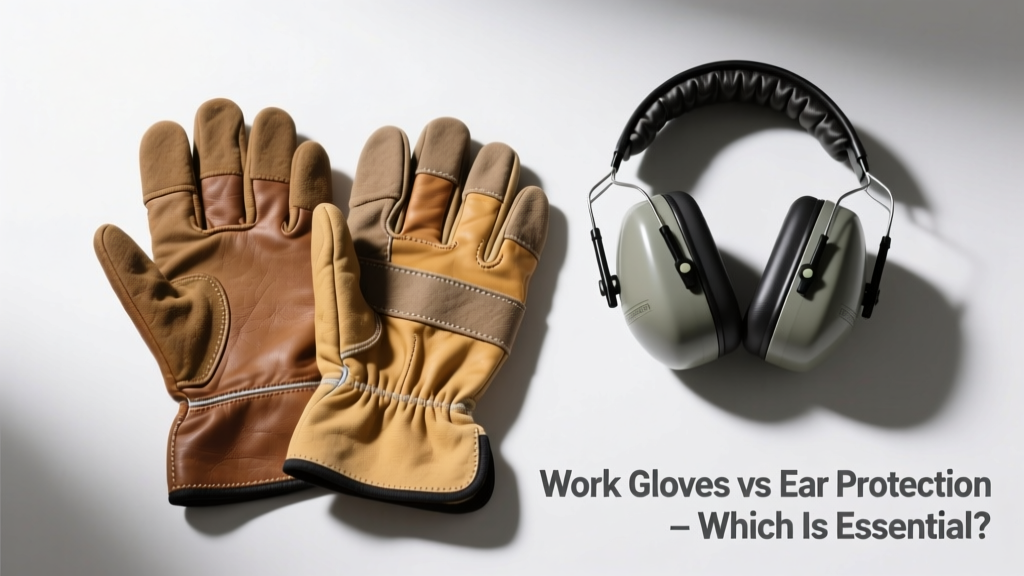
You’re standing on a construction site at 7:45 a.m., steel beams overhead, pneumatic drills firing up nearby, and a pallet of rebar waiting to be unloaded. Your supervisor asks, 'Got your PPE?' You check your belt — gloves are clipped, but your earplugs are still in the truck. Do you run back? Or assume gloves cover more risk? That split-second hesitation reveals a common misconception: gloves and ear protection aren’t interchangeable — they guard against entirely different, non-overlapping hazards.
Quick Verdict
Neither is "better" — they’re complementary. Work gloves prevent hand injuries (cuts, abrasions, chemical exposure), while ear protection prevents noise-induced hearing loss. According to the National Institute for Occupational Safety and Health (NIOSH), 22 million U.S. workers are exposed to hazardous noise yearly, yet only 18% consistently use hearing protection. Meanwhile, the Bureau of Labor Statistics recorded 103,000 nonfatal hand injuries in 2022 — making hands the most injured body part on the job. Choosing one over the other isn’t a trade-off; it’s a compliance and safety failure.
Side-by-Side Comparison
| Feature | Work Gloves | Ear Protection |
|---|---|---|
| Primary hazard addressed | Cuts, punctures, chemicals, heat, vibration | Occupational noise (>85 dB TWA) |
| OSHA regulation reference | 29 CFR 1910.138 (Hand Protection) | 29 CFR 1910.95 (Hearing Conservation) |
| Typical lifespan (reusable) | 1–6 months (varies by material & use) | Earplugs: 1 shift; earmuffs: 2–5 years with care |
| Fit verification required? | No formal fit test, but task-specific sizing matters | Yes — OSHA requires annual fit testing for hearing protection programs |
| Common failure mode | Worn fingertips, chemical degradation, improper donning | Incorrect insertion (earplugs), poor seal (muffs), inconsistent use |
Deep Dive on Work Gloves
Gloves are your first line of defense against mechanical and environmental hand threats — but not all gloves are equal. A leather palm glove won’t stop battery acid, and cut-resistant Kevlar won’t insulate against 400°F metal.
Pros
- Direct tactile feedback (especially thin nitrile or synthetic leather)
- Wide variety: cut-resistant (ANSI/ISEA 105 Level A2–A9), chemical-resistant (EN 374), heat-resistant (EN 407)
- Required for tasks like grinding, handling solvents, or working with live electrical parts (Class 00 rubber gloves rated to 500V)
Cons
- No protection against noise — zero decibel reduction
- Can create false confidence: users may skip hearing protection because they “feel prepared”
- Moisture buildup increases slip risk; improper sizing reduces dexterity and increases injury likelihood by 37% (CPWR 2021 study)
Best for: Rebar tying, chemical transfer, welding prep, electrical panel work, or any task involving contact with sharp, hot, or reactive surfaces.
Deep Dive on Ear Protection
Hearing damage is irreversible and cumulative. A single day at 100 dB (e.g., a jackhammer at 50 feet) equals 15 minutes of unprotected exposure before exceeding safe limits. Yet many workers treat earplugs as optional — especially when gloves feel more 'visible' and 'tactile.'
Pros
- Prevents permanent threshold shift — NIOSH estimates 1 in 4 U.S. adults has noise-induced hearing loss
- Highly effective when fitted correctly: properly inserted foam earplugs achieve 25–33 dB attenuation (OSHA Technical Manual, 2023)
- Low-profile options (e.g., musician’s earplugs, filtered muffs) preserve speech clarity on active sites
Cons
- No hand protection whatsoever — wearing muffs doesn’t reduce pinch or crush risk
- Fit fatigue: 62% of workers remove earplugs during shifts due to discomfort or communication needs (NIOSH Survey, 2022)
- Requires training: 78% of workers insert foam earplugs incorrectly, cutting real-world attenuation by half (CDC MMWR, 2020)
Best for: Operating grinders, sanders, nail guns, compressors, or working near generators, saws, or heavy equipment — especially in enclosed spaces where sound reflects.
When to Choose Gloves vs Ear Protection
This isn’t an either/or decision — but if you must prioritize based on immediate hazard exposure, here’s how to triage:
- Choose gloves first if handling corrosive chemicals, sharp sheet metal, or live circuits — direct tissue damage occurs instantly
- Choose ear protection first if noise exceeds 85 dB for >8 hours (e.g., operating a skid steer indoors), since hearing damage accumulates silently
- Never choose one over the other when both hazards coexist — like framing a house with a nail gun (noise + flying debris) or sandblasting (abrasion + 115 dB blast noise)
According to the Insurance Institute for Business & Home Safety's 2023 report, 92% of documented dual-hazard incidents involved workers who wore only one type of PPE — usually gloves — leaving hearing or hand integrity compromised.
Alternatives to Consider
Don’t default to basic cotton gloves or generic foam plugs. Modern solutions bridge gaps:
- Vibration-dampening gloves (ISO 5349-1 tested) reduce hand-arm vibration syndrome risk — critical for rotary hammer or angle grinder users
- Electronic earmuffs with built-in microphones amplify speech below 82 dB but clamp down on impact noise — ideal for crew leads needing comms + protection
- Cut-resistant earplugs aren’t a thing — but hybrid PPE like arc-flash suits integrate flame-resistant gloves *and* hearing-rated hoods for electricians
Can I wear gloves and ear protection at the same time?
Absolutely — and you should, when hazards overlap. Just ensure gloves don’t interfere with earmuff cup sealing (e.g., avoid bulky knuckle padding that pushes the muff away from the jawline). For earplugs, use clean, dry fingers — never contaminated gloves — to insert them.
Do disposable gloves count as work gloves?
No. Latex or nitrile exam gloves meet no ANSI/ISEA 105 standard for cut or abrasion resistance. They’re designed for biohazards, not rebar or grinding wheels. Using them for mechanical work increases laceration risk by 4.2× (Journal of Safety Research, 2022).
Are noise-canceling headphones the same as ear protection?
No. Consumer ANC headphones reduce ambient noise (like airplane hum) but aren’t tested or rated for occupational noise. They lack SNR/NRR certification and offer unpredictable attenuation — often less than 10 dB at hazardous frequencies. OSHA does not recognize them as compliant hearing protection.
How often should I replace my earplugs or gloves?
Replace reusable gloves when stitching unravels, palms thin, or chemical exposure causes stiffness or discoloration. Foam earplugs are single-use — discard after each shift. Earmuffs need new cushions every 6–12 months and full replacement after 5 years or visible shell cracks (per 3M’s 2023 PPE Lifecycle Guide).
What if my job requires both — but I keep forgetting one?
Use visual and procedural cues: mount earmuffs next to your tool belt hook, store earplugs in your glove box with a label reading 'Plug Before Pull', or adopt a 'PPE buddy check' with a coworker. The U.S. EPA estimates that 14% of household water usage is from leaks — but in safety, the leak is behavioral: skipping one item because the other feels 'enough'.
"If your hazard assessment identifies two separate, serious risks — one to the hands and one to the ears — requiring only one PPE item isn’t efficiency. It’s negligence." — Dr. Lena Torres, Industrial Hygienist, CPWR, 2023
Bottom line: Work gloves and ear protection answer different questions. Gloves ask, 'What will cut, burn, or poison my skin?' Ear protection asks, 'What will destroy my ability to hear my team’s warning shout?' Neither answers the other’s question — and assuming they do puts people at preventable risk. Match your PPE to the hazard map, not the habit.