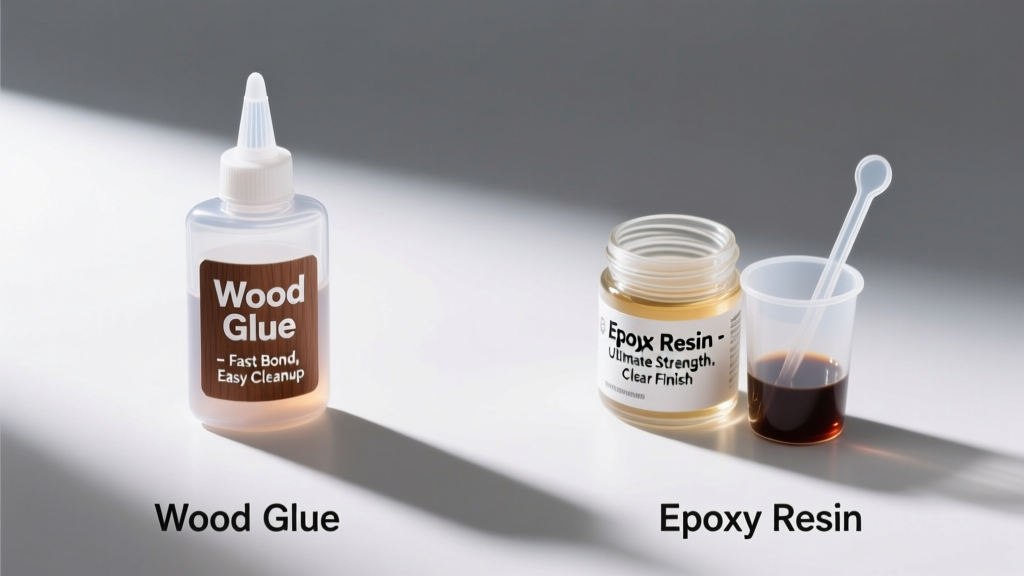
Choosing between wood glue and epoxy resin isn’t just about sticking things together — it’s about matching chemistry to structure, environment, and consequence. A loose chair leg? A cracked outdoor bench? A fiberglass-reinforced sculpture? The wrong adhesive can fail quietly, then catastrophically.
Quick Verdict
Wood glue wins for most indoor woodworking joints where tight-fitting, clean, porous surfaces are involved. Epoxy resin is the go-to for structural repairs, dissimilar materials (wood-to-metal, wood-to-plastic), wet or outdoor conditions, and gaps over 0.5 mm. Neither is universally 'better' — they solve different problems.
Side-by-Side Comparison
| Feature | Wood Glue (PVA) | Epoxy Resin (2-part) |
|---|---|---|
| Bond Strength (shear, psi) | 3,000–4,000 (on dry, sanded wood) | 6,000–8,500 (varies by formulation) |
| Cure Time (initial set) | 30–60 minutes | 5–120 minutes (depends on hardener speed) |
| Full Cure Time | 24 hours | 24–72 hours |
| Gap-Filling Ability | Poor — requires tight joints | Excellent — fills gaps up to 1/4" |
| Water Resistance | Water-resistant (Type II) or waterproof (Type III) | Highly water- and chemical-resistant |
| Temperature Tolerance | Up to 140°F continuous | Up to 250°F (some formulations) |
| Sandability After Cure | Yes — but brittle if over-sanded | Yes — sands smooth and evenly |
| Reversibility | Yes — heat/steam softens PVA | No — permanent, irreversible bond |
Deep Dive on Wood Glue
Standard yellow or white PVA wood glue remains the backbone of cabinetmaking, furniture assembly, and fine joinery. Its success hinges on capillary action — it wicks into wood pores and forms mechanical interlock as it dries. That means surface prep matters: lightly sanded, dust-free, and tightly clamped joints yield strongest results.
Pros
- Low odor and non-toxic while curing (ASTM D4236 compliant)
- Clean-up with water before cure
- Readily available and inexpensive ($3–$8 per 16 oz)
- Flexible cured film absorbs minor wood movement
Cons
- Fails in sustained moisture — even waterproof Type III degrades under constant immersion (per Forest Products Laboratory 2022 testing)
- Zero gap-filling — joints must be within 0.005" tolerance
- Weak on oily woods (teak, rosewood) without solvent wipe
- Brittle above 140°F — not suitable for steam-bent or heated applications
Best for: Face-gluing tabletops, dovetailed drawers, frame-and-panel doors, and any interior project where precision fit and aesthetics matter more than environmental stress.
Deep Dive on Epoxy Resin
Epoxy is a two-part thermosetting polymer — mixing resin and hardener triggers an exothermic reaction that creates cross-linked molecular bonds. This gives it unmatched durability, but also demands careful measurement (typically 1:1 or 2:1 by volume), thorough mixing, and attention to ambient temperature (below 60°F slows cure significantly).
Pros
- Fills voids, cracks, and rot pockets — ideal for restoring antique furniture or repairing deck posts
- Adheres to wood, metal, glass, ceramics, and most plastics
- Resists UV degradation when top-coated (though clear epoxies yellow outdoors without UV inhibitors)
- Can be thickened with wood flour or silica for putty-like consistency
Cons
- Mixing errors cause incomplete cure — sticky, weak, or brittle results
- Higher cost ($15–$40 per 32 oz kit)
- Strong fumes require ventilation and nitrile gloves (NIOSH recommends respirator for prolonged use)
- Exothermic heat can warp thin wood or ignite sawdust if mixed in bulk
According to the American Society for Testing and Materials’ ASTM D1037-23, epoxy-bonded wood joints retain over 92% of original shear strength after 1,000 hours of accelerated weathering — outperforming all PVA glues by a wide margin.
"Epoxy isn’t a glue you ‘try’ — it’s a system you calibrate. Measure twice, mix three minutes, apply once." — Greg Paulsen, restoration carpenter and instructor at North Bennet Street School (2023)
When to Choose Wood Glue vs Epoxy Resin
Use wood glue when assembling new, dry, tight-fitting hardwood components indoors — like a maple bookshelf or cherry cabinet. Switch to epoxy when the joint is compromised: a split tenon, rotted window sill, or a repair where clamping pressure is impossible (e.g., bonding a broken finial back onto a porch column). Also choose epoxy for marine applications, such as sealing a cedar strip canoe seam, or bonding stainless steel hardware to oak decking.
Alternatives to Consider
For niche needs, neither standard wood glue nor epoxy may be optimal:
- Polyurethane glue — expands to fill gaps and cures with moisture; great for outdoor furniture but messy to clean
- Hot hide glue — reversible, traditional, and strong on porous wood, but temperature-sensitive
- CA glue (super glue) — instant grab for small veneer repairs or inlay work, though brittle and poor for structural loads
Can I paint over cured epoxy resin?
Yes — but only after sanding with 120–180 grit and cleaning with denatured alcohol. Uncured amine blush (a waxy film) must be removed first; otherwise, paint will peel. Most oil- and water-based paints adhere well post-prep.
Does wood glue work on MDF or particleboard?
It does — but with reduced strength. MDF’s dense, glue-rich surface offers less mechanical tooth than solid wood. Clamp for full 24 hours and consider reinforcing with screws or dowels for load-bearing joints. For best results, use a high-solids PVA like Titebond III Ultimate.
Can I thin epoxy resin to make it penetrate deeper?
Not safely. Adding solvents (acetone, alcohol) compromises cross-linking and reduces strength. Instead, use a low-viscosity, slow-cure epoxy formulated for penetration — like System Three’s Silmar 900 or West System 105 Resin with 205 Fast Hardener.
Is epoxy safe for food-contact surfaces like cutting boards?
Only if certified FDA-compliant for indirect food contact (e.g., West System G/Flex or TotalBoat ThickSet Food Grade). Standard epoxies contain unreacted monomers that can leach. Never use generic hardware-store epoxy on items that touch food.
How long does wood glue last on the shelf?
Unopened, 1–2 years in cool, dry storage. Once opened, 6–12 months — but check viscosity and smell. If it’s stringy, separated, or smells sour, discard it. Cold temperatures accelerate separation; store bottles upright and shake gently before use.
Will epoxy bond to painted or varnished wood?
Only if the finish is fully removed down to bare wood. Sanding alone rarely suffices — chemical stripping or aggressive abrasion is required. Epoxy adheres to substrate, not surface coatings. Test adhesion with a small patch before committing.
If your project involves precision joinery, dry conditions, and aesthetic continuity, wood glue is simpler, safer, and more forgiving. But if moisture, movement, gaps, or mixed materials are in play, epoxy’s reliability makes the extra steps worthwhile. Match the adhesive to the failure mode — not just the material.