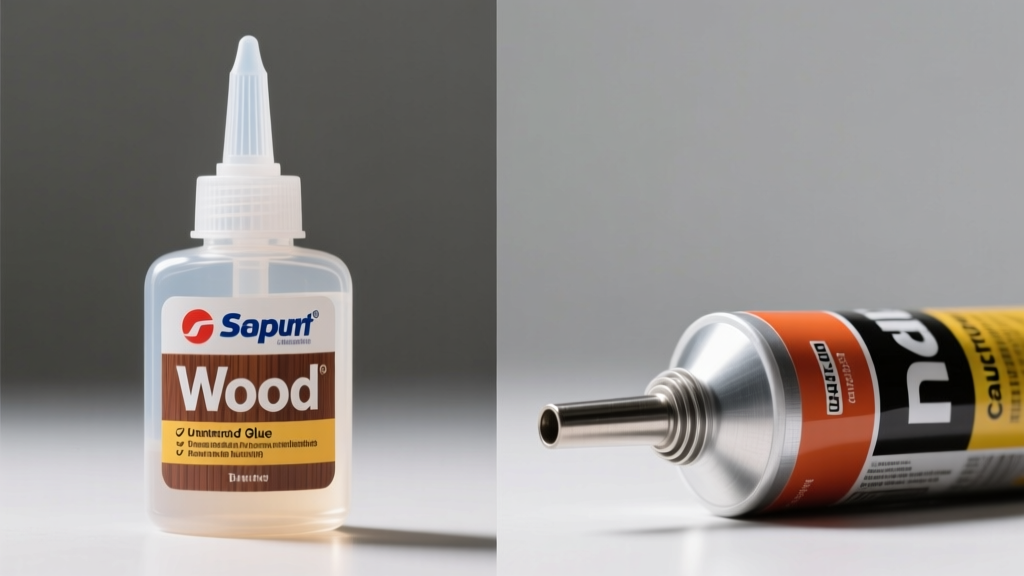
You’re holding a loose cabinet shelf, patching a cracked deck board, or assembling a bookshelf — and suddenly you’re staring at two tubes on the shelf: yellow wood glue and thick, tan construction adhesive. Both promise strength, but they solve different problems. Choosing wrong means weak joints, messy cleanup, or failed bonds that show up months later.
Quick Verdict
Wood glue wins for clean, strong interior wood-to-wood joints where clamping is possible and moisture exposure is low. Construction adhesive excels when bonding dissimilar materials (wood to concrete, drywall to subfloor), filling gaps, or working in damp or structural applications where flexibility and shear resistance matter more than instant rigidity. Neither is universally 'better' — it’s about matching chemistry to context.
Side-by-Side Comparison
| Feature | Wood Glue (PVA) | Construction Adhesive |
|---|---|---|
| Bond Type | Surface-to-surface; requires tight-fitting joints | Fills gaps up to 1/4"; bonds uneven or porous substrates |
| Dry Time (initial set) | 30–60 minutes (clamping required) | 2–4 hours (no clamping needed) |
| Full Cure Time | 24 hours | 24–72 hours (depends on humidity and temperature) |
| Water Resistance | Water-resistant (Type II) or waterproof (Type III); not for constant immersion | Highly water-resistant; many meet ASTM D3498 for exterior use |
| Shear Strength (psi) | 3,000–4,000 psi (e.g., Titebond III) | 1,500–2,800 psi (e.g., Liquid Nails LN-903) |
| Cleanup | Easy with water before drying | Requires mineral spirits or specialized solvents |
Deep Dive on Wood Glue
Traditional yellow or white PVA wood glue (like Gorilla Wood Glue or Franklin Titebond) forms a rigid, brittle bond ideal for precision joinery. Its polymer chains interlock with wood fibers, creating strength that often exceeds the wood itself — provided surfaces are clean, flat, and tightly clamped.
Pros
- Non-toxic and low-VOC when cured (safe for cutting boards and children’s furniture)
- Creates invisible, sandable seams — critical for finish carpentry
- Reversible with heat and moisture (useful for repairs or antique restoration)
- Cost-effective: $3–$8 per 8 oz bottle, enough for dozens of small projects
Cons
- Requires precise fit and clamping pressure — fails with gaps over 0.005"
- Poor performance on oily woods (teak, rosewood) or non-porous surfaces (metal, plastic, glass)
- Loses strength below 45°F or above 90°F during application
According to the Forest Products Laboratory’s 2022 adhesion testing, PVA glues achieve optimal bond strength only when joint squeeze-out is visible and evenly distributed — a sign of proper clamping pressure and surface contact.
Deep Dive on Construction Adhesive
Formulated as solvent-based, latex-modified, or polyurethane hybrids (e.g., PL Premium, Loctite PL Squeeze Tube), construction adhesive is engineered for building-scale demands. It cures via moisture absorption or solvent evaporation, forming a flexible, impact-absorbing bond that tolerates minor substrate movement.
Pros
- Bonds wood to masonry, concrete, drywall, foam board, and even some plastics
- Acts as both adhesive and sealant — blocks air infiltration in wall assemblies
- Performs reliably in cold garages or humid basements (down to 20°F for some polyurethane types)
- Meets code requirements for structural subfloor and sill plate attachment (IRC R502.2.2)
Cons
- Cannot be sanded or stained — visible bead remains unless masked with trim
- Longer repositioning window means accidental smearing is hard to fix
- Polyurethane versions expand slightly while curing and emit acetic acid odor for 24+ hours
When to Choose Wood Glue vs Construction Adhesive
Use wood glue when: assembling face frames, gluing veneer, repairing chair legs, or building picture frames — anywhere appearance, precision, and reversibility matter. Choose construction adhesive when: attaching baseboards over uneven walls, securing stair treads to stringers, bonding insulation to concrete foundations, or reinforcing joist hangers (per Simpson Strong-Tie’s 2023 installation guidelines).
"In residential framing, construction adhesive isn’t optional — it’s part of the load path. When used with nails, it increases floor system stiffness by up to 40% and reduces squeaks long-term." — Journal of Light Construction, 2021
Alternatives to Consider
Don’t default to just these two. For temporary holds, try blue painter’s tape or hot glue. For outdoor furniture exposed to rain and UV, consider epoxy (like West System G/Flex) or marine-grade polyurethane (e.g., 3M 5200). For quick, no-clamp indoor fixes, cyanoacrylate (super glue) works on small, non-load-bearing wood joints — though it brittles over time. And for historic timber framing, traditional hide glue remains preferred for its thermal reversibility and compatibility with aged wood.
Can I mix wood glue and construction adhesive?
No. Their chemistries are incompatible — mixing causes unpredictable curing, weakened bonds, and potential separation. Even layering them risks poor interfacial adhesion. Stick to one adhesive per joint.
Does construction adhesive work on pressure-treated wood?
Yes — but only after the wood has dried to ≤19% moisture content. Wet CCA- or ACQ-treated lumber inhibits cure and can cause bubbling. The American Wood Protection Association (AWPA M4-22) recommends waiting 2–4 weeks post-installation before applying adhesive.
Is wood glue food-safe once cured?
Most PVA wood glues (e.g., Titebond Original, Elmer’s Carpenter’s Wood Glue) are FDA-compliant for indirect food contact (cutting boards, bowls) when fully cured — but always verify the label. Avoid urea-formaldehyde or phenol-formaldehyde glues for food surfaces.
How long does construction adhesive last on the shelf?
Unopened, latex-based versions last 12–24 months; polyurethane types last 6–12 months. Store upright in a cool, dry place. If the tube feels stiff or separates into layers, discard it — partially cured adhesive won’t bond properly.
Can I paint over construction adhesive?
Latex-based adhesives accept latex paint after full cure (72 hours). Polyurethane types require priming with an oil-based or bonding primer first — otherwise, paint may peel or discolor. Always test on a scrap piece first.
What’s the best adhesive for repairing a warped hardwood floor board?
Neither wood glue nor standard construction adhesive is ideal. Instead, use a high-solids, low-viscosity subfloor adhesive like Bostik DuraGrip or Roberts 1407 — injected through drilled holes — combined with weight and clamping. For severe warping, replacement is safer than repair.
There’s no universal adhesive — only the right one for the material, environment, and load. Start by asking: Is this joint hidden or visible? Does it move or stay still? Will it get wet? Answer those three questions, and your choice becomes clear — whether you reach for the yellow bottle or the caulk gun.