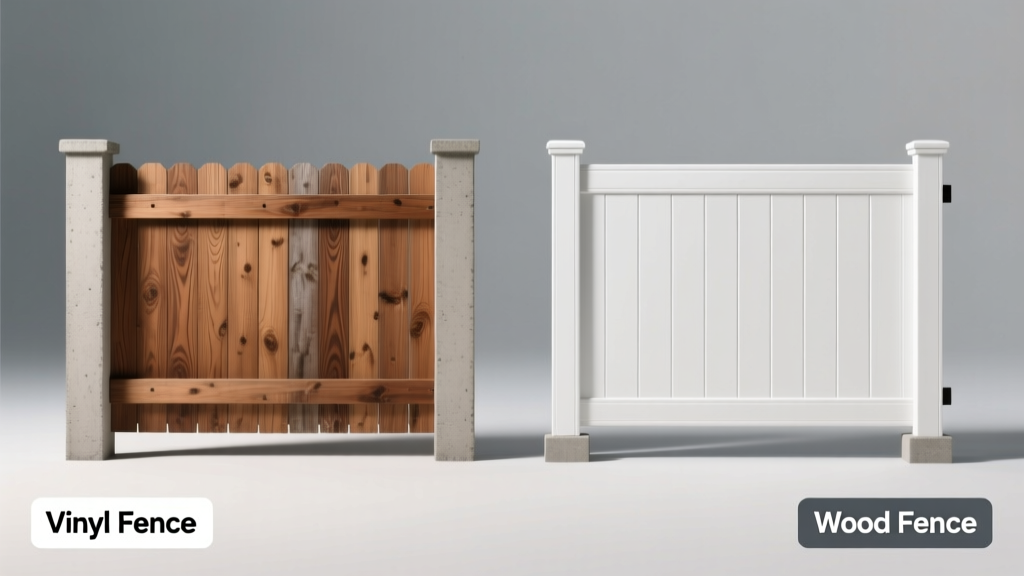
Choosing between wood and vinyl fencing isn’t just about looks—it’s a decision that affects your wallet for 10, 20, or even 30 years. You’re weighing upfront cost against decades of upkeep, local weather resistance against neighborhood aesthetics, and DIY feasibility against contractor dependence.
Quick Verdict
Vinyl wins for low-maintenance longevity and consistent appearance in humid or coastal climates; wood wins for custom craftsmanship, repair flexibility, and initial affordability in dry or temperate zones. Neither is universally 'better'—but one almost always fits your specific yard, budget, and lifestyle better than the other.
Side-by-Side Comparison
| Feature | Wood Fence | Vinyl Fence |
|---|---|---|
| Average Installed Cost (6-ft privacy, per linear foot) | $22–$38 | $32–$52 |
| Lifespan (with maintenance) | 12–15 years (cedar/redwood); 8–12 years (pressure-treated pine) | 25–40 years (non-prorated warranties typically cover 20–30 years) |
| Annual Maintenance | Staining/sealing every 2–3 years; checking for rot, warping, insect damage | Rinse with hose twice yearly; occasional mild soap for mold/mildew in shaded areas |
| Fire Resistance | Combustible (Class C rating unless treated with fire retardant) | Self-extinguishing (ASTM E84 Class A rating standard) |
| Environmental Impact | Renewable resource; biodegradable; emissions from preservatives vary | PVC production involves chlorine and fossil fuels; recycling infrastructure remains limited (only ~1% of PVC fencing is recycled, per the Vinyl Institute 2023 report) |
Deep Dive on Wood Fence
Wood remains the most common fence material in the U.S., especially in rural and suburban neighborhoods where natural texture and design flexibility matter.
Pros
- Lower upfront cost—especially with pressure-treated pine or locally milled cedar
- Easy to cut, drill, and modify on-site for slopes, gates, or custom heights
- Accepts paint, stain, or clear sealants for full aesthetic control
- Repairs are straightforward: replace individual pickets or posts without replacing entire sections
Cons
- Requires resealing every 2–3 years in most climates—or more often in direct sun or heavy rain
- Vulnerable to termites, carpenter ants, and fungal decay (especially at ground contact points)
- Warping and splitting occur over time—even premium woods like redwood show movement after 7–10 years
According to the Insurance Institute for Business & Home Safety's 2023 report, untreated wood fences in high-humidity regions (e.g., Gulf Coast, Pacific Northwest) fail structurally 40% faster than those in arid zones like Arizona or New Mexico.
Deep Dive on Vinyl Fence
Vinyl fencing has grown from niche alternative to mainstream choice—especially among homeowners prioritizing consistency and hands-off ownership.
Pros
- No painting, staining, or sealing required over its lifetime
- Resists rot, rust, insects, and corrosion—even in salt-air coastal environments
- Available in realistic wood-grain textures and multiple colors (though color options are narrower than wood stains)
Cons
- Higher initial investment—typically 30–50% more than comparable wood installations
- Brittle in extreme cold (<20°F); can crack under impact or heavy snow load
- Difficult to repair: broken rails or panels usually require full replacement—not patching
"Vinyl’s biggest advantage isn’t durability—it’s predictability. What you see at installation is what you’ll get for two decades, assuming proper ground prep and post setting." — Dave R., certified fencing contractor with 28 years’ experience in Ohio and Michigan
When to Choose Wood vs Vinyl
Match the material to your real-world conditions—not just preferences.
- Choose wood if: You’re on a tight budget, plan to stay <5 years, want to stain or paint to match your home’s trim, or live in a dry, moderate climate (e.g., Denver, Sacramento, Albuquerque).
- Choose vinyl if: You’re planning to stay 10+ years, live in a high-rainfall, coastal, or termite-prone area (e.g., Florida, Louisiana, South Carolina), or prioritize zero annual maintenance.
- Avoid vinyl if: Your yard sees frequent sub-freezing temps with heavy snow accumulation—or if your HOA prohibits synthetic materials.
Alternatives to Consider
While wood and vinyl dominate residential fencing, newer options fill specific niches:
- Aluminum fencing: Lightweight, rust-proof, and ideal for pool enclosures or modern architectural styles—but offers minimal privacy.
- Composite fencing: Made from wood fiber + plastic resin; bridges the gap with wood-like appearance and vinyl-level maintenance—but costs 20% more than vinyl and lacks long-term performance data beyond 15 years.
- Bamboo fencing: Fast-growing, eco-friendly, and visually distinctive—but not rated for structural privacy use and degrades quickly in damp shade.
How much does labor cost difference affect the decision?
Wood is generally easier for experienced DIYers: basic tools and familiarity mean many install it themselves. Vinyl requires precise post spacing, level rail alignment, and specialized fasteners—so professional installation is strongly advised. Labor adds $10–$18/linear foot for wood but $15–$25/linear foot for vinyl due to tighter tolerances and longer setup time.
Does vinyl fade or yellow over time?
Modern vinyl uses titanium dioxide UV inhibitors and co-extruded color layers. Most reputable brands (e.g., CertainTeed, Ply Gem) show less than 5% color shift over 10 years in independent ASTM G154 testing. However, lower-tier vinyl installed in full southern exposure may show slight yellowing near the top rail by year 8—especially white formulations.
Can I mix wood and vinyl in one fence?
Yes—and it’s increasingly common. Many homeowners use vinyl posts and rails (for stability and low maintenance) with wood pickets (for warmth and texture). Just ensure the wood is kiln-dried and pre-drilled to avoid splitting, and use stainless-steel fasteners to prevent galvanic corrosion where dissimilar materials meet.
Is vinyl safe for homes with kids or pets?
Vinyl fencing is non-toxic once installed and meets ASTM F963 toy safety standards for lead and phthalates. Its smooth surface eliminates splinters, sharp edges, and protruding nails—making it safer than older or poorly maintained wood fences. However, avoid vinyl products labeled “recycled content” unless third-party tested, as trace heavy metals can occasionally appear in off-spec batches.
What’s the best wood species for longevity?
Cedar and redwood lead for natural decay resistance, lasting 15+ years untreated in dry climates. Pressure-treated southern yellow pine is the most widely used—and most cost-effective—but requires ground-contact-rated treatment (UC4B or UC4C per AWPA standards) for posts. Avoid untreated spruce or fir for ground-contact applications—they rarely last beyond 5 years.
If your yard faces constant wind, heavy rain, or curious wildlife, the right fence won’t just look good—it’ll hold up without constant attention. For most homeowners who plan to stay put longer than a decade, vinyl delivers peace of mind. But if you value adaptability, authenticity, and short-term savings, wood remains deeply capable—when matched to the right species and climate.