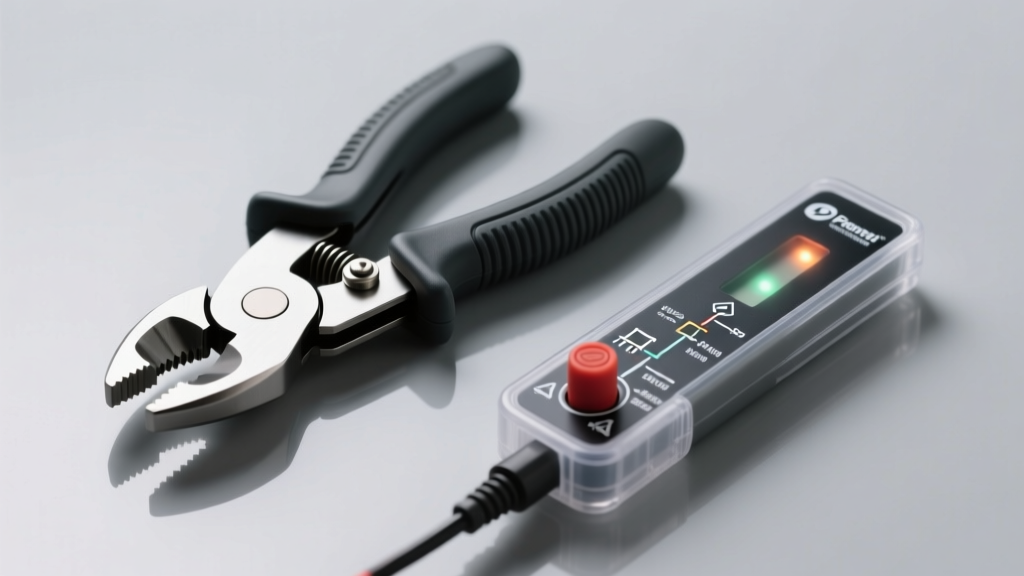
You’re standing in front of an open junction box, holding a pair of pliers, a roll of tape, and wondering: do I need a wire stripper or a voltage tester first? It’s not a silly question — these tools look simple, but they serve fundamentally different, non-interchangeable roles in electrical work.
Quick Verdict
Neither tool is "better" — they’re complementary, not competitive. A wire stripper prepares conductors for connection; a voltage tester confirms absence or presence of power. Using one in place of the other risks shock, failed connections, or code violations. According to the National Fire Protection Association’s Electrical Safety Foundation International (ESFI) 2022 Report, 18% of residential electrical injuries involved misidentifying live circuits — often due to skipping voltage verification before stripping.
Side-by-Side Comparison
| Feature | Wire Stripper | Voltage Tester |
|---|---|---|
| Primary function | Removes insulation from copper/aluminum wires without nicking conductors | Detects AC/DC voltage presence (typically 50–1000V range) |
| Required for NEC compliance? | No — but essential for proper terminations | Yes — OSHA 1910.333(b)(2) mandates verification before contact |
| Typical price range | $8–$45 (manual); $65–$180 (auto-adjusting) | $12–$35 (non-contact); $40–$120 (contact multimeter-style) |
| Common failure mode | Dull blades → nicked wire → overheating/failure | Battery depletion or sensor drift → false-negative readings |
| Training needed | Minimal — muscle memory improves with practice | Moderate — requires understanding of test points, grounding, and limitations |
Deep Dive on Wire Stripper
A wire stripper is a precision cutting and gripping tool designed to score and remove insulation cleanly. Quality models feature calibrated notches for common gauges (10–22 AWG), spring-loaded handles, and hardened steel jaws.
Pros
- Cuts insulation cleanly without damaging conductor strands — critical for reliable terminations
- Enables faster, repeatable prep for outlets, switches, and splices
- Auto-adjusting models (e.g., Ideal Sure-Strip) handle multiple gauges in one squeeze
Cons
- Useless for verifying circuit status — gives zero safety feedback
- Poorly maintained strippers cause nicks that reduce ampacity by up to 30% (per IEEE Std 835-2021)
- Not rated for use on energized conductors — never substitute for lockout/tagout verification
If you’re installing a new light fixture or replacing a receptacle, a wire stripper belongs in your pouch — but only after confirming the circuit is de-energized. For more on safe termination techniques, see our guide on how to strip wire properly.
Deep Dive on Voltage Tester
A voltage tester verifies whether a conductor or terminal is energized — a non-negotiable step before any physical contact. Non-contact testers (NCTs) sense electric fields; contact testers measure potential difference directly.
Pros
- Prevents electrocution — ESFI reports a 62% reduction in shock incidents when NCTs are used pre-work
- Fast verification at outlets, breakers, and junction boxes (under 2 seconds per point)
- Some models (e.g., Klein Tools NCVT-2) include continuity and GFCI testing modes
Cons
- Non-contact testers can give false positives near EMI sources (e.g., dimmer switches, motors)
- Cannot strip, cut, or bend wire — zero utility for physical wire prep
- Battery-dependent; expired batteries cause dangerous false negatives
"Always test your tester on a known live source first — then on the target circuit — then retest the known source. That three-step verification catches 97% of tester failures." — Mike Hester, Master Electrician & NFPA 70E Instructor, 2023
For troubleshooting flickering lights or dead outlets, a voltage tester is your first and most critical diagnostic tool. Pair it with a multimeter vs voltage tester comparison if you need precise measurements beyond presence/absence.
When to Choose Wire Stripper vs Voltage Tester
Choose a wire stripper when:
- You’ve already verified the circuit is off and need to prepare 3+ wires for a new switch or outlet
- You’re building a panelboard and terminating dozens of THHN conductors
- You’re crimping connectors and require consistent, undamaged wire ends
Choose a voltage tester when:
- You’re arriving at an unmarked panel and don’t know which breaker controls the outlet
- You’re repairing a ceiling fan and want to confirm both hot and traveler wires are de-energized
- You’re diagnosing why a GFCI won’t reset — checking line/load side voltage is essential
Alternatives to Consider
While neither tool replaces the other, some hybrid devices bridge adjacent needs:
- Combination tools: Klein Tools’ 11-in-1 Lineman’s Pliers include basic stripping notches and built-in voltage detection — but lack precision of dedicated strippers and reliability of standalone testers
- Digital multimeters: Fluke 115 offers true RMS voltage measurement, continuity, and resistance — ideal for diagnostics, but overkill for quick go/no-go checks
- Insulated lineman’s pliers: Useful for bending and twisting, but not for stripping or testing — see our lineman’s pliers vs needle-nose comparison for context
Can I use a wire stripper to check if a wire is live?
No — wire strippers have no sensing capability and are not insulated for live work. Attempting this violates OSHA 1910.333 and risks arc flash. Always use a tester first.
Do all voltage testers detect both AC and DC?
No. Most non-contact testers only detect AC. DC voltage (e.g., from solar arrays or EV chargers) requires a contact-type tester rated for DC — like the Extech 480823, which covers 12–600V DC.
Is a $15 wire stripper sufficient for DIY home projects?
Yes — for occasional use on 12–14 AWG NM-B cable. But avoid ultra-cheap models with stamped steel jaws; they dull fast and crush conductors. The Irwin Vise-Grip 2077300 ($19) holds calibration well through 500+ uses.
Why did my voltage tester light up near a plastic junction box with no wires?
Non-contact testers react to stray capacitance and electromagnetic fields — especially near metal conduit, fluorescent ballasts, or even cell phones. Always verify with a known live source and consider using a contact tester for ambiguous readings.
Can I strip Romex with a standard wire stripper?
Most standard strippers handle the individual conductors inside Romex (NM-B), but not the outer sheath. Use a dedicated Romex stripper (e.g., Greenlee 710) or utility knife for the jacket — never try to strip sheathing with a standard wire stripper.
What’s the shelf life of a non-contact voltage tester battery?
Alkaline batteries typically last 12–18 months with intermittent use. Lithium CR2032 cells (in higher-end models) hold charge longer but cost more to replace. Test battery function monthly — a weak battery causes silent failure.
At the end of the day, asking "which is better" misses the point: a wire stripper shapes the connection; a voltage tester safeguards the person making it. Own both. Calibrate and verify each before every job. Your hands — and your circuit — depend on it.