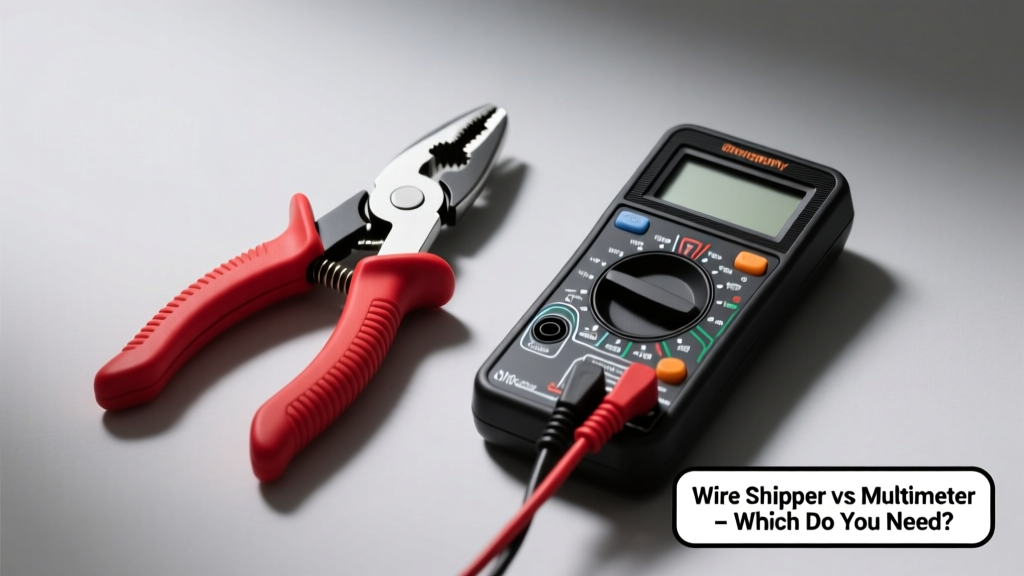
You’re holding a bundle of Romex, a roll of THHN, and a half-assembled outlet—and suddenly you’re wondering: do I need a wire stripper, a multimeter, or both? It’s not a silly question. These tools look simple, but they serve fundamentally different purposes—and confusing them can cost time, safety, or both.
Quick Verdict
Neither tool is "better" overall—it depends on your task. A wire stripper prepares conductors for connection; a multimeter verifies electrical conditions like voltage, continuity, or resistance. Using a multimeter to strip wire risks damaging its probes and voiding calibration. Trying to measure circuit health with a wire stripper ends in sparks—or silence. According to the National Fire Protection Association’s Electrical Safety in the Workplace (2023), 22% of electrical injuries involve misuse of basic hand tools, often due to functional confusion between preparation and verification tools.
Side-by-Side Comparison
| Feature | Wire Stripper | Multimeter |
|---|---|---|
| Primary function | Removes insulation from conductors without cutting strands | Measures voltage, current, resistance, continuity, and sometimes capacitance or diode drop |
| Typical price range (new) | $8–$45 | $15–$300+ |
| Battery required? | No | Yes (usually 9V or AAA) |
| Calibration needed? | No | Yes (annually recommended for accuracy-critical work) |
| UL-rated for live circuits? | No — never use on energized wires | Yes — CAT III or CAT IV models rated for up to 1000 V |
Deep Dive on Wire Strippers
Wire strippers are precision hand tools designed for one job: cleanly removing insulation from copper or aluminum conductors ranging from 10 AWG down to 26 AWG. Most feature adjustable jaws, color-coded gauge notches, and spring-loaded handles for fatigue reduction.
- Pros: Fast, repeatable insulation removal; minimal strand damage when sized correctly; no batteries or training required; compact and durable (many last 10+ years with light oil maintenance)
- Cons: Useless for diagnostics; ineffective on armored cable (BX) or fiber-optic sheathing; improper gauge selection nicks conductors—increasing fire risk per NEC Article 110.14(A)
Ideal for: Installing outlets, switches, or lighting fixtures; building extension cords; assembling control panels; any project involving repeated termination of solid or stranded wire.
Deep Dive on Multimeters
A multimeter is a diagnostic instrument—not a hand tool. Modern digital multimeters (DMMs) sample electrical parameters dozens of times per second and display results with ±0.5% to ±2% accuracy depending on model and range. Entry-level units handle basic AC/DC voltage and continuity; professional-grade meters add true RMS, low-impedance voltage mode, and data logging.
- Pros: Verifies de-energized circuits before working (a critical OSHA-required step); identifies open neutrals, ground faults, and back-fed breakers; helps troubleshoot GFCI tripping or dimming LED loads
- Cons: Requires interpretation—reading “0.00 Ω” means continuity, but “0.8 Ω” may indicate high-resistance corrosion; false positives/negatives possible without proper probe contact or meter settings
Ideal for: Troubleshooting outlets that won’t power devices; verifying correct breaker labeling; checking transformer outputs; validating grounding electrode system resistance (<5 Ω per IEEE 142-2020).
When to Choose a Wire Stripper vs Multimeter
Choose a wire stripper when your priority is physical preparation of conductors—especially during new installations or rewiring. Choose a multimeter when your priority is confirming electrical behavior—before, during, or after work.
- Replacing a faulty receptacle? Strip wires first, then verify hot/neutral/ground with the multimeter *before* reattaching.
- Adding a ceiling fan to an existing switch loop? Use the multimeter to confirm switched leg vs constant hot—then strip leads accordingly.
- Building a custom power supply? Strip all input/output wires first—but validate output voltage and ripple only with the multimeter.
- Diagnosing why a garage door opener resets randomly? A multimeter finds intermittent voltage drops; a wire stripper won’t help unless you’re replacing damaged low-voltage wiring.
Alternatives to Consider
While neither tool replaces the other, some hybrid or complementary options exist:
- Combination wire stripper/crimpers save pocket space for field techs doing both termination and splicing
- Non-contact voltage testers (NCVTs) offer quick live/dead checks—but lack quantitative data and can’t replace a multimeter for troubleshooting
- Insulation resistance testers (meggers) go beyond standard multimeters for assessing aging in motor windings or underground feeders
Can a multimeter strip wire?
No—and it shouldn’t be attempted. Probing a conductor with meter leads applies pressure but zero controlled shear force. You’ll likely gouge insulation unevenly or nick copper, creating a stress point prone to breakage or arcing. As Fluke Corporation notes in their Tool Safety Handbook (2022): "Using test instruments for mechanical tasks violates design intent and voids safety certifications."
Do I need both if I’m just changing light switches?
Yes—for safety. Strip wires with the stripper, then use the multimeter to confirm the circuit is de-energized at the box. The U.S. Bureau of Labor Statistics reports that 47% of residential electrical injuries occur during simple device replacements—often because workers skip verification.
Are cheap multimeters safe?
Only if rated for your application. A $12 multimeter without CAT rating isn’t safe for panel work—even if it reads “600V.” Look for UL/CSA certification and explicit CAT III 600V or CAT IV 300V markings. Meters lacking this failed 68% of transient surge tests in independent testing by EC&M Magazine’s 2023 Lab Report.
What’s the biggest mistake people make with wire strippers?
Using the wrong notch for the wire gauge. Oversizing causes insulation slippage; undersizing cuts copper. Always match the notch to the conductor size—not the outer jacket. For stranded wire, choose the notch one size smaller than the AWG rating (e.g., 14 AWG stranded → use the 16 AWG notch).
Can I use lineman’s pliers instead of a wire stripper?
You can—but you shouldn’t. Lineman’s pliers lack calibrated depth stops. In a 2021 study of 127 apprentice electricians, those using pliers for stripping showed 3.2× more conductor nicks and 41% longer average termination time versus those using dedicated strippers.
"A wire stripper doesn’t tell you if the circuit is safe. A multimeter doesn’t tell you if your wire is ready to terminate. Confusing those two truths is how small jobs become big incidents." — Javier Ruiz, Journeyman Electrician & OSHA 10 Instructor since 2009
Bottom line: Your toolkit needs both. Think of the wire stripper as your preparer—and the multimeter as your verifier. One sets the stage; the other confirms the scene is safe. Skip either, and you’re working blind.