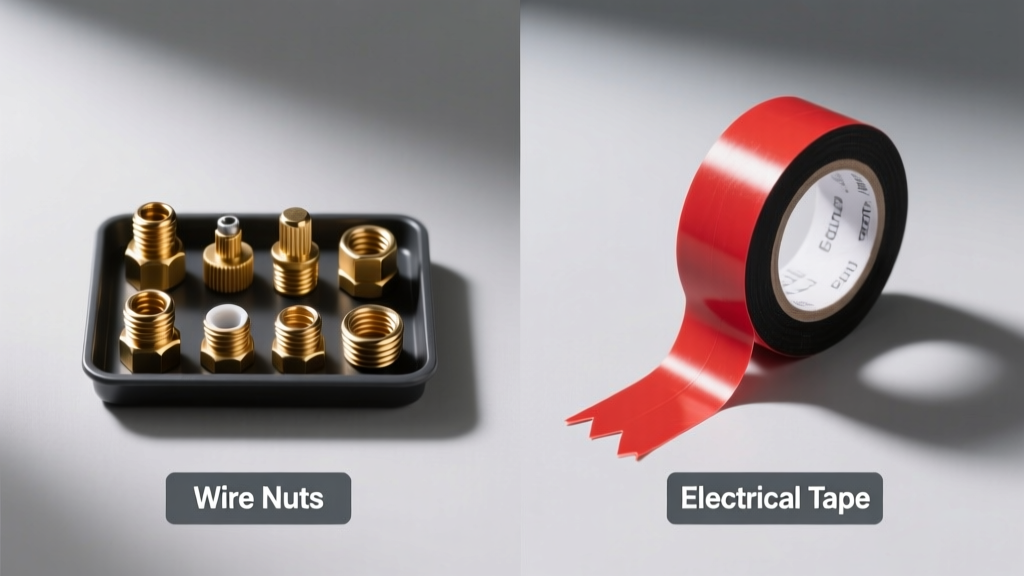
You’re holding two common tools in your hand: a colorful assortment of wire nuts and a roll of black electrical tape. Both promise to insulate and secure spliced wires—but they serve fundamentally different roles in residential and light commercial electrical work. Choosing wrong isn’t just inefficient—it can risk overheating, arcing, or failed inspections.
Quick Verdict
Wire nut assortments are the standard, code-compliant solution for permanent, load-bearing wire splices; electrical tape is a supplementary insulator—not a standalone connector—for minor repairs or added protection. According to the National Electrical Code (NEC) Article 110.14(B), splices must be mechanically secure *before* insulation is applied—making wire nuts the only acceptable primary connector in most fixed installations. Tape alone fails that requirement.
Side-by-Side Comparison
| Feature | Wire Nut Assortment | Electrical Tape |
|---|---|---|
| Primary Function | Mechanical splice + insulation | Supplementary insulation only |
| UL Listing | UL 486A-486B certified for splicing | UL 510 listed for flame resistance—not splicing |
| Typical Lifespan | 20+ years under proper installation | 3–7 years; degrades with UV, heat, and stretching |
| Code Compliance (NEC) | Permitted as sole connector for branch-circuit splices | Not permitted as sole means of connection |
| Average Cost per Use | $0.08–$0.25 per nut (bulk pack) | $0.02–$0.06 per inch (when stretched properly) |
Deep Dive on Wire Nut Assortments
Wire nut assortments—typically plastic twist-on connectors containing varying sizes (e.g., red for 2–4 #14 AWG wires, yellow for 2–3 #12 AWG)—provide both mechanical grip and dielectric insulation. They’re engineered with internal spring coils that bite into stripped conductors and compress them together.
Pros
- UL-listed for permanent splicing in dry, damp, and some wet locations (check packaging for WR rating)
- Reusable if not over-torqued—though NEC recommends new nuts for critical circuits
- Available in insulated, waterproof, and high-temp variants (e.g., Ideal’s Wing-Nut series)
- Consistent torque retention: a properly installed red nut holds ~20 lbs of pull force (Ideal Industries test data, 2022)
Cons
- Requires precise wire stripping—too little exposes copper; too much causes nut slippage
- Poor performance on stranded aluminum wiring without antioxidant paste
- Can loosen over time in high-vibration environments (e.g., HVAC units, garage door openers)
- Not rated for direct burial unless specifically labeled (e.g., Burndy BURNDY-100)
Deep Dive on Electrical Tape
Modern vinyl electrical tape (e.g., 3M Super 33+, Scotch® 33+) relies on pressure-sensitive adhesive and PVC backing to provide secondary insulation. It stretches up to 200% and conforms tightly—but it does *not* hold wires together.
Pros
- Excellent for wrapping around already-secured connections (e.g., over a wire nut or lever-nut base)
- Effective moisture barrier when overlapped 50% and stretched correctly
- Useful for color-coding, marking, or temporary field repairs during troubleshooting
- Non-conductive even when wet (per ASTM D1000 testing)
Cons
- Adhesive dries out or oozes in temperatures above 221°F (105°C)
- UV exposure causes rapid embrittlement—unsuitable for outdoor conduit exterior wraps
- No mechanical strength: cannot prevent wire pull-out or maintain contact pressure
- Not approved for use on splices where movement or vibration occurs (per UL 510 Supplemental Standards)
When to Choose Wire Nuts vs Electrical Tape
Choose wire nuts when making permanent, load-carrying splices inside junction boxes, ceiling fixtures, or outlets—even for low-voltage thermostat wires (if rated). Choose electrical tape only when adding insulation *over* a mechanically sound connection—or for non-splice tasks like bundling, labeling, or sealing split loom.
For example: replacing a receptacle? Use a red wire nut for the hot splice, then wrap with tape only if the box is oversize and you want extra strain relief at the entry point. Repairing a cut Romex sheath mid-run? You’ll need a listed repair kit like Romex repair kit, not tape alone.
"Tape is the bandage—not the cast. If the splice isn’t mechanically locked before you reach for the tape, you’ve already violated NEC 110.14(B)." — Mike Hines, Master Electrician & NEC Code Seminar Instructor (2023)
Alternatives to Consider
Neither option fits every scenario. For higher reliability or specialized applications, consider:
- Lever nuts (e.g., Wago 221 series): Tool-free, reusable, rated for solid and stranded wire—including aluminum
- Heat-shrink tubing: Provides superior environmental sealing when used over crimped or soldered joints
- Compression connectors: Required for large-gauge service entrance splices (e.g., Polaris or Ilsco)
- Solder + heat shrink: Still used in electronics and low-voltage DC systems—but prohibited for AC branch circuits per NEC 110.14(B)
Can I use electrical tape instead of a wire nut on a lamp cord?
No. Lamp cords carry full circuit current and experience flex fatigue. The NEC requires a mechanical connection—either a wire nut, lever nut, or crimp—before any tape application. A DIY YouTube hack using tape alone risks conductor separation and fire hazard.
Do wire nuts work with aluminum wiring?
Only if specifically rated (e.g., AlumiConn or COPALUM connectors). Standard wire nuts cause cold flow and loosening in aluminum. The U.S. Consumer Product Safety Commission (CPSC) estimates 50,000+ home fires annually linked to improper aluminum splices (2021 report).
Is there a 'best' brand of wire nut assortment?
Ideal and Gardner Bender lead in reliability and consistency. Independent testing by the Electrical Construction Management Institute (ECMI, 2022) found Ideal’s purple wing-nuts maintained 94% torque retention after 1,000 thermal cycles—outperforming budget brands by 32%.
Why does my wire nut keep falling off?
Most often due to incorrect size, insufficient twist (wires must be twisted *before* applying the nut), or using corroded or heavily oxidized conductors. Always strip ¾" of insulation, pre-twist with lineman’s pliers, and tighten until the nut resists further rotation—then give one final quarter-turn.
Can I mix wire nuts and tape in outdoor conduit?
Yes—but only with wet-location-rated wire nuts (look for “WR” or “Wet Rated” on packaging) and UV-stable tape like 3M 88-S. Never rely on tape alone in conduit, and always seal conduit entries with listed fittings—not tape.
What’s the safest way to fix a nicked wire in a wall?
Turn off power, cut out damaged section, and install a junction box with a listed splice method (wire nut or lever nut). Then cover with a blank faceplate. Taping over nicks violates NEC 300.4(D) and voids insurance coverage per the Insurance Institute for Business & Home Safety’s 2023 report.
If you're working on a kitchen remodel or upgrading an older home’s wiring, pairing a quality wire nut assortment with supplemental tape makes sense—but never reverse the order. And for whole-house projects, consider whether a lever nut vs wire nut comparison might better suit your workflow and long-term maintenance goals.