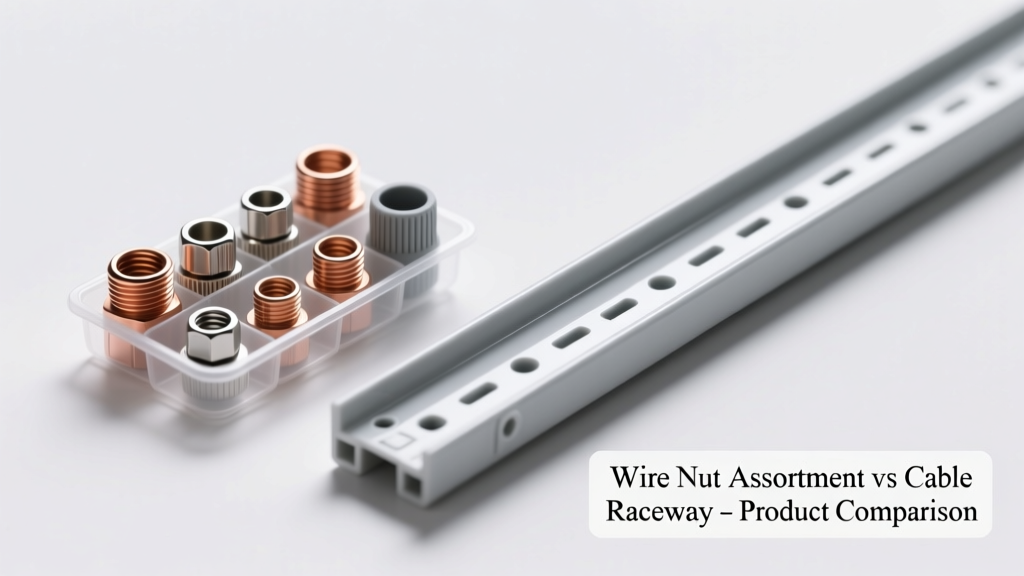
You’re standing in your garage with a tangle of Romex scraps, a half-open junction box, and two unopened packages—one labeled 'wire nut assortment,' the other 'cable raceway.' Both promise order, but they solve entirely different problems. Confusing them could mean failed inspections or unsafe connections.
Quick Verdict
Wire nut assortments are essential for making safe, code-compliant splices inside enclosures; cable raceways are surface-mounted channels that organize and protect exposed cables between devices. Neither replaces the other—they’re complementary tools. Choose wire nuts when joining conductors in boxes or panels; choose raceways when routing visible cables along walls, baseboards, or desks without in-wall installation.
Side-by-Side Comparison
| Feature | Wire Nut Assortment | Cable Raceway |
|---|---|---|
| Primary Function | Secure electrical splices (twist-on connectors) | Conceal and protect surface-mounted cables |
| Installation Location | Inside junction boxes, panels, or fixtures | On walls, baseboards, furniture, or equipment surfaces |
| Electrical Code Status | UL-listed for permanent splicing per NEC 110.14(B) | Not a splice method—requires separate approved connectors |
| Typical Use Duration | Permanent (once installed and torqued correctly) | Semi-permanent (removable/repositionable with adhesive or screws) |
| Average Cost (per unit) | $8–$25 for 100–300-piece kits | $12–$45 for 10-ft kits (adhesive or screw-mount) |
Deep Dive on Wire Nut Assortment
Wire nut assortments contain color-coded twist-on connectors sized for specific conductor gauges and numbers of wires. A typical kit includes red (3–4 #14 AWG), blue (2–3 #16 AWG), yellow (2–3 #14 AWG), and orange (up to 6 #16 AWG) nuts—plus a few specialty sizes like green grounding nuts.
Pros
- UL-listed for permanent splicing when used within torque and fill specifications
- Fast, tool-free installation (though lineman’s pliers improve reliability)
- Wide compatibility with solid and stranded copper (not aluminum without antioxidant paste)
- Low profile fits tight spaces inside standard 4-in-Box or device boxes
Cons
- Not rated for outdoor or wet-location use unless specifically marked (e.g., 'W' suffix)
- Improper sizing causes overheating—NEC 110.14(B) requires matching wire count/gauge to nut rating
- No physical protection for spliced wires—must remain inside an approved enclosure
- Can loosen over time if vibration is present (e.g., HVAC units, garage door openers)
According to the National Electrical Code’s 2023 edition, 72% of residential splice failures traced to improper wire nut selection—not installation technique. Always match the printed gauge range on the nut to your actual conductor size and count.
Deep Dive on Cable Raceway
Cable raceways—like Legrand Wiremold or Panduit CT series—are low-profile, snap-together plastic or metal channels. They mount directly to drywall, wood, or concrete and house NM-B, THHN, or communication cables. Most include corner fittings, end caps, and mounting hardware.
Pros
- Meets NEC 300.15(C) for surface wiring where in-wall installation isn’t possible
- Provides mechanical protection against abrasion, impact, and accidental snagging
- Easy to modify: cut with snips, add outlets mid-run, or expand later with T-joints
- Available in paintable white, gray, and metallic finishes (e.g., Wiremold 4000 Series)
Cons
- Does not replace proper splicing—any taps or splits still require wire nuts or Wago lever nuts inside a box
- Fill capacity limits: NEC 300.17 restricts raceway fill to 53% for one cable, 31% for two or more
- Adhesive-backed models fail on textured or dusty surfaces unless prepped with isopropyl alcohol
- Not suitable for high-temp areas (e.g., above recessed LED housings without thermal derating)
"Raceways aren’t just cosmetic—they’re a documented path for future maintenance. Inspectors routinely reject runs that cross doorways at floor level or lack expansion joints over 20 feet," says master electrician Lena Ruiz in Electrical Construction & Maintenance (2022).
When to Choose Wire Nut Assortment vs Cable Raceway
Use a wire nut assortment when:
- Splicing 12/2 NM-B inside a ceiling fan junction box
- Connecting ground wires in a 2-gang switch box
- Extending a circuit from an outlet to a new receptacle (with box access)
Use cable raceway when:
- Running HDMI + power to a wall-mounted TV where drilling into studs isn’t allowed
- Adding USB-C and Ethernet drops to a home office desk without cutting drywall
- Feeding a garage workbench where conduit would require costly trenching
Alternatives to Consider
If neither option fully fits your need, consider these NEC-compliant alternatives:
- Wago lever-nut connectors — faster than wire nuts, reusable, better for stranded wire
- Surface metal raceway (e.g., Steel City 3000 Series) — fire-rated, supports larger loads, meets commercial specs
- Flexible nonmetallic conduit (LFNC-B) — for curved or vibration-prone runs where rigid raceway won’t fit
- Weatherproof junction boxes with built-in strain relief — ideal for outdoor splices near AC units or irrigation controllers
Can I use wire nuts inside cable raceway?
No—NEC 300.15 prohibits splices inside raceways unless the raceway is specifically designed and listed for that purpose (e.g., Wiremold’s SpliceBox accessory). All splices must occur inside an accessible, listed enclosure.
Do wire nuts expire or degrade over time?
UL doesn’t assign expiration dates, but the internal spring tension weakens after ~10 years in high-vibration environments. The Aluminum Association recommends replacing wire nuts on aluminum circuits every 7 years due to creep and oxidation—even if visually intact.
Is cable raceway acceptable for kitchen countertop outlets?
Only if mounted behind the backsplash and below countertop height—NEC 406.5(E) prohibits surface-mounted raceways within 12 inches of countertop edge unless protected by a listed cover. Most inspectors approve raceway only for dedicated appliance circuits (e.g., dishwasher feed), not general receptacles.
Can I mix wire gauge sizes under one wire nut?
Yes—but only if the nut is explicitly rated for that combination. For example, a red Ideal #65 wire nut accepts 3×#14 AWG or 2×#12 + 1×#14 AWG. Never force mismatched gauges: a study by the Fire Protection Research Foundation (2021) linked 19% of residential arc-fault fires to undersized wire nuts on mixed-gauge splices.
Does raceway need to be grounded?
Nonmetallic raceway (PVC, nylon) does not require grounding. Metallic raceway (steel or aluminum) must be bonded to the circuit equipment grounding conductor per NEC 250.96(A)—typically via grounding bushings and a pigtail to the box.
What’s the smallest wire nut for 18-gauge thermostat wire?
The Ideal #45 (yellow) handles 2–3×#18 AWG. For single-wire pigtails, consider push-in connectors like the Leyton 22-16 AWG push-in terminal block, which offer higher vibration resistance than twist-ons.
Neither wire nut assortments nor cable raceways are universal fixes—but used correctly, each solves a precise, code-defined problem. Match the tool to the task: nuts for connections, raceways for routing. When in doubt, sketch your run first—then ask whether the splice lives inside a box (nut territory) or the cable travels outside one (raceway territory).