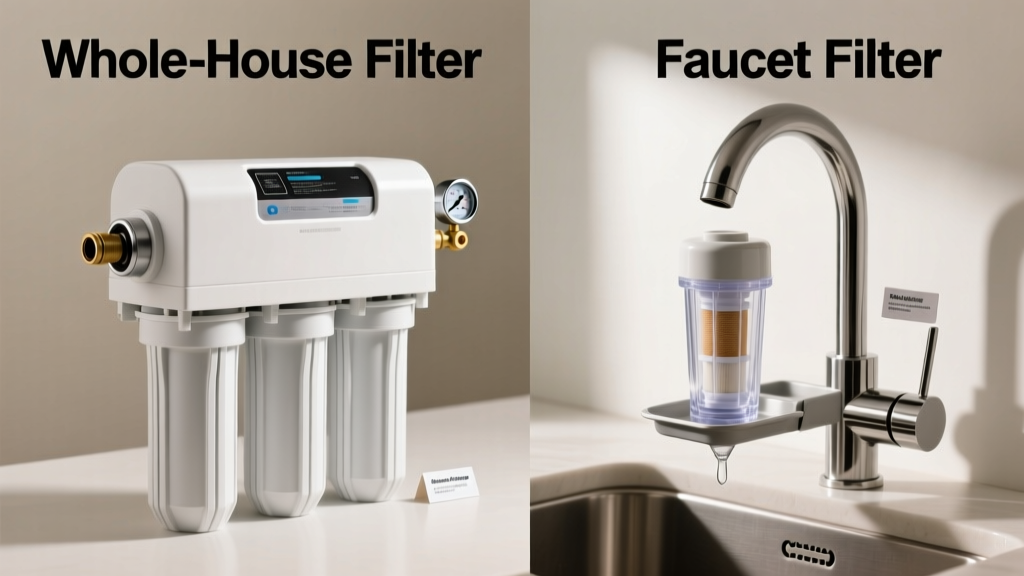
Finding clean, safe water at home shouldn’t mean choosing between convenience and coverage. You’re weighing a whole house filter that treats every drop entering your home against a faucet filter that cleans just what you drink or cook with—and both have real trade-offs in cost, installation, and effectiveness.
Quick Verdict
A whole house filter is better if your water has sediment, chlorine odor, or contaminants affecting showers, laundry, and appliances—and you want protection for every fixture. A faucet filter wins when your main concern is drinking water taste and safety, budget is tight, and you don’t need whole-home treatment. According to the U.S. EPA estimates that 14% of household water usage is from leaks—but far more goes unfiltered where it matters most: at the tap.
Side-by-Side Comparison
| Feature | Whole House Filter | Faucet Filter |
|---|---|---|
| Installation | Requires plumbing access near main water line; professional install recommended | Attaches directly to existing kitchen faucet; DIY in under 5 minutes |
| Coverage | Treats all water entering the home (showers, toilets, washing machines) | Only treats water from one faucet (typically kitchen sink) |
| Upfront Cost | $300–$1,800+ (including installation) | $25–$120 |
| Filter Replacement | Every 6–12 months; $80–$200 per cartridge | Every 2–4 months; $20–$50 per cartridge |
| Contaminant Removal | Removes sediment, chlorine, iron, some VOCs; limited on lead or PFAS without specialty media | Effective on chlorine, lead, mercury, and select PFAS (e.g., NSF-certified models like reverse osmosis or activated carbon) |
Deep Dive on Whole House Filters
Whole house systems sit where municipal or well water enters your home. They’re built for volume and durability—not precision filtration. Most use multi-stage setups: a sediment pre-filter, then granular activated carbon (GAC) or catalytic carbon to reduce chlorine and odors.
- Pros: Protects plumbing and appliances from scale and sediment; eliminates chlorine smell in showers; reduces skin irritation for sensitive users
- Cons: Doesn’t remove dissolved heavy metals (like lead) or PFAS unless paired with specialty media; higher upfront and maintenance cost; requires space near main shutoff valve
- Ideal for: Homes with well water high in iron or sulfur; households with hard water and frequent appliance repairs; families wanting chlorine-free bathing and laundry
Deep Dive on Faucet Filters
Faucet-mounted filters snap onto standard kitchen taps and route water through replaceable cartridges—usually activated carbon or carbon block. Some advanced versions integrate ion exchange or silver-impregnated carbon to inhibit bacterial growth.
- Pros: Affordable entry point; certified to remove lead, chlorine, and certain pesticides (look for NSF/ANSI 42, 53, or 401); easy to move or upgrade
- Cons: Slows flow rate (often to 0.5–0.7 GPM); doesn’t protect other fixtures; cartridges clog faster with high sediment or turbidity
- Ideal for: Renters; apartments with no plumbing access; homes with city water meeting EPA standards but needing extra lead or taste removal at point-of-use
When to Choose Whole House vs Faucet Filter
Choose whole house if your shower water smells strongly of chlorine, your laundry fades quickly, or your humidifier leaves white dust—even if your tap water tastes fine. Choose faucet if you only drink and cook with filtered water, live in a rental, or your water report shows low sediment but elevated lead at the tap (common in older homes with lead service lines).
"A faucet filter can be 99% effective for lead removal—if certified to NSF/ANSI 53—but it does nothing for the 80 gallons per day the average person uses outside the kitchen. That’s why we recommend layered solutions: whole house for particulates and chlorine, plus point-of-use for metals." — Dr. Lena Cho, Water Quality Engineer, NSF International, 2022
Alternatives to Consider
Neither option fits every situation. Here are three realistic alternatives:
- Under-sink filter: Higher capacity than faucet models, hides beneath cabinet, often includes dual-stage carbon + sediment removal (see our under-sink comparison)
- Reverse osmosis (RO) system: Removes >95% of dissolved solids, including nitrates, fluoride, and PFAS—but wastes 3–4 gallons per gallon filtered and requires under-sink space
- Well-specific combo systems: For private wells, pairing a whole house sediment + chlorination system with a point-of-use RO unit addresses bacteria, iron, and heavy metals together
Do whole house filters remove lead?
Standard whole house carbon filters do not reliably remove lead—it’s too soluble and passes through granular media. Only whole house systems with KDF-55, ion exchange resin, or specialty lead-adsorbing media (like Aquasana Rhino series) meet NSF/ANSI 53 for lead reduction. Always verify certification.
Can I use both a whole house and faucet filter?
Yes—and it’s often smart. A whole house filter handles chlorine, sediment, and VOCs before they reach pipes and fixtures; a faucet or under-sink unit adds final-stage removal of lead, cysts, or PFAS. Just ensure the faucet filter’s inlet pressure stays within spec (most require 20–80 PSI).
How often do I really need to replace filters?
Faucet filters should be swapped every 100–200 gallons—or roughly every 2–4 months for a family of four. Whole house cartridges vary: sediment pre-filters may need monthly checks in sandy well water, while carbon stages last 6–12 months depending on chlorine levels. Track usage with a water meter or calendar alert.
Will a faucet filter work with a pull-down sprayer?
Most standard faucet filters won’t fit pull-down or pull-out sprayers due to threading and clearance issues. Look for models explicitly labeled “compatible with pull-down faucets” (e.g., Brita On Tap or PUR FM-3700B), or consider an under-sink alternative instead.
Are there whole house filters that soften water too?
Yes—many combine filtration and ion-exchange softening (e.g., Fleck 5600SXT + carbon tank). But true softening requires salt and regeneration cycles. If your goal is only scale reduction—not sodium addition—consider a salt-free conditioner paired with a carbon filter instead.
What if my water comes from a private well?
Well water demands testing first. A whole house filter alone won’t address bacteria, nitrates, or arsenic. The CDC recommends annual well testing—and pairing filtration with UV disinfection or RO for microbiological or chemical risks. See our well water testing guide for lab-recommended kits.
There’s no universal “better” option—only the right tool for your water, plumbing, and priorities. Start with a certified lab test, map where you use water most, and match technology to the problem—not the marketing.