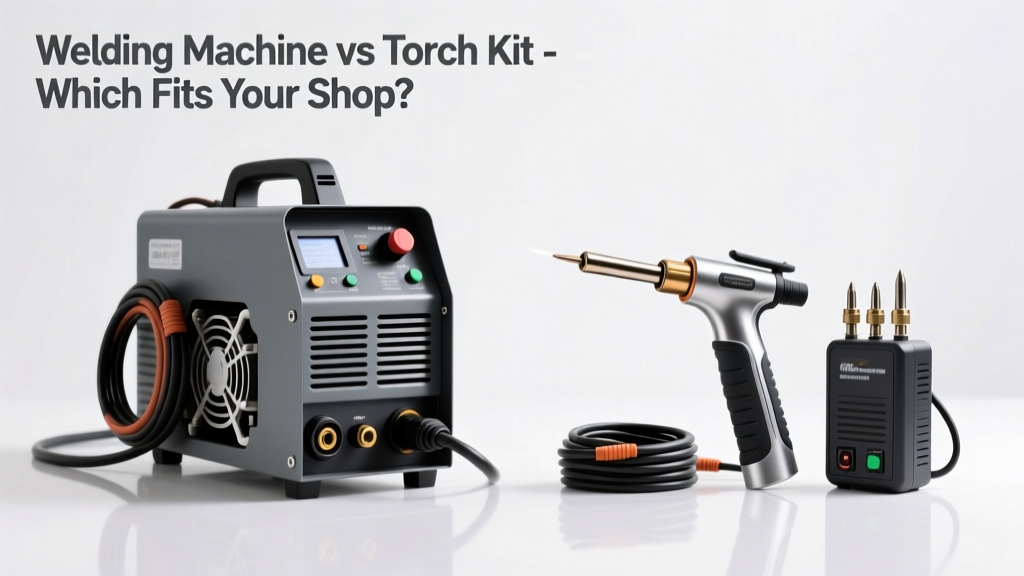
Choosing between a welding machine and a torch kit isn’t just about budget—it’s about whether you’re repairing a rusted trailer hitch or brazing copper tubing in a tight attic crawl space. The wrong choice means wasted time, poor joints, or even safety risks.
Quick Verdict
A welding machine delivers stronger, structural-grade joints on steel and stainless up to 3/8" thick—but demands power, training, and workspace. A torch kit (oxy-acetylene or propane) is portable, affordable, and ideal for heating, bending, brazing, and thin-metal work under 1/8", though it lacks penetration for load-bearing welds. For most DIYers tackling home repairs, auto body fixes, or HVAC work, the torch kit offers faster setup and broader versatility. For fabricators building gates, trailers, or furniture from raw steel, a MIG or stick welder is non-negotiable.
Side-by-Side Comparison
| Feature | Welding Machine (110V MIG) | Torch Kit (Oxy-Propane) |
|---|---|---|
| Typical price range | $350–$650 | $180–$420 |
| Power source | 110V household outlet | Two gas cylinders (oxygen + fuel) |
| Max steel thickness (single pass) | 3/16"–3/8" (depending on wire/gas) | 1/8" (brazing) or 1/4" (cutting with proper tip) |
| Portability | Bulky; 35–50 lbs; requires cord & gas bottle (if using shielding gas) | Lightweight torch head + two cylinders (~40–60 lbs total); works off-grid |
| Learning curve | Moderate: timing, travel speed, gun angle matter critically | Gentler start: flame adjustment and distance are primary controls |
| Primary applications | Fusion welding steel, stainless, aluminum (with upgrades) | Brazing, soldering, heating, bending, cutting, annealing, jewelry work |
Deep Dive on Welding Machines
Modern entry-level MIG welders like the Lincoln Electric K2185-1 or Hobart Handler 140 deliver consistent arc starts, adjustable voltage/wire feed, and compatibility with flux-core wire (no external gas needed). They excel at joining clean, prepared steel—especially when joint fit-up is tight and strength is critical.
Pros
- Produces fusion welds with tensile strength matching base metal (e.g., 70,000+ psi for mild steel)
- Higher deposition rates mean faster completion of long seams or thick sections
- Minimal post-weld cleanup compared to brazed joints
- Can be upgraded with spool guns for aluminum or pulse settings for thinner materials
Cons
- Requires stable 110V power and often an extension cord rated for 20A continuous draw
- Sensitive to rust, paint, or mill scale—surface prep adds time
- Not suitable for non-ferrous metals without gear upgrades (e.g., TIG setup)
- Spatter, UV radiation, and fumes demand PPE: auto-darkening helmet, gloves, ventilation
According to the American Welding Society’s Welding Handbook, Vol. 2 (2022), improper grounding or inconsistent travel speed accounts for over 68% of porosity and lack-of-fusion defects in beginner MIG work.
Deep Dive on Torch Kits
Oxy-propane and oxy-acetylene kits remain indispensable for HVAC techs, plumbers, and restoration specialists. The BernzOmatic JT1000 or Victor OX2-200 offer precision flame control, adjustable oxidizing/carburizing/neutral zones, and compatibility with multiple tip sizes for tasks ranging from soft-soldering electronics to cutting 2" steel plate.
Pros
- No electricity required—ideal for job sites without outlets or during outages
- Flame can be fine-tuned for annealing springs, shrinking metal panels, or stress-relieving cast iron
- Brazing filler rods (e.g., AWS BCuP-5) create corrosion-resistant, ductile joints in copper, brass, and dissimilar metals
- Lower startup cost includes regulator, hoses, tips, striker, and gauges
Cons
- Flame-based heating introduces thermal distortion—less precise than arc welding for square assemblies
- Oxygen tanks require DOT recertification every 5 years; acetylene is unstable above 15 psi
- Brazed joints rely on capillary action—not mechanical interlock—so fit-up must be exact (0.001–0.005" gap)
- Fire hazard increases near insulation, wood framing, or flammable vapors
"A well-adjusted neutral flame at 4–6 psi oxygen and 3–5 psi propane delivers optimal heat for copper tube brazing—too much oxygen causes pinholes; too much fuel leaves soot that prevents filler flow." — Refrigeration Service Engineer’s Handbook, 5th ed. (2021), p. 142
When to Choose a Welding Machine vs Torch Kit
Choose a welding machine if you’re fabricating a welded steel bench, reinforcing a rusted truck frame, or repairing farm equipment where load-bearing integrity matters. It’s also the only practical option for aluminum trailer repairs or stainless exhaust systems.
Choose a torch kit if you’re replacing a section of copper water line, repairing antique cast-iron radiators, bending rebar for garden trellises, or performing emergency bodywork on a car with cracked quarter panels. Its flexibility shines when you need heat—not just fusion.
Alternatives to Consider
- Spot welders for sheet metal assembly (e.g., auto body patches)
- Soldering irons for electronics or small plumbing joints under 1/2"
- Plasma cutters paired with a MIG welder for rapid prototyping and scrap metal work
- Cold bonding epoxies like J-B Weld SteelStik for non-structural, low-temp repairs
Can I weld aluminum with a torch kit?
No—torch kits lack the focused heat and inert atmosphere needed for aluminum’s oxide layer. You’ll get brittle, porous joints. Use TIG or AC MIG instead.
Is a torch kit safe for indoor use?
Only with active ventilation and CO monitors. The U.S. EPA estimates combustion byproducts from oxy-fuel torches can raise indoor CO levels by 12–20 ppm per minute in poorly ventilated spaces.
Do I need certification to operate either tool?
No federal license is required for personal use. But OSHA 1910.252 mandates employer-provided training for workplace welding/brazing—and many insurers require documented safety training for liability coverage.
Which is better for automotive exhaust repair?
For stainless steel cat-back systems: MIG welder. For mild steel manifolds or flex pipes: torch brazing with silicon bronze rod gives superior thermal fatigue resistance—verified in SAE Technical Paper 2020-01-0821.
How long do consumables last?
A 10-lb spool of .030" MIG wire lasts ~10–15 hours of continuous welding. A standard MC-100 propane cylinder (20 lb capacity) runs ~4–6 hours at 5 psi; oxygen lasts ~30–40% longer at same pressure.
Can I convert a torch kit to cut metal?
Yes—with a cutting attachment and appropriate tip. Oxy-propane cuts slower than oxy-acetylene but avoids acetylene’s instability. Expect ~1/2" max cut depth on mild steel with a #00 tip and proper preheat.
If your garage holds both a Miller Multimatic 220 and a Victor torch set, you’re covered for 95% of metalwork scenarios. But if space, budget, or experience limits you to one tool, match it to your most frequent task—not your dream project. Start with the torch kit if you’re still learning metal behavior; upgrade to welding once you’ve mastered heat control and joint design.