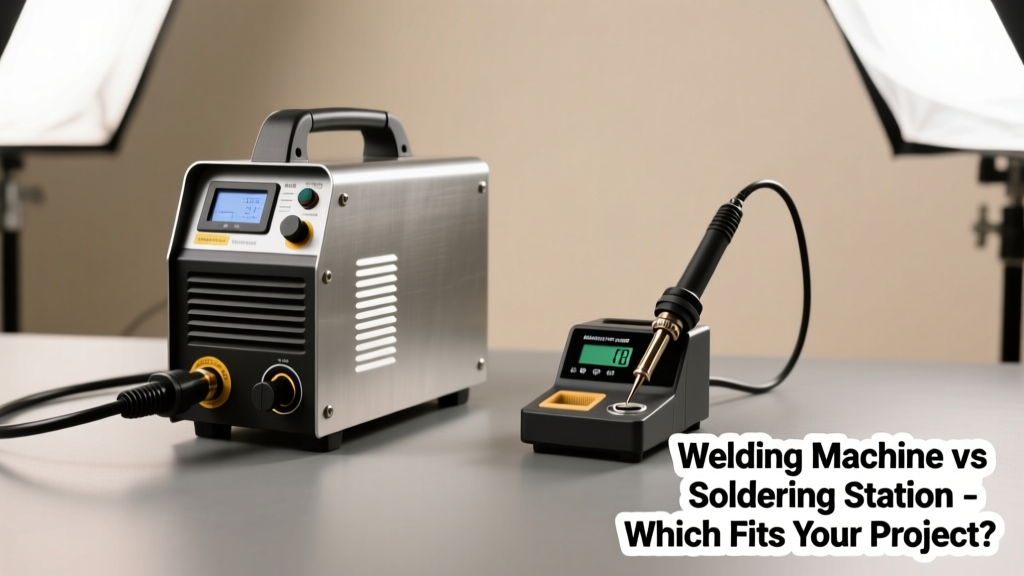
You’re holding a broken steel bracket and a frayed circuit board—and wondering whether to plug in your MIG welder or fire up your temperature-controlled soldering station. It’s not just about heat: it’s about metallurgy, joint integrity, and scale. These tools operate on fundamentally different principles, and choosing wrong can mean weak joints, fried components, or unnecessary expense.
Quick Verdict
A welding machine joins thick, structural metals using intense localized heat (often >6,000°F) to melt base materials and fuse them. A soldering station joins thin conductive surfaces—like PCB traces or wires—using low-temperature filler (typically 360–800°F) without melting the workpieces. Neither is "better" universally: welding dominates fabrication and repair of load-bearing metal; soldering is essential for electronics assembly, repair, and delicate metalwork. According to the American Welding Society’s 2022 Handbook, over 92% of industrial electronics assembly relies exclusively on soldering—not welding—due to thermal sensitivity and precision requirements.
Side-by-Side Comparison
| Feature | Welding Machine | Soldering Station |
|---|---|---|
| Typical Operating Temperature | 3,000–10,000°F (MIG/TIG) | 360–800°F (adjustable tip) |
| Joint Strength | Full-penetration, often stronger than base metal | Electrical/mechanical bond only—strength limited by solder volume and wetting |
| Power Requirements | 110V–575V; 20–400+ amps; often needs dedicated circuit | 110V; 20–100W typical; runs on standard outlet |
| Required Skill Level | High—requires practice for consistent bead control and penetration | Moderate—consistent results achievable within hours of training |
| Hazard Profile | UV radiation, fumes (ozone, hexavalent chromium), spatter, arc flash | Low-level fumes (rosin, lead-free flux); minimal burn risk with modern temp control |
Deep Dive on Welding Machines
Welding machines—including MIG, TIG, and stick units—generate arcs or plasma to melt and coalesce base metals. They excel where mechanical strength, durability, and environmental resistance matter most.
- Pros: Creates metallurgically bonded joints suitable for structural steel, automotive frames, and outdoor fixtures; handles material thicknesses from 24-gauge up to 1-inch plate; compatible with stainless, aluminum, and carbon steel with proper setup.
- Cons: High startup cost ($400–$3,500+); requires PPE (helmet, gloves, respirator); produces hazardous fumes—especially when welding galvanized or painted steel; impractical for fine electronics or jewelry work.
- Ideal use cases: Repairing a rusted trailer hitch, fabricating a custom gate, rebuilding a motorcycle subframe, or attaching brackets to a steel workbench.
As noted by the U.S. Occupational Safety and Health Administration (OSHA) in its 2023 Welding Safety Bulletin, improper ventilation during welding increases respiratory illness risk by 3.7× among hobbyists working in unmodified garages.
Deep Dive on Soldering Stations
A soldering station is a temperature-regulated system—usually comprising a digital controller, iron, stand, sponge, and sometimes desoldering tools. It melts solder (a tin-based alloy) to form conductive bridges between components.
- Pros: Precise thermal control prevents component damage; compact footprint fits on a benchtop; low learning curve for basic through-hole and surface-mount work; affordable entry points ($45–$250).
- Cons: Cannot join structural metals; unsuitable for high-current applications without heavy-gauge wire or bus bars; lead-free solder demands higher temps and faster technique—increasing risk of pad lifting on PCBs.
- Ideal use cases: Replacing a capacitor on a laptop motherboard, assembling an Arduino sensor shield, repairing headphone wires, or building LED lighting strips.
"A 5°C overshoot on a 350°F soldering profile can reduce thermal cycling life of a ceramic capacitor by 40%. That’s why digital feedback loops aren’t optional—they’re reliability insurance." — Dr. Lena Cho, IPC Certified Trainer, IPC-A-610G Revision Notes, 2021
When to Choose a Welding Machine vs Soldering Station
Select based on material, function, and consequence of failure—not just heat output.
- If the joint must bear weight, resist vibration, or survive outdoors: choose welding.
- If you’re connecting signals, power traces, or low-voltage sensors: choose soldering.
- If the base material is thinner than 0.020″ (e.g., sheet brass or copper foil): soldering avoids burn-through.
- If you need electrical continuity *and* mechanical rigidity in one step (e.g., grounding a chassis): consider spot welding—but only with specialized equipment like a spot welding machine.
- If you’re repairing vintage audio gear with fragile point-to-point wiring: soldering is mandatory—welding would vaporize insulation and traces.
Alternatives to Consider
Neither tool fits every joining need. For intermediate applications, these options bridge the gap:
- Brazing torch kits: Use filler rods (brass/silver) at 1,100–1,500°F—ideal for copper pipe, bicycle frames, or jewelry where strength exceeds solder but heat input stays below welding thresholds.
- Mechanical fasteners: Rivets, bolts, or crimp connectors avoid heat entirely—perfect for field repairs or thermally sensitive assemblies.
- Conductive epoxies: Useful for bonding small SMD components or EMI shielding where soldering access is impossible—but conductivity is 10–100× lower than solder.
Can I weld electronics?
No. Welding’s extreme heat instantly destroys semiconductor junctions, delaminates PCB layers, and vaporizes copper traces. Even micro-TIG setups lack the spatial control needed for IC-scale work. Stick to reflow ovens or hot-air rework stations for surface-mount devices.
Is soldering strong enough for metal sculpture?
Rarely. While silver solder (hard solder) reaches ~1,200°F and offers decent tensile strength (~40,000 psi), it still falls far short of a TIG weld in 304 stainless (~90,000 psi). For freestanding metal art, brazing or welding ensures longevity—soldering works only for decorative, non-load-bearing accents.
Do I need gas with either tool?
Most MIG welders require shielding gas (CO₂ or argon mix); TIG always does. Stick welders don’t—but produce more spatter. Soldering stations never require gas; some advanced rework stations use nitrogen for oxide suppression during lead-free work, but it’s optional.
What’s the biggest safety mistake beginners make?
Assuming soldering is “safe” and skipping fume extraction. Rosin-core solder releases formaldehyde and hydrochloric acid vapors at 600°F. The National Institute for Occupational Safety and Health (NIOSH) recommends local exhaust ventilation for >1 hour/day of soldering—especially with lead-free alloys (NIOSH Alert 2022-108).
Can I use a soldering station to repair aluminum?
Not reliably. Aluminum oxide forms instantly, blocking solder adhesion. Specialized aluminum-soldering kits exist (e.g., with abrasive flux and zinc-aluminum rods), but they produce weak, corrosion-prone joints. For structural aluminum, use TIG welding—or mechanical fastening.
How long do tips last on each tool?
A quality soldering iron tip lasts 6–24 months with proper tinning and cleaning; aggressive flux or overheating cuts life in half. Welding consumables vary widely: MIG contact tips last 1–3 weeks under heavy use; tungsten electrodes for TIG may last months if not contaminated—but require frequent grinding.
Choosing between welding and soldering isn’t about picking the “more powerful” tool—it’s about matching physics to purpose. A welder won’t fix your guitar’s output jack, and a soldering station won’t hold your deck railing together. Know your material, know your margin for error, and match the process—not the hype. For hybrid projects, consider adding a desoldering pump or portable MIG unit to round out your capability without overcommitting.