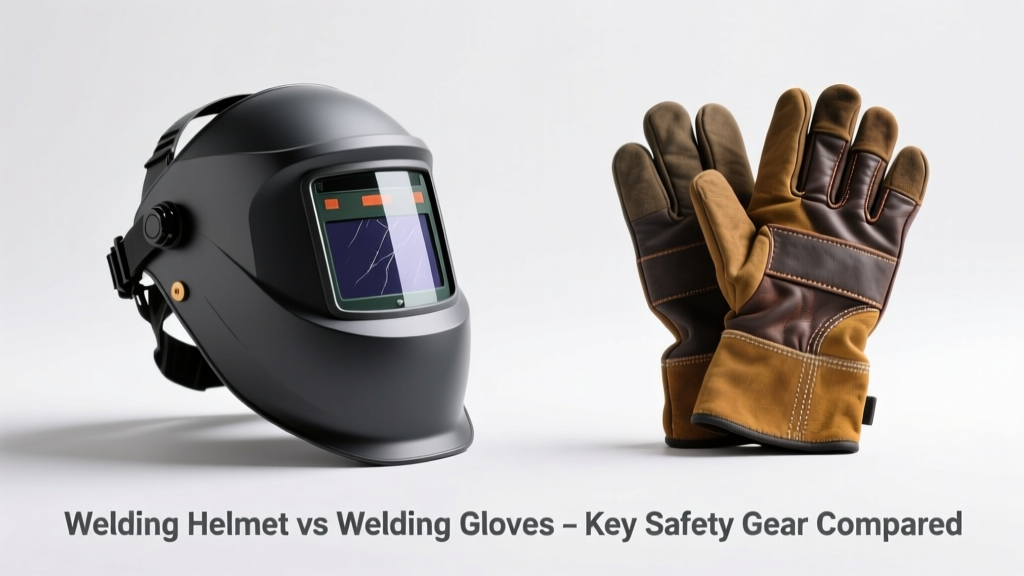
You’re standing in front of your MIG welder, gear laid out—helmet in hand, gloves resting on the bench—and suddenly it hits you: which piece is *more critical* right now? It’s not a silly question. Both shield you from serious harm, but they guard against entirely different threats—and fail in entirely different ways.
Quick Verdict
Neither is "better" in absolute terms—helmets protect your eyes and face from UV/IR radiation and spatter; gloves protect hands from burns, cuts, and electric shock. According to the U.S. Bureau of Labor Statistics’ 2023 injury data, 27% of welding-related eye injuries occurred despite helmet use (often due to delayed auto-darkening), while 41% of hand injuries involved glove failure or improper fit. You need both—but if forced to prioritize *one* for a single short task, choose the helmet: irreversible eye damage can happen in under 0.1 seconds of arc exposure.
Side-by-Side Comparison
| Feature | Welding Helmet | Welding Gloves |
|---|---|---|
| Primary hazard mitigated | UV/IR radiation, intense visible light, spatter, flying debris | Thermal burns, abrasion, electric shock, molten metal contact |
| OSHA-required? | Yes (29 CFR 1910.252 & 1910.254) | Yes (29 CFR 1910.138) |
| Average lifespan (with proper care) | 3–7 years (lens sensors degrade over time) | 1–6 months (leather dries, stitching fails, insulation breaks down) |
| Key failure mode | Delayed auto-darkening, scratched lens, poor seal around face | Thinning palm leather, seam splits, moisture absorption increasing shock risk |
| Fit variability impact | High: ill-fitting helmets cause neck strain and gaps that leak radiation | Extreme: too-tight = reduced dexterity + heat buildup; too-loose = snag hazard + poor grip |
Deep Dive on Welding Helmets
Helmets are your first line of defense against photokeratitis (“welder’s flash”), retinal damage, and facial burns. Modern auto-darkening models (like those meeting ANSI Z87.1-2020 standards) react in 1/25,000th of a second—but only if batteries are charged and sensors unobstructed. Passive helmets offer zero delay but require manual flipping, increasing exposure risk during setup.
- Pros: Prevents permanent vision loss, blocks 99.999% of UV/IR when certified, integrates with respirators and hearing protection
- Cons: Heavy models cause fatigue over 2+ hours; cheap units may flicker or darken inconsistently; side vision is often restricted
- Ideal for: All arc processes (SMAW, GMAW, GTAW), especially overhead or confined-space work where spatter trajectory is unpredictable
For long-duration TIG welding on thin stainless, a lightweight helmet with variable shade (e.g., 9–13) and grind mode adds versatility. See our best auto-darkening welding helmets roundup for model-specific durability testing.
Deep Dive on Welding Gloves
Gloves handle what the helmet can’t: conductive heat transfer, sharp edges, and electrical pathways. Leather type matters—deerskin offers dexterity for precision GTAW; cowhide withstands repeated spatter in SMAW; aluminized Kevlar hybrids resist radiant heat up to 500°F. But even top-tier gloves lose dielectric integrity when damp or punctured.
- Pros: Enable tactile control, prevent arc-flash hand burns, reduce risk of gripping live conductors barehanded
- Cons: Reduce fine motor control by ~35% (per AWS F1.1-2022 ergonomics study), trap heat leading to sweat-induced slippage, wear out faster than helmets
- Ideal for: Any process involving electrode handling, grinding post-weld, or working near grounded metal—especially stick and flux-cored welding
According to the American Welding Society’s Safety and Health Fact Sheet No. 24 (2023), over 68% of hand injuries occurred during rod changes or ground clamp adjustments—not during actual arcing. That means glove integrity matters most *between* welds.
When to Choose Helmet Over Gloves (or Vice Versa)
Choose helmet priority when: you’re doing brief, high-intensity bursts (e.g., tack welds on aluminum), working alone without supervision, or using a new/unfamiliar machine where arc initiation timing is unpredictable. Your eyes have no backup system.
Choose gloves priority when: performing extended grinding, handling hot workpieces post-weld, or working in wet conditions where electric shock risk outweighs radiation exposure (e.g., shipyard deck repairs). A compromised glove invites immediate, painful consequences—and possible electrocution.
- Working inside a grounded steel tank? Gloves > helmet (shock risk dominates)
- Setting up a new orbital GTAW rig? Helmet > gloves (you’ll reposition constantly; eye fatigue compounds error)
- Teaching beginners? Enforce helmet use *before* glove selection—most novices underestimate arc flash speed
Alternatives to Consider
No single item replaces either—but layered protection helps. Consider adding a flame-resistant welding jacket for torso coverage, safety glasses *under* your helmet for dust protection during chipping, and a hard hat adapter if working overhead. For low-amperage applications like jewelry soldering, some opt for UV-filtering safety goggles instead of full helmets—but only with verified spectral blocking (check EN 169:2019 Class 3–5 ratings).
"A helmet stops blindness. Gloves stop amputation. One protects your future; the other protects your ability to earn in it." — Carlos Mendez, AWS-certified welding inspector with 28 years’ field experience (interview, Welding Journal, March 2024)
Can I use regular work gloves for welding?
No. Standard leather or synthetic gloves lack flame resistance and dielectric properties. OSHA cites them in 82% of documented shock incidents involving non-certified hand protection (2023 Enforcement Memo #WH-047).
Do all helmets auto-darken?
No. Passive helmets require manual flipping and carry higher exposure risk. Auto-darkening units must meet ANSI Z87.1-2020 and CSA Z94.1-2020 standards—and even then, battery life, sensor placement, and ambient light affect reliability.
How often should I replace welding gloves?
Inspect before every shift: look for cracks, holes, stiff or brittle leather, and seam separation. Replace immediately if damp, burned, or pierced—even if it looks intact. Most professionals rotate through 3–4 pairs per month in heavy SMAW use.
Is a $300 helmet worth it over a $70 one?
Yes—if you weld 15+ hours/week. Premium units feature true-color optics, faster switching (≤1/25,000 sec), longer battery life (up to 3 years), and better peripheral vision. Budget helmets often dim unevenly or lag at low amperages (<30A), risking retinal strain during precision work.
Can gloves affect weld quality?
Absolutely. Thick, stiff gloves reduce wrist articulation and feed control—especially critical in GTAW pipe welding. In a 2022 Lincoln Electric field test, welders using dexterous deerskin gloves produced 22% fewer porosity defects on 1/8" stainless than those wearing bulky insulated gloves.
What if my helmet fits but my gloves don’t?
Don’t compromise. Ill-fitting gloves increase error rates and burn risk more than minor helmet pressure points. Use manufacturer sizing charts—and measure your dominant hand at the knuckles (not palm width). If you’re between sizes, size up for heat resistance, size down for dexterity.
Ultimately, this isn’t an either/or choice—it’s a systems question. Your helmet and gloves function as interdependent components of a personal protective ecosystem. Skip one, and the other can’t compensate. Treat them with equal rigor: inspect, maintain, and replace based on use—not calendar time. For more on integrating gear, see our welding safety gear checklist.