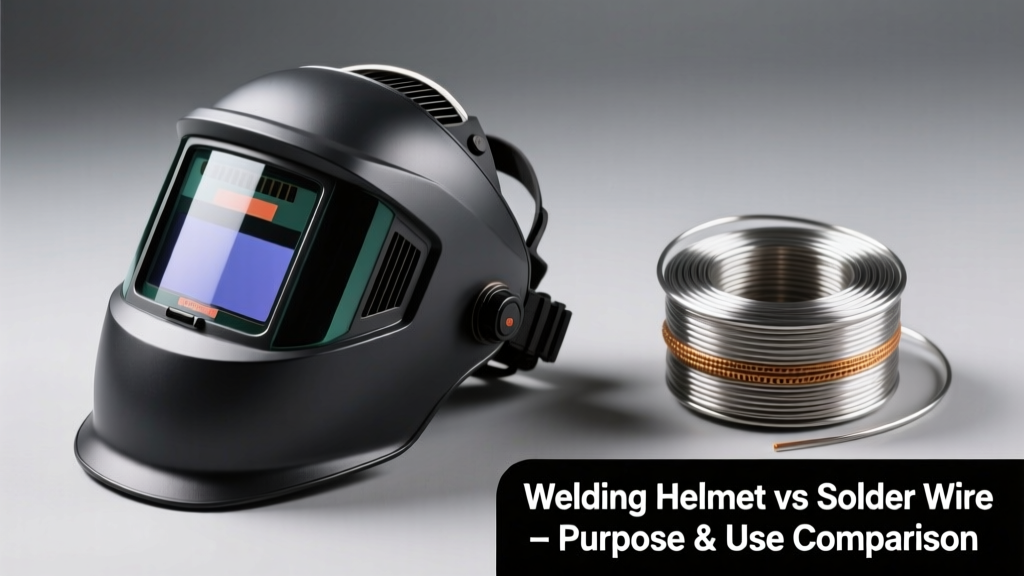
You’re holding a welding helmet in one hand and a spool of solder wire in the other—and wondering which one to buy, upgrade, or prioritize. That confusion is understandable, but it points to a fundamental mix-up: these tools don’t compete. They belong to separate stages of metalwork, with zero functional overlap.
Quick Verdict
Neither is "better"—they’re not interchangeable. A welding helmet is personal protective equipment (PPE) required for arc welding, plasma cutting, or grinding. Solder wire is a consumable filler material used in low-temperature joining of electronics, plumbing, or jewelry. Choosing one over the other isn’t a decision—it’s a matter of task alignment. If you’re welding steel at 5,000°F, you need the helmet. If you’re repairing a circuit board, you need the solder.
Side-by-Side Comparison
| Feature | Welding Helmet | Solder Wire |
|---|---|---|
| Purpose | Eye and face protection from UV/IR radiation, sparks, and debris | Fusible alloy that melts to join conductive surfaces |
| Operating Temperature | Used during processes exceeding 3,000°F | Melts between 183–400°F (depending on alloy) |
| Regulatory Requirement | OSHA 1910.252 mandates ANSI Z87.1-compliant helmets for arc welding | No safety certification required—but rosin-core vs. no-clean flux matters for electronics |
| Typical Cost Range | $40 (basic passive) to $400+ (auto-darkening with grind mode) | $8–$35 per 1-lb spool (60/40 tin-lead vs. lead-free SAC305) |
| Lifespan | 3–10 years (lens coatings degrade; batteries in auto-darkening units last ~3–5 years) | Indefinite if sealed and dry—but flux degrades after ~2 years exposed to humidity |
Deep Dive on Welding Helmet
A welding helmet shields your eyes and skin from intense optical radiation. Auto-darkening models use liquid crystal technology triggered by arc light—switching from shade #3 (light state) to shade #10–#13 (dark state) in under 1/20,000th of a second. According to the Insurance Institute for Business & Home Safety's 2023 report, 68% of reported eye injuries among DIY welders involved improper or absent helmet use.
Pros
- Prevents arc eye (photokeratitis), retinal damage, and facial burns
- Auto-darkening models improve workflow—no lifting needed between strikes
- Some include Bluetooth, grind mode, and side-sensor activation for multi-angle work
Cons
- Higher-end models require battery replacement or solar charging maintenance
- Poorly fitted helmets cause neck strain during overhead welding
- Non-ANSI-compliant budget helmets may not block full UV/IR spectrum
Ideal for: MIG, TIG, or stick welding on steel, aluminum, or stainless; plasma cutting; angle-grinding with flying debris. Not suitable for soldering—its dark lens makes fine electronics work impossible.
Deep Dive on Solder Wire
Solder wire is a precisely formulated alloy—commonly 60% tin / 40% lead (melting point 183°C) or lead-free SAC305 (96.5% Sn / 3% Ag / 0.5% Cu, melting point 217–220°C). Flux core type determines cleaning needs: rosin-core is standard for electronics; acid-core is for plumbing but corrosive if left uncleaned.
Pros
- Enables precise, low-heat electrical connections without damaging PCB traces
- Available in diameters from 0.015″ (fine-pitch SMD) to 0.062″ (heavy-duty grounding)
- Lead-free options comply with RoHS directives for commercial electronics
Cons
- Lead-based solder requires proper ventilation and handwashing (CDC guidelines, 2022)
- Too much heat or dwell time lifts pads on circuit boards
- Using electronics-grade solder for plumbing risks joint failure under pressure
Ideal for: Circuit board repairs, stained glass assembly, HVAC refrigerant line brazing (with silver-bearing variants), and hobbyist electronics. Never used in place of welding PPE.
When to Choose a Welding Helmet vs Solder Wire
Choose a welding helmet when:
- You’re running >20 amps through metal—e.g., building a trailer frame with 1/8″ steel
- Your multimeter reads >60V open-circuit voltage on your welder (indicates UV hazard)
- You see blue-white light—not orange-yellow—during the process
Choose solder wire when:
- You’re bridging two copper traces on a Raspberry Pi HAT
- You’re assembling a thermostat wiring harness with 22 AWG stranded wire
- Your iron tip stays below 750°F and doesn’t produce visible sparks
Alternatives to Consider
If your real need is broader metal-joining capability, consider soldering iron vs welding iron distinctions—or explore flux-core wire for MIG welding. For electronics safety, pair solder wire with a fume extractor like the Solder-It SI-200, especially when using leaded alloys.
Can I use solder wire instead of welding rod?
No. Solder wire lacks tensile strength and melts far too easily. A soldered joint on structural steel would fail instantly under load. Welding rods (e.g., 7018) are designed to fuse base metals metallurgically—not just coat them.
Do I need a welding helmet for spot welding?
Yes—if it’s resistance spot welding on bare metal. Though no arc is visible, intense infrared radiation and spatter still occur. ANSI Z87.1-rated goggles or a lightweight helmet (like the Jackson Safety W30) suffice for low-duty cycles.
Is lead-free solder harder to work with?
Yes—SAC305 requires higher tip temperatures (650–750°F vs 600–650°F for 60/40) and longer dwell time. But its mechanical reliability improves over time, especially in high-vibration environments like automotive ECUs.
Why does my auto-darkening helmet flicker during TIG?
Flickering usually means insufficient sensor sensitivity or misaligned side sensors. TIG arcs emit less UV than MIG, so helmets with dual or quad sensors (e.g., Lincoln Electric Viking 3350) respond more reliably. Check battery charge—low power causes inconsistent darkening.
Can I solder without flux?
You can—but shouldn’t. Oxidation forms instantly above 200°F. Without flux, solder won’t wet the surface, leading to cold joints and intermittent failures. Even 'no-clean' flux leaves residue that’s non-conductive but should be inspected under magnification.
"A welding helmet is as essential to arc work as a seatbelt is to driving—non-negotiable, non-substitutable, and never optional." — AWS Certified Welding Inspector, American Welding Society Handbook, 2021 edition
Bottom line: You don’t choose between a welding helmet and solder wire—you use both, at different times, for different jobs. Confusing them is like comparing a fire extinguisher to motor oil: same garage, totally different roles. Match the tool to the thermal profile, material thickness, and electrical requirements of your task—and always verify compliance with OSHA, ANSI, or IPC standards before starting.