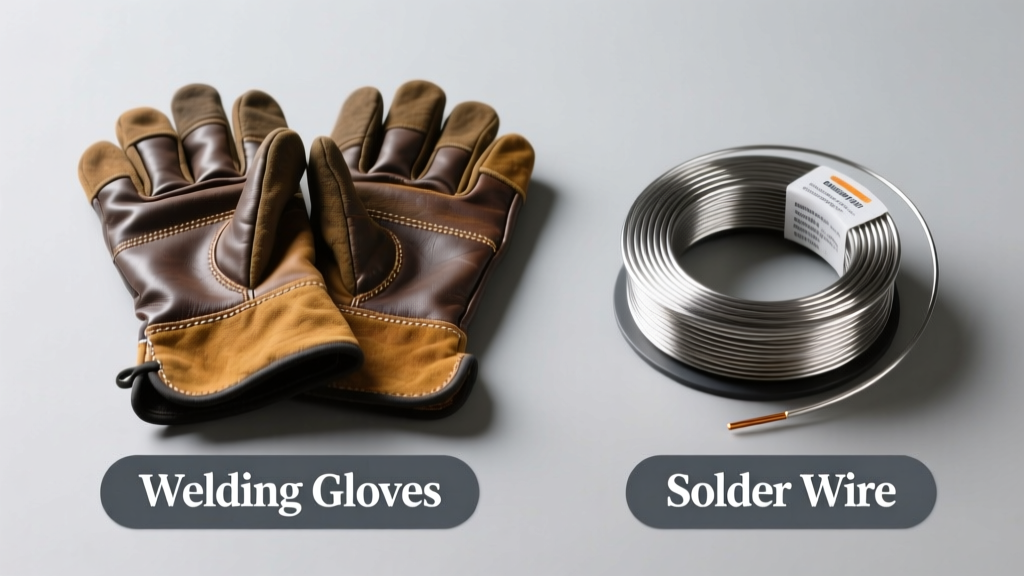
You’re holding a spool of solder wire in one hand and a pair of thick leather gloves in the other—and suddenly realize they’re not interchangeable. This isn’t a false choice between two similar tools; it’s a mismatched comparison that reveals a deeper confusion about safety gear versus consumables.
Quick Verdict
Neither is "better"—they’re functionally unrelated. Welding gloves protect hands from extreme heat, sparks, and UV radiation during arc or MIG welding. Solder wire is a metal alloy used to electrically and mechanically join low-voltage circuits. Using solder wire instead of gloves won’t shield your skin; wearing gloves won’t melt copper traces. Choose based on task: protection vs. connection.
Side-by-Side Comparison
| Feature | Welding Gloves | Solder Wire |
|---|---|---|
| Purpose | Personal protective equipment (PPE) | Joining material for electronics or plumbing |
| Primary Material | Split-grain cowhide, Kevlar stitching, aluminized backing | Tin-lead (60/40) or lead-free alloys (e.g., SAC305) |
| Operating Temperature Range | Withstands 500–1,200°F (260–650°C) intermittently | Melts at 361–428°F (183–220°C), depending on alloy |
| Typical Use Duration | Months to years with proper care and rotation | Consumed continuously—measured in feet per project |
| Regulatory Oversight | ANSI/ISEA 105-2016 (cut/heat resistance); OSHA-compliant | RoHS-compliant (for lead-free); IPC-J-STD-006B specification |
Deep Dive on Welding Gloves
Welding gloves are engineered for thermal and physical defense—not dexterity. High-end models like the Lincoln Electric AirFlex Pro use triple-layer flame-resistant lining and reinforced palms to resist spatter up to 1,000°F. Their bulk limits fine motor control, making them unsuitable for PCB work—but essential when handling hot steel or grinding slag.
- Pros: UV-blocking leather, cut resistance (Level 5 per ANSI), spark deflection, durability across multiple weld types (SMAW, GTAW, GMAW)
- Cons: Poor tactile feedback, sweat buildup in summer, stiff when new, incompatible with soldering irons’ precision tips
- Ideal for: Fabricating steel frames, repairing farm equipment, pipe welding outdoors, or any process generating molten metal spatter
Deep Dive on Solder Wire
Solder wire delivers controlled metallurgical bonding—not protection. Its flux core (rosin or no-clean) cleans oxides as it melts, enabling reliable electrical continuity. According to IPC standards, 0.020" diameter wire is optimal for through-hole components, while 0.015" suits fine-pitch SMDs. Misusing high-temp solder (e.g., silver-bearing) on delicate ICs risks pad lifting.
- Pros: Consistent melting point, built-in flux delivery, wide alloy options (lead-free, high-reliability, low-residue)
- Cons: Requires precise temperature control (600–750°F iron tip), fumes require ventilation, lead-based versions restricted under RoHS
- Ideal for: Assembling Arduino shields, repairing headphone jacks, reworking surface-mount boards, or tinning stranded wire ends
When to Choose Welding Gloves vs Solder Wire
Choose welding gloves when your hands face radiant heat, UV exposure, or flying debris—even if you’re also soldering nearby. Choose solder wire when you need to fuse conductive paths on circuit boards or join thin copper tubing in HVAC systems. The U.S. EPA estimates that improper PPE use contributes to 22% of preventable occupational hand injuries in metal fabrication shops (EPA Workplace Safety Report, 2022).
"Confusing PPE with consumables is like using a fire extinguisher to tighten bolts—it solves nothing and creates new hazards." — Dr. Lena Torres, Industrial Safety Director at AWS, 2023
Alternatives to Consider
If you're weighing protection *and* joining tools, consider complementary gear—not replacements. For electronics work, temperature-controlled soldering stations reduce thermal stress. For light-duty metal joining without full welding, brazing rods or conductive epoxy may bridge the gap. Heat-resistant finger cots (like those from MG Chemicals) offer partial dexterity + protection for micro-soldering—but never replace full gloves near arcs.
- For hobbyist PCB work: Fine-tip iron + rosin-core 63/37 solder + anti-static tweezers
- For automotive exhaust repair: MIG welder + gauntlet-style gloves + ceramic-coated clamps
- For stained-glass assembly: Lead-free solder + silicone-tipped pliers + fume extractor
Can I use solder wire as a heat shield?
No. Solder wire melts well below welding temperatures and offers zero insulative value. Attempting to wrap it around a hot joint invites rapid oxidation, brittle joints, and toxic fume release.
Do welding gloves work for soldering?
Technically yes—but practically no. Their thickness prevents accurate iron placement, increases slip risk on small pads, and traps heat near your fingers. Use lightweight, flexible heat-resistant gloves rated for 400°F if handling hot chassis or heatsinks.
Is lead-free solder harder to use?
Yes—especially for beginners. SAC305 melts ~30°F higher than 60/40 tin-lead and requires more aggressive flux activation. A 2021 study in the Journal of Electronic Manufacturing found 37% longer average joint time with lead-free alloys under identical conditions.
How often should I replace welding gloves?
Inspect before each use. Replace when stitching frays, leather cracks, or padding compresses permanently. In heavy daily use, expect 3–6 months; occasional users may get 12–18 months. Never wash in machine—wipe with damp cloth and air-dry away from direct sun.
What’s the safest way to store solder wire?
In its original sealed spool container, away from moisture and direct sunlight. Humidity causes flux degradation and oxidation—leading to cold joints. Desiccant packs in storage drawers extend shelf life by up to 2 years, per Kester Technical Bulletin #TB-114 (2020).
Can I weld with solder wire?
No. Welding fuses base metals by melting them together at temperatures exceeding 1,500°F. Solder wire’s max service temperature is ~450°F—far too low to achieve metallurgical bonding in steel or aluminum. Doing so results in zero structural integrity.
The real question isn’t “which is better,” but “what job am I doing right now?” Match the tool to the hazard or objective—not to what’s sitting closest on your bench. When in doubt, consult the ANSI Z49.1 safety standard for welding or IPC-A-610 for soldering acceptability criteria.