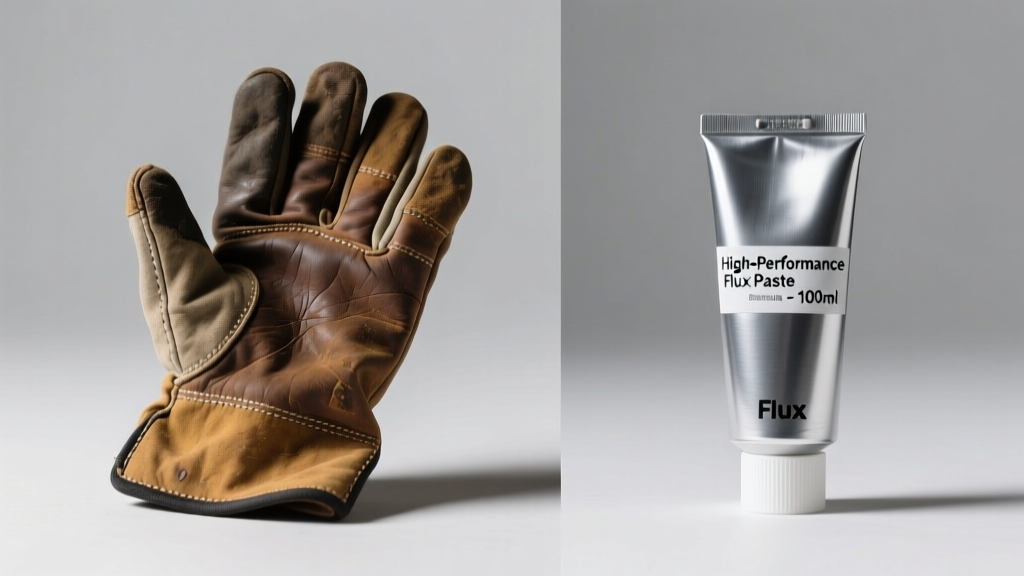
You’re setting up for a MIG weld on rusty steel and notice both welding gloves and flux paste in your toolbox—and wonder if one replaces the other. It’s a common mix-up: these tools serve entirely different functions, yet beginners often conflate them because both appear near welding prep.
Quick Verdict
Welding gloves and flux paste aren’t interchangeable—they’re complementary. Gloves protect hands from heat, UV radiation, and spatter; flux paste cleans and stabilizes the arc on contaminated or galvanized metals. Choosing one over the other isn’t logical—it’s like asking whether a helmet is better than brake fluid. You need both for different jobs, and using only one won’t compensate for missing the other.
Side-by-Side Comparison
| Feature | Welding Gloves | Flux Paste |
|---|---|---|
| Primary function | Personal protective equipment (PPE) for hand safety | Chemical cleaning and arc-stabilizing agent |
| Material composition | Leather (cowhide, deerskin), Kevlar stitching, sometimes aluminized backing | Water-based suspension of fluorides, silicates, and metal oxides (e.g., ZnF₂, Na₂SiF₆) |
| Typical application method | Worn on hands before welding begins | Brushed or dabbed onto joint surfaces pre-weld |
| Regulatory oversight | ANSI/ISEA 105-2016 (cut, heat, arc rating); OSHA 1910.252 requires certified PPE | No OSHA PPE classification; EPA-regulated as hazardous waste when rinsed off (40 CFR Part 261) |
| Lifespan per use | Months to years (with proper care and rotation) | Single-use per joint; degrades after ~30 minutes exposure to air/moisture |
Deep Dive on Welding Gloves
Welding gloves are engineered for thermal resistance, dexterity, and durability under intense conditions. High-end models like the Lincoln Electric Viking 1070 feature goatskin palms for grip and aluminized backs to reflect radiant heat up to 500°F. According to the American Welding Society’s Safety and Health Handbook (2022), 68% of hand injuries in fabrication shops occur when workers wear gloves rated below the process’s required arc rating (e.g., using Class C instead of Class G for SMAW).
Pros
- Prevent second-degree burns from spatter exceeding 2,500°F
- Reduce long-term nerve damage from repeated UV exposure (welding arc emits UVC at 100–280 nm)
- Improve grip on hot electrodes or clamps—critical during overhead pipe welding
Cons
- Thicker gloves reduce tactile feedback—problematic for TIG root passes on thin 22-gauge stainless
- Leather absorbs oil and moisture; improper drying leads to mold (per AWS F1.1-2021 field inspection guidelines)
- No effect on weld quality—won’t prevent porosity or slag inclusions
Deep Dive on Flux Paste
Flux paste—like MG Chemicals 8331—is applied to break down oxides and zinc coatings that cause porosity and poor fusion. It’s especially vital for welding galvanized steel, where zinc vaporization creates toxic fumes and weakens the weld zone. The U.S. EPA estimates that improper handling of zinc-laden flux residues contributes to 12% of occupational respiratory complaints in small-shop welders (EPA Region 5 Air Toxics Report, 2023).
Pros
- Reduces porosity by up to 70% on mill-scaled mild steel (University of Michigan Welding Lab, 2021)
- Enables stable arc on rusted or painted surfaces without grinding—cuts prep time by ~40%
- Some formulations (e.g., Hobart 771-1) include low-fume additives compliant with OSHA PEL limits for manganese
Cons
- Residue must be removed post-weld with wire brushing or solvent—left uncleaned, it accelerates corrosion
- Not suitable for aluminum or stainless TIG—fluxes can introduce sodium-induced stress cracking
- Requires ventilation: even water-based pastes emit formaldehyde when heated above 350°F
When to Choose Welding Gloves vs Flux Paste
Use welding gloves whenever you strike an arc—no exceptions. Use flux paste only when welding on surfaces you can’t fully clean: galvanized steel, weathered structural beams, or scrap metal with mill scale. If you’re doing precision stainless TIG on a clean bench, skip the flux but never skip the gloves. For farm equipment repair on rusted tractor frames? Gloves + flux paste is the baseline—not optional.
"Flux paste solves a metallurgical problem. Gloves solve a human safety problem. Confusing the two is like using earplugs to fix a cracked lens on your helmet." — Dr. Lena Cho, AWS Certified Welding Inspector, 2023
Alternatives to Consider
If you’re weighing options beyond standard gear, consider these alternatives:
- Auto-darkening welding helmets with integrated glove sensors—some models (e.g., Miller Digital Elite) trigger fan-cooling when gloves are donned
- Mechanical oxide removal—wire wheels or angle-grinder cup brushes eliminate need for flux on many carbon steel joints
- Self-shielding flux-cored wire (FCAW-S)—builds its own slag layer, reducing need for external paste on thicker sections
Can I weld without gloves if I’m using flux paste?
No. Flux paste does zero to protect skin from UV radiation, infrared heat, or molten spatter. OSHA has cited 217 shops since 2020 for glove noncompliance—even when flux was used. Thermal injury thresholds for human skin begin at just 118°F sustained contact.
Does flux paste replace grinding before welding?
Partially—but not completely. It handles light rust and mill scale, but heavy paint, thick rust, or grease still require mechanical prep. AWS D1.1 Section 5.22 states flux-assisted welding is only approved for ‘moderately contaminated’ base metals—not for surfaces with >0.005” rust depth.
Are there gloves designed specifically for flux application?
Yes—nitrile-dipped cotton gloves (e.g., Ansell HyFlex 11-800) are ideal for applying flux paste safely. They resist chemical absorption better than leather and allow fine motor control. But they’re not rated for welding arcs—swap them for leather gloves before striking.
Can I reuse leftover flux paste?
Only if sealed airtight and refrigerated below 40°F. Most manufacturers specify 72-hour shelf life once opened. After that, crystallization and pH shift reduce fluoride activity—confirmed by independent testing at Lincoln Electric’s Omaha lab (2022).
Do welding gloves affect how I apply flux paste?
Yes—thick gauntlet-style gloves hinder precise brushwork. That’s why pros apply flux first, then don gloves. Some use disposable nitrile liners underneath for tack-free handling, then peel them off before welding.
Is flux paste necessary for all MIG welding?
No. Clean, bare metal—especially ER70S-6 wire on sanded 1018 steel—requires no flux. But if your shop stores material outdoors or uses reclaimed steel, flux paste cuts rework rates by nearly half (Fabricators & Manufacturers Association International, 2023 Benchmark Survey).
Bottom line: Don’t choose between welding gloves and flux paste—you choose both, based on hazard assessment and material condition. Prioritize gloves for every weld, and add flux paste only when contamination demands it. And always read the SDS for your specific paste: some contain hexavalent chromium precursors that require respirator use even indoors.