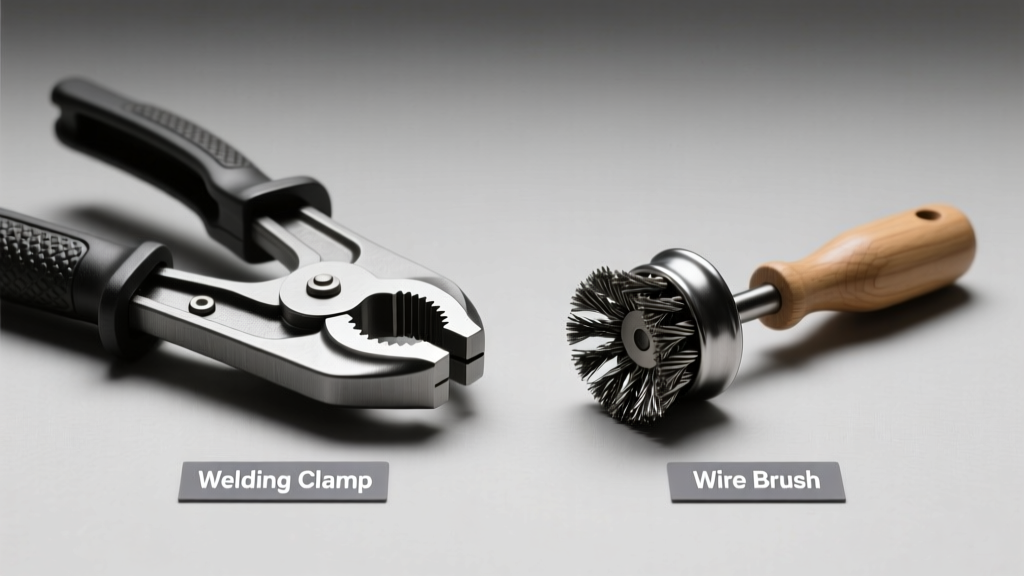
You’re prepping for a weld—metal’s cut, edges are aligned—but now you’re stuck: do you reach for the locking welding clamp or the stiff-wire brush? They look nothing alike, yet both show up in the same toolbox, often at the same critical moment. Confusion isn’t surprising: one holds, the other cleans—and sometimes, you need both.
Quick Verdict
Neither tool is "better" overall—it depends entirely on the task. A welding clamp secures workpieces under high heat and pressure; a wire brush removes rust, mill scale, and contaminants from surfaces before or after welding. Using a wire brush to hold metal risks slippage and poor fusion; using a clamp to clean metal is impossible. According to the American Welding Society’s Welding Handbook, Vol. 1 (2022), improper joint preparation—including inadequate cleaning—accounts for over 32% of field weld failures. So choosing the right tool isn’t about preference—it’s about function and failure prevention.
Side-by-Side Comparison
| Feature | Welding Clamp | Wire Brush |
|---|---|---|
| Primary Function | Mechanical holding & alignment during welding | Surface cleaning: rust, scale, paint, oxidation |
| Typical Material | Hardened steel with insulated handles (e.g., copper-coated jaws) | Steel or stainless-steel bristles; wood, plastic, or metal handle |
| Heat Tolerance | Rated to 400–600°F (204–315°C); some high-temp models to 800°F | Handles degrade above 250°F; bristles soften or lose tension near weld zones |
| Common Sizes | 4–24 inch jaw capacity; C-clamp, locking toggle, or magnetic variants | Handheld (4–12" length); rotary (½"–1" shank) or angle-grinder mounted |
| Average Lifespan (with care) | 5–10+ years (jaws may wear but are often replaceable) | 3–12 months (bristle wear accelerates with abrasive surfaces or excessive pressure) |
Deep Dive on Welding Clamps
Welding clamps excel where precision, repeatability, and thermal stability matter. High-leverage designs—like the Klamp Pro 12-inch toggle clamp—apply up to 1,200 lbs of force, minimizing movement during tack welding. Their insulated handles prevent arc flash hazards and reduce heat transfer to the operator’s grip.
- Pros: Prevents joint distortion under thermal stress; enables consistent gap control; reusable across dozens of projects; compatible with jigs and fixtures
- Cons: Adds setup time; can mar soft metals (e.g., aluminum) without protective jaw pads; ineffective on curved or irregular surfaces without custom adapters
- Ideal use cases: Square butt joints on mild steel plate; fixture-based production welding; pipe alignment before root pass; MIG/TIG setups requiring zero movement
Deep Dive on Wire Brushes
A wire brush isn’t just for post-weld cleanup—it’s part of the weld’s foundation. The U.S. Department of Transportation’s Bridge Welding Inspector Manual (2021) mandates removal of all visible mill scale within 1 inch of the joint edge before welding structural steel. That’s where a quality brush delivers measurable ROI: cleaner starts, fewer porosity defects, and stronger fusion.
- Pros: Fast surface prep; portable and low-cost; works on contoured or hard-to-reach areas; available in manual, pneumatic, and electric versions
- Cons: Inconsistent coverage if technique varies; can embed ferrous particles into stainless (risking rust); ineffective on thick rust or heavy paint without abrasives
- Ideal use cases: Pre-weld cleaning of carbon steel flanges; post-weld slag and spatter removal; maintenance work on farm equipment; touch-up between passes on thick-section welds
When to Choose a Welding Clamp vs Wire Brush
Ask yourself: "Is this about position or purity?" If the metal needs to stay still while current flows and filler melts—that’s clamp territory. If the surface needs oxide removed so molten metal bonds cleanly—that’s brush territory. Real-world overlap happens, but never simultaneously: you clean first, then clamp.
- Building a trailer frame? Clamp the crossmembers, then brush the weld zones before tacking.
- Repairing a rusted gate hinge? Wire-brush the corroded area first—then clamp the hinge leaf flat for a solid fillet weld.
- Working with thin-gauge stainless? Skip aggressive brushing—use a dedicated stainless brush to avoid cross-contamination, then hold with non-marring clamps.
- Doing overhead welds on conduit? A magnetic clamp may slip—rely on a lightweight wire brush for quick prep, then use strap clamps or tack-and-hold technique.
Alternatives to Consider
Sometimes neither tool fully solves the problem. Here’s what seasoned welders turn to when clamps lack reach or brushes lack bite:
- Angle grinder with flap disc: Faster than wire brushing for heavy scale; less aggressive than grinding wheels
- Magnetic welding ground clamp: Not for holding parts—but ensures stable electrical return path (critical for arc stability)
- Pin vise + carbide burr: For tight internal corners where brushes and clamps can’t fit
- Spot welder: Replaces mechanical clamping in sheet metal fabrication—though requires power and training
Can I use a wire brush instead of a clamp to hold metal?
No. A wire brush applies zero clamping force. Attempting to “hold” metal with it invites misalignment, inconsistent gaps, and dangerous movement during arc ignition. That’s why AWS D1.1 explicitly prohibits unsecured joints in structural welding procedures.
Do I need both tools for basic DIY welding?
Yes—if you’re welding anything beyond scrap practice pieces. A $12 brass-handled wire brush and a $22 6-inch locking C-clamp cover 90% of home garage needs. Skipping either increases rework: poor prep causes porosity; poor holding causes distortion.
Which wire brush type works best before TIG welding?
Stainless-steel bristle brushes—never carbon steel—on aluminum or stainless. Carbon bristles leave embedded iron that rusts later. Use light pressure and brush *with* the grain, not across it. As Miller Electric advises in their TIG Welding Best Practices Guide (2023): "One pass with a clean stainless brush removes oxides without smearing or contamination."
"A weld is only as strong as the cleanliness of the joint—and no amount of amperage compensates for mill scale." — AWS Certified Welding Inspector, Linda Torres, 2022
Are magnetic clamps safe for all welding processes?
Magnetic clamps work well for short-duration MIG or stick welding on ferrous metals—but fail completely on aluminum, stainless, or painted surfaces. They also lose holding power above 300°F. Always verify magnetic strength with a test piece before committing to production.
How often should I replace my wire brush?
Replace when >25% of bristles are bent, broken, or splayed—or if cleaning takes noticeably longer. A worn brush doesn’t remove scale; it just polishes over it. Keep two brushes on hand: one for prep, one for post-weld cleanup.
Can welding clamps damage my workpiece?
Yes—especially on softer metals or polished finishes. Use nylon jaw covers or copper shim stock to distribute pressure. One pro tip: tighten clamps incrementally in sequence (like lug nuts), not all at once, to prevent warping on thin sheet metal.
Bottom line: clamps and brushes aren’t rivals—they’re teammates in the weld prep chain. Respect their roles, match them to the job, and you’ll spend less time grinding out bad welds and more time building things that last. For deeper dives, check our guides on how to clean metal before welding and welding fixtures for repeatable accuracy.