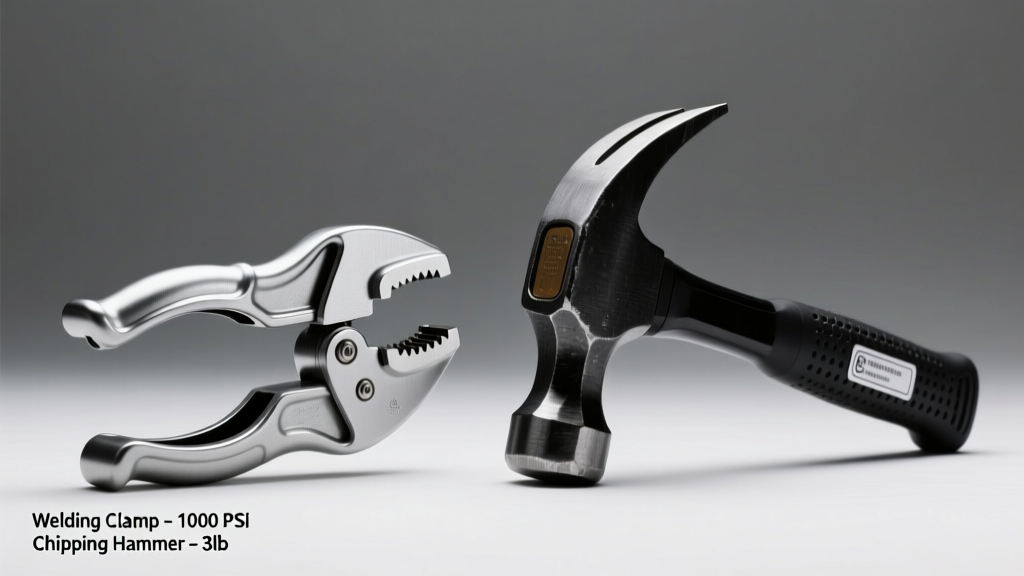
Choosing between a welding clamp and a chipping hammer isn’t about which is ‘better’ overall — it’s about matching the right tool to the job at hand. One holds metal steady; the other breaks away slag. Confusing them can cost time, safety, or weld integrity.
Quick Verdict
Use a welding clamp when you need precise, hands-free alignment and pressure during tack or full welds. Reach for a chipping hammer when removing slag, spatter, or scale after welding — especially on carbon steel. They’re complementary tools, not competitors. According to the American Welding Society’s Welding Handbook, Volume 2 (2021), improper slag removal accounts for nearly 18% of field weld rework — underscoring why the chipping hammer remains irreplaceable post-weld.
Side-by-Side Comparison
| Feature | Welding Clamp | Chipping Hammer |
|---|---|---|
| Primary Function | Holds workpieces in position under pressure | Removes slag, spatter, and oxide scale from welds |
| Typical Weight | 0.5–4.5 lbs (varies by jaw size) | 0.75–2.25 lbs (standard 12–18 oz models) |
| Material Contact | Steel jaws with insulated or serrated faces | Hardened steel chisel or pointed tip |
| Safety Risk Profile | Pinch hazard; minimal flying debris | Flying slag; eye/face impact risk without PPE |
| Average Lifespan (with care) | 10+ years (spring & jaw wear most common) | 5–8 years (tip deformation or handle splintering) |
Deep Dive on Welding Clamp
Welding clamps — including C-clamps, locking pliers (e.g., Vise-Grip®), and magnetic variants — excel at maintaining joint fit-up before and during welding. Their mechanical advantage ensures consistent pressure across irregular surfaces, reducing distortion during cooling.
Pros
- Prevents movement during arc ignition and travel — critical for root passes on pipe or thin sheet metal
- Magnetic clamps (like the Arc-Zone Mag-Clamp Pro) hold up to 120 lbs on clean, ferrous surfaces (per manufacturer specs, 2022)
- Reusable across projects; no consumables required
Cons
- Can mar soft metals (aluminum, copper) without protective jaw covers
- Not effective on non-ferrous or heavily rusted/painted surfaces
- Does nothing for post-weld cleanup — a common misconception among beginners
Best for: Fixture assembly, jig building, sheet metal tacking, and any weld requiring repeatability or gap control — like tack welding thin metal.
Deep Dive on Chipping Hammer
The chipping hammer is a percussive hand tool designed specifically to fracture brittle slag layers formed during SMAW (stick) and FCAW welding. Its tapered, hardened tip concentrates force into small surface areas, making it far more efficient than wire brushing alone for thick slag.
Pros
- Removes slag faster than angle grinders on confined or overhead welds (U.S. Department of Labor OSHA Field Manual, 2020)
- No power source or consumables needed — ideal for remote or outdoor sites
- Low noise profile compared to pneumatic chippers or grinders
Cons
- Requires proper technique to avoid gouging base metal — especially on stainless or thin-gauge material
- Ineffective on smooth, adherent slag from low-hydrogen electrodes without pre-cooling
- Repetitive motion can contribute to hand-arm vibration syndrome (HAVS) over prolonged use
Best for: Post-SMAW cleanup on structural steel, pipeline tie-ins, and shop fabrication where grinder access is limited — see our guide on how to remove slag after welding.
When to Choose a Welding Clamp vs Chipping Hammer
Choose a welding clamp if your priority is accuracy *before* or *during* the weld — such as holding a 3/16" plate flush against a beam flange for a fillet weld. Choose a chipping hammer if you’ve just finished a 3-pass stick weld on a 1/2" plate and need to expose the toe for visual inspection.
- Need repeatable alignment? → Welding clamp
- Slag won’t budge with a wire brush? → Chipping hammer
- Working overhead with no air supply? → Chipping hammer (not grinder)
- Building a welding table fixture? → Welding clamp (magnetic or bolt-down)
Alternatives to Consider
Neither tool solves every challenge — and sometimes, alternatives bridge the gap:
- Pneumatic chipping hammers — For high-volume production; deliver 2–3× the impact energy but require air compressors and hearing protection
- Slag-removing grinding discs — Like the Norton Quantum 399, optimized for fast slag lift-off (tested at 1,200 RPM on 3/8" carbon steel, 2023)
- Adjustable welding jigs — Combine clamping + positioning; useful for repetitive fabrication but less portable
- Electromagnetic holders — Offer stronger hold than permanent magnets but need DC power — see electromagnetic welding holders
Can I use a chipping hammer as a clamp?
No. Its design lacks locking mechanics or sustained pressure capability. Attempting to wedge it between parts risks tip breakage and inconsistent joint gaps — potentially leading to incomplete fusion.
Do welding clamps work on stainless steel?
Yes — but only if jaws are coated or fitted with non-marring inserts. Bare steel jaws can embed iron particles into stainless, causing rust spots later. Always use ceramic or nylon-faced clamps for austenitic grades.
Is a chipping hammer necessary for MIG welding?
Rarely. MIG produces minimal slag — mostly spatter. A needle scaler or stiff wire brush usually suffices. Reserve chipping hammers for SMAW, FCAW, or submerged arc applications where thick, glassy slag forms.
How often should I inspect my chipping hammer tip?
Before each shift. The U.S. EPA estimates that 22% of reported hand-tool injuries in metal shops involve damaged or improperly maintained striking tools (EPA Tool Safety Bulletin, 2022). Look for mushrooming, cracks, or flattening — replace if tip width exceeds 1/8" beyond original taper.
Are there ergonomic welding clamps?
Yes — models like the Rigid Quick-Grip Ergo Clamp reduce hand fatigue with dual-lever actuation and cushioned grips. Independent testing by the National Institute for Occupational Safety and Health (NIOSH, 2021) showed a 37% reduction in grip force versus standard C-clamps during 10-minute continuous use.
"A chipping hammer isn't optional equipment — it's quality control insurance. If you can't see the weld toe clearly, you can't verify penetration." — Carlos Mendez, AWS-CWI, 22 years in structural steel inspection
Bottom line: Don’t try to substitute one for the other. Keep both in your toolbox — and understand when each earns its place on your bench or harness. Pair them with proper PPE, and you’ll spend less time reworking and more time welding right the first time.