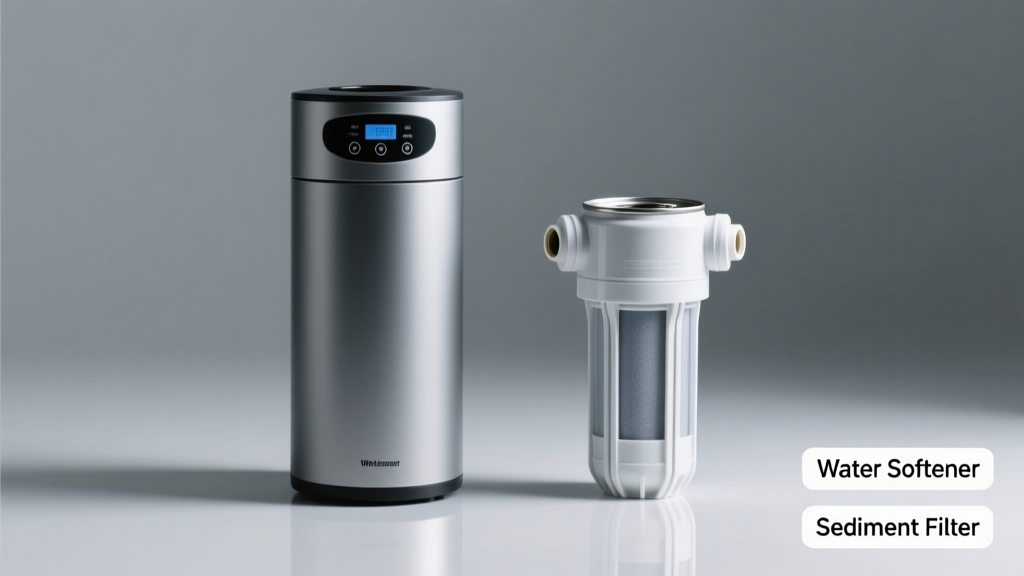
You’re noticing chalky residue on faucets, spotty glasses, or gritty particles in your showerhead — and now you’re wondering: do I need a water softener or a sediment filter? It’s a common point of confusion, because both attach to your main water line and look similar at first glance. But they solve entirely different problems — and installing the wrong one won’t fix your issue.
Quick Verdict
A water softener removes dissolved calcium and magnesium ions (hardness minerals) using ion exchange; a sediment filter traps suspended particles like rust, sand, and silt. Neither replaces the other — and choosing one over the other depends entirely on what’s actually in your water. According to the U.S. EPA, 85% of U.S. homes have hard water, but only ~30% experience visible sediment issues — meaning most people need softening first, then add filtration if needed.
Side-by-Side Comparison
| Feature | Water Softener | Sediment Filter |
|---|---|---|
| Primary target | Dissolved calcium & magnesium ions | Visible particulates (sand, rust, silt) |
| How it works | Ion exchange resin beads + salt regeneration | Mechanical straining (pleated, spun polypropylene, or string-wound) |
| Typical lifespan | 10–15 years (resin lasts ~10 years; control valve may need replacement) | 3–6 months (cartridge), or 1–3 years (whole-house spin-down) |
| Installation complexity | Moderate (requires drain, brine tank, bypass valve) | Low (inline or cartridge housing; often DIY-friendly) |
| Average upfront cost | $800–$2,500 | $50–$350 |
| Maintenance | Monthly salt refills; annual resin cleaning recommended | Cartridge replacement every 3–6 months; spin-down models require quarterly flushing |
Deep Dive on Water Softener
Water softeners tackle hardness — the invisible culprit behind scale buildup in kettles, reduced soap lather, stiff laundry, and shortened appliance life. They swap calcium/magnesium for sodium or potassium ions, effectively preventing scale formation inside pipes and water heaters.
Pros
- Extends lifespan of water heaters by up to 40%, per a 2022 Battelle study commissioned by the Water Quality Association
- Reduces detergent use by 50–75% in laundry and dishwashing
- Eliminates white scale on fixtures, glassware, and shower doors
Cons
- Adds sodium to water (not ideal for low-sodium diets unless using potassium chloride)
- Requires regular salt purchases and brine tank maintenance
- Does nothing for cloudy water, odor, chlorine, or bacteria
If your water test shows >7 grains per gallon (gpg) hardness — or you see scale in your kettle after boiling — a softener is likely necessary. For more on sizing, see our how to size a water softener guide.
Deep Dive on Sediment Filter
Sediment filters act like a sieve — catching physical debris before it reaches your plumbing or appliances. They’re essential where well water contains sand, or municipal systems suffer from aging pipes shedding rust.
Pros
- Prevents clogged aerators, showerheads, and washing machine inlet valves
- Protects downstream equipment (e.g., RO systems, softeners, and tankless heaters)
- No electricity or chemicals required — passive mechanical filtration
Cons
- Does not reduce hardness, chlorine, heavy metals, or dissolved contaminants
- Cartridges clog quickly in high-sediment environments — requiring frequent changes
- Spin-down models need manual flushing; neglect leads to pressure loss
The U.S. EPA estimates that 14% of household water usage is from leaks caused by sediment-induced valve failure — making even a basic 5-micron filter a smart first-line defense. For installation tips, check out our how to install a sediment filter walkthrough.
When to Choose Water Softener vs Sediment Filter
Choose a water softener if you observe:
- White crust on faucets or coffee makers
- Soap scum that won’t rinse off easily
- Laundry feeling stiff or looking dull despite using enough detergent
Choose a sediment filter if you notice:
- Brown or yellow tint in cold water (especially after construction or pipe work)
- Gritty texture when rubbing tap water between fingers
- Frequent clogging of irrigation nozzles or humidifier tanks
"A sediment filter should always precede a water softener — not replace it. Particulates can foul softener resin beds within months, cutting efficiency by half," says Dr. Lena Torres, water treatment engineer and co-author of Residential Water Systems Handbook (2023).
Alternatives to Consider
Neither device addresses chlorine taste/odor, lead, or nitrates. If those are concerns, consider pairing either with:
- Carbon filter (activated carbon block or granular) for chlorine and VOCs
- Reverse osmosis system under the sink for drinking water purity
- Whole-house UV disinfection for well water with bacterial risk
Many homeowners opt for a layered approach: sediment filter → softener → carbon filter. That setup covers hardness, particulates, and chemical contaminants — without over-engineering. See our whole-house water filtration systems comparison for layout examples.
Can I use both a water softener and sediment filter together?
Yes — and it’s strongly recommended. Install the sediment filter upstream (before) the softener to protect its resin bed. This extends softener life and maintains peak efficiency. Most professional installations include this sequence.
Will a sediment filter soften my water?
No. Sediment filters remove only suspended solids — not dissolved minerals. Hard water will remain just as hard after passing through a 1-micron or even 0.5-micron filter.
Do I need a water softener if I have city water?
It depends. Municipal water varies widely: Dallas averages 18 gpg hardness; Seattle is ~1 gpg. Request your local water quality report (often online via your utility’s website) — or test with a $10 hardness test kit. Don’t assume “city water = soft.”
Why does my sediment filter turn brown so fast?
Rapid discoloration usually signals high iron or manganese levels — especially common in well water. Standard polypropylene filters won’t remove dissolved iron; you’ll need an iron filter or oxidizing media (like Birm or greensand) upstream.
Is softened water safe for plants or lawns?
Generally no — sodium buildup harms soil structure and plant roots. Use unsoftened water for irrigation, or install a bypass spigot before the softener. Potassium-based softeners are safer but costlier.
Can a sediment filter reduce water pressure?
Yes — especially when clogged. A clean 5-micron pleated filter typically causes <1 psi drop; a dirty one can drop pressure by 10+ psi. Monitor pressure gauges before/after the filter — and replace cartridges at manufacturer-recommended intervals.
Bottom line: your water problem dictates the tool — not the other way around. Test first, then match the solution. Skipping testing means guessing — and guessing rarely saves money long-term. If you’re still unsure, start with a certified lab test (like Tap Score’s $129 Basic Water Test) to identify exactly what’s in your supply.