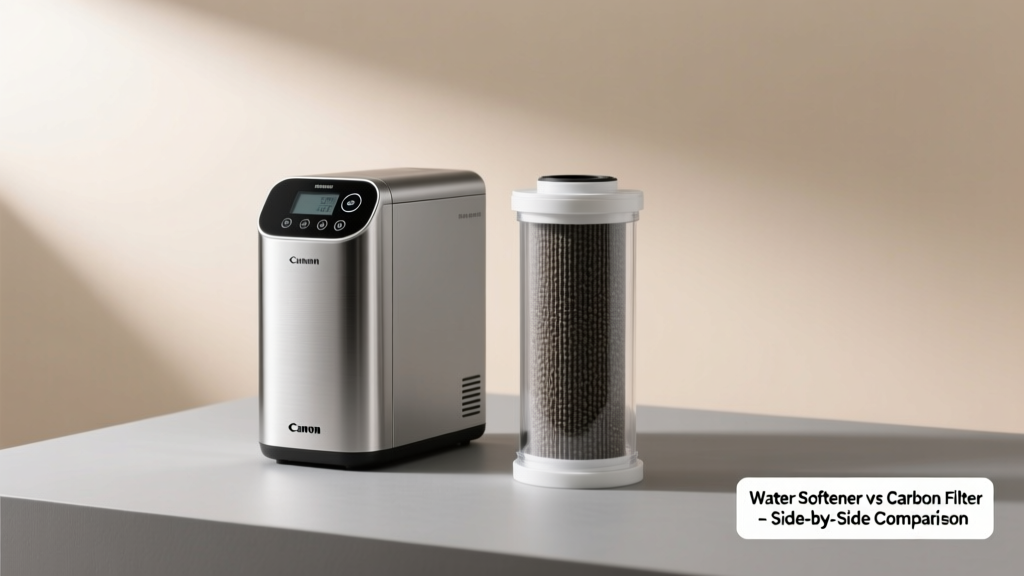
You’re standing in the hardware store aisle, staring at two very different boxes: one labeled 'water softener,' the other 'carbon filter.' Both promise better water — but they solve entirely different problems. Choosing wrong means paying for a solution that doesn’t fix your actual issue.
Quick Verdict
A water softener tackles hard water minerals (calcium and magnesium) to prevent scale buildup and extend appliance life. A carbon filter targets chlorine, VOCs, pesticides, and bad tastes or odors — but does nothing for hardness. Neither is 'better' universally; it depends on your water test results and household priorities. If your water smells like bleach and leaves brown stains, carbon wins. If your showerhead clogs monthly and soap won’t lather, go softener.
Side-by-Side Comparison
| Feature | Water Softener | Carbon Filter |
|---|---|---|
| Primary target | Calcium, magnesium ions (hardness) | Chlorine, chloramines, VOCs, pesticides, sediment, odors |
| Removes iron? | Only up to ~1–3 ppm (with specialty resin) | No — unless paired with iron-removal media |
| Installation location | Whole-house (main water line) | Point-of-use (under sink, faucet) or whole-house (larger units) |
| Monthly operating cost | $5–$15 (salt + electricity) | $0–$8 (filter replacements only) |
| Lifespan (unit) | 10–15 years (with resin replacement every 10+ yrs) | 5–10 years (housing); filters replaced every 3–6 months |
| Requires electricity? | Yes (for timer or metered regeneration) | No (gravity or pressure-driven) |
Deep Dive on Water Softeners
Water softeners use ion exchange: sodium or potassium ions swap places with calcium and magnesium in your water. This prevents limescale in pipes, water heaters, dishwashers, and coffee makers. According to the Water Quality Association’s 2022 Consumer Survey, 72% of softener users reported reduced detergent use and softer laundry after installation.
Pros
- Eliminates scale buildup — extends lifespan of water heaters by up to 40%, per ASHRAE’s 2021 HVAC efficiency report
- Improves soap lathering and reduces soap scum in showers and sinks
- Reduces spotting on glassware and fixtures
Cons
- Adds sodium (or potassium) to water — not recommended for sodium-restricted diets unless using a reverse osmosis system downstream
- Requires regular salt refills and periodic cleaning of the brine tank
- Does not improve taste, odor, or remove contaminants like lead or bacteria
Deep Dive on Carbon Filters
Activated carbon works through adsorption — contaminant molecules stick to the porous surface of the carbon. It’s especially effective against chlorine (which causes rubber gasket degradation) and volatile organic compounds (VOCs) commonly found in municipal supplies. The U.S. EPA estimates that over 90% of public water systems use chlorine or chloramine disinfection — making carbon filtration highly relevant for taste, odor, and health-conscious households.
Pros
- Removes chlorine, chloramines, THMs, pesticides, and pharmaceutical residues
- No salt, no electricity, no wastewater — low environmental footprint
- Available as affordable under-sink units (best under-sink water filter) or whole-house systems
Cons
- Does not reduce hardness — scale still forms on kettles and showerheads
- Carbon can exhaust silently; performance drops without visible warning
- Ineffective against dissolved minerals (nitrates, fluoride, arsenic, sodium)
When to Choose a Water Softener vs Carbon Filter
If your water test shows >7 grains per gallon (GPG) hardness — or you see white crust on faucets, stiff laundry, and frequent dishwasher repairs — a softener is essential. But if your city issues boil advisories, your tap water smells like swimming pool, or you’re concerned about herbicides from nearby agriculture, carbon is your first line of defense.
Many homes need both: a whole-house carbon filter to remove chlorine before it damages softener resin, followed by a softener to handle hardness. That setup is common in well water treatment systems, where iron, sulfur, and hardness often coexist.
"A carbon filter without hardness removal will still let scale destroy your hot water tank — and a softener without carbon leaves you drinking chlorinated water. They’re complementary, not competitive." — Dr. Lena Cho, Environmental Engineering, University of Massachusetts Amherst, 2023
Alternatives to Consider
Depending on your water profile, other options may outperform either standalone system:
- Reverse osmosis (RO): Removes hardness *and* contaminants, but wastes 3–5 gallons per gallon produced and requires under-sink space
- Template-Assisted Crystallization (TAC): Salt-free 'softening' that prevents scale without adding sodium — but doesn’t remove hardness ions (so water remains technically hard)
- KDF/carbon combo filters: Use copper-zinc media to extend carbon life and reduce heavy metals — popular in shower water filter systems
Can I use both a water softener and carbon filter together?
Yes — and it’s often ideal. Install carbon first (to remove chlorine), then softener downstream. Chlorine degrades softener resin over time; removing it first doubles resin life. Whole-house carbon + softener setups cost $2,200–$4,000 installed but deliver comprehensive protection.
Do carbon filters remove fluoride?
No. Standard activated carbon does not remove fluoride. You’ll need bone char carbon (a specific type) or reverse osmosis. Most countertop and under-sink carbon filters list fluoride removal only if explicitly certified to NSF/ANSI Standard 58.
Will a water softener fix my dry skin?
Some people report improved skin and hair feel — likely due to reduced soap residue and less mineral buildup on skin. But dermatology studies (Journal of the American Academy of Dermatology, 2020) show no direct clinical link between softened water and eczema improvement. Moisturizer use remains more impactful than water hardness alone.
How often do I replace carbon filters?
Every 3–6 months for point-of-use systems (e.g., under-sink), depending on usage and chlorine levels. Whole-house carbon tanks last 6–12 months — but monitor pressure drop and taste changes. Don’t wait for failure: exhausted carbon can leach trapped contaminants back into water.
Are magnetic or electronic descalers effective?
No. Independent testing by the Water Quality Association (2021) found zero measurable reduction in scale formation across 12 leading brands. These devices lack third-party certification and are not recommended as substitutes for ion exchange or TAC.
Do I need a water test before choosing?
Yes — absolutely. Free city water reports don’t test for iron, hardness, or pH. Use an EPA-certified lab like Tap Score ($129) or National Testing Labs ($89) to get actionable data. Guessing leads to overspending on the wrong technology.
Your water isn’t generic — it’s shaped by your geology, pipes, and treatment plant. A softener won’t make chlorinated water taste better. A carbon filter won’t stop your kettle from scaling. Start with a test, match the tool to the problem, and remember: clean water isn’t one-size-fits-all.