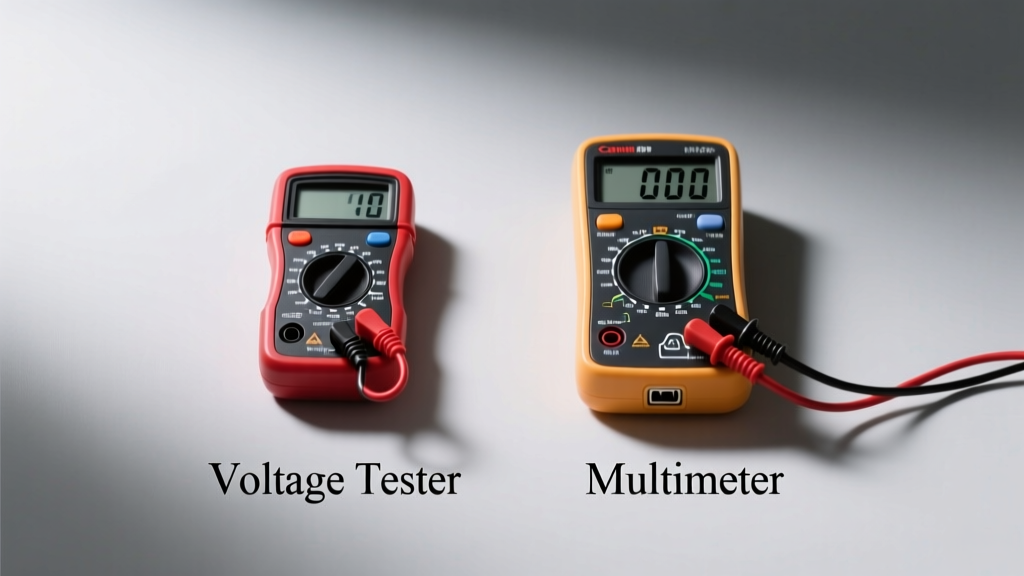
You’re standing in front of an electrical panel, holding a wire, and wondering: do you need a simple voltage tester or a full multimeter? It’s not just about cost — it’s about safety, precision, and whether you’ll actually use half the features.
Quick Verdict
A non-contact voltage tester is faster, safer, and foolproof for basic live/dead checks — ideal for homeowners, handymen, or electricians doing quick verification before work. A multimeter delivers precise measurements (voltage, current, resistance, continuity) and is essential for diagnostics, troubleshooting circuits, and professional repair. Neither is universally 'better'; the right tool depends on your task, skill level, and how much data you need — not how many buttons it has.
Side-by-Side Comparison
| Feature | Voltage Tester | Multimeter |
|---|---|---|
| Primary function | Detects presence of AC voltage (non-contact or contact) | Measures voltage, current, resistance, continuity, capacitance, diode drop, and more |
| Accuracy | Qualitative only (yes/no) | Quantitative: ±0.5% to ±2% typical accuracy (e.g., Fluke 117 specs) |
| AC voltage range | Typically 50–1000 V (non-contact), limited sensitivity below 90 V | Usually 0.1 mV–1000 V AC/DC, with autoranging or manual selection |
| Current measurement | No | Yes — up to 10 A (with fused current jacks); clamp models go higher |
| Portability & speed | Pen-sized, fits in pocket; test in <1 second | Bulkier; requires setup, range selection, and probe placement (30+ seconds per reading) |
| Price (entry-level) | $8–$25 (Klein Tools NCVT-1, Southwire 40200) | $25–$120 (AstroAI DM6000, Fluke 115) |
Deep Dive on Voltage Testers
Voltage testers come in two main types: non-contact (NCV) testers — which sense electromagnetic fields — and contact testers, like solenoid “wiggy” testers that require direct wire contact and draw small current to light or vibrate.
Pros
- No exposed metal contact needed — safer for beginners checking outlets or breakers
- Extremely fast: confirm live wires before touching them (critical for OSHA-compliant lockout/tagout prep)
- Low failure rate: few moving parts or batteries to manage (though LED/battery life matters — most last 1–2 years)
- Compact and rugged: Klein Tools’ NCVT-2 fits in a jeans pocket and survives 10-ft drops (per their 2022 durability testing)
Cons
- No numerical readout — can’t distinguish 120 V from 240 V, or detect phantom voltage
- Fails on shielded cables, armored conduit, or low-voltage DC systems (e.g., 12 V automotive or PoE)
- False positives possible near fluorescent lights or ungrounded neutrals; false negatives if battery is weak or insulation is too thick
According to the National Fire Protection Association’s Electrical Safety Foundation International (ESFI) 2023 Home Electrical Safety Report, 32% of DIY electrical incidents involved misreading or skipping voltage verification — underscoring why even pros keep an NCV tester clipped to their belt before grabbing a multimeter.
Deep Dive on Multimeters
A digital multimeter (DMM) is a calibrated measurement instrument — not just a detector. Entry-level models measure AC/DC voltage, resistance, and continuity; pro units add temperature, frequency, data logging, and True RMS for non-sinusoidal waveforms (like variable-speed drives).
Pros
- Quantitative data: see exact voltage drop across a switch (e.g., 0.8 V = failing contact) or resistance of a heating element (24 Ω vs. OL = open)
- Diagnostic versatility: test diodes, capacitors, and circuit continuity with audible tone — critical for HVAC techs or appliance repair
- True RMS capability (in mid-tier+ models) measures distorted waveforms accurately — vital for modern electronics and LED lighting circuits
Cons
- Steeper learning curve: misplacing probes in current jacks can blow fuses or damage the meter
- Slower workflow: requires selecting correct mode, range, and stable probe contact — impractical for rapid panel sweeps
- Higher risk if misused: inserting probes into a live 240 V outlet while in current mode creates a short circuit (Fluke’s 2021 Field Safety Bulletin cites this as #2 cause of DMM-related arc flash incidents)
When to Choose a Voltage Tester vs Multimeter
Choose a voltage tester when:
- You’re verifying power is off before changing a light fixture or GFCI outlet
- You’re a landlord checking tenant outlets during routine inspections
- You’re working in tight spaces where probe access is impossible (e.g., behind drywall or inside junction boxes)
Choose a multimeter when:
- You’re diagnosing why a thermostat isn’t powering up (measuring 24 VAC transformer output)
- You’re calibrating a solar charge controller or measuring battery bank voltage under load
- You’re an HVAC tech tracing a refrigerant pressure switch circuit (needs continuity + resistance tests)
Alternatives to Consider
Hybrid tools bridge the gap — but with trade-offs. The clamp meter adds non-invasive current measurement to multimeter functions, ideal for load profiling. The advanced NCV tester like the Extech VA220 includes LCD voltage estimation (low/mid/high) and sensitivity adjustment. For serious troubleshooting, many pros carry both: a $15 NCV tester for initial safety sweep, then a Fluke 117 for root-cause analysis.
Can a voltage tester replace a multimeter?
No — it detects presence, not value. You wouldn’t use a thermometer to adjust oven temperature; similarly, you can’t troubleshoot a dimmer switch or verify proper grounding with yes/no voltage detection alone.
Is a multimeter overkill for basic home repairs?
Often, yes — especially if you only change outlets, switches, or fixtures. But if you plan to service garage door openers, ceiling fans with remote receivers, or smart home hubs, the multimeter pays for itself in avoided callbacks and misdiagnoses.
Do I need CAT-rated tools?
Absolutely — if you’re testing anywhere near panels, breakers, or service entrances. Non-CAT-rated testers and meters risk catastrophic failure during voltage spikes. Look for CAT III 600 V (for branch circuits) or CAT IV 600 V (for utility connections). The U.S. Bureau of Labor Statistics logged 1,100+ electrical injuries in 2022 linked to improper tool rating (BLS Census of Fatal Occupational Injuries, 2023).
Why does my NCV tester beep near a USB charger?
Because cheap switching power supplies leak high-frequency noise onto ground paths — creating false positives. This is why pros always verify with a contact tester or multimeter before declaring a circuit dead.
What’s the biggest mistake people make with multimeters?
Leaving the dial in current (A) mode when measuring voltage — a classic error that blows internal fuses and sometimes destroys the meter. Always return to voltage mode after current checks. As one journeyman electrician told us:
"I’ve replaced three fuses this week — not because the meter failed, but because someone forgot to turn the dial. Muscle memory beats manuals every time."
If your work involves confirming power status quickly and safely, start with a quality voltage tester — then upgrade to a multimeter when your projects demand numbers, not just signals. And remember: no tool replaces de-energizing, verifying, and locking out. The best meter in the world won’t help if you skip the first step.