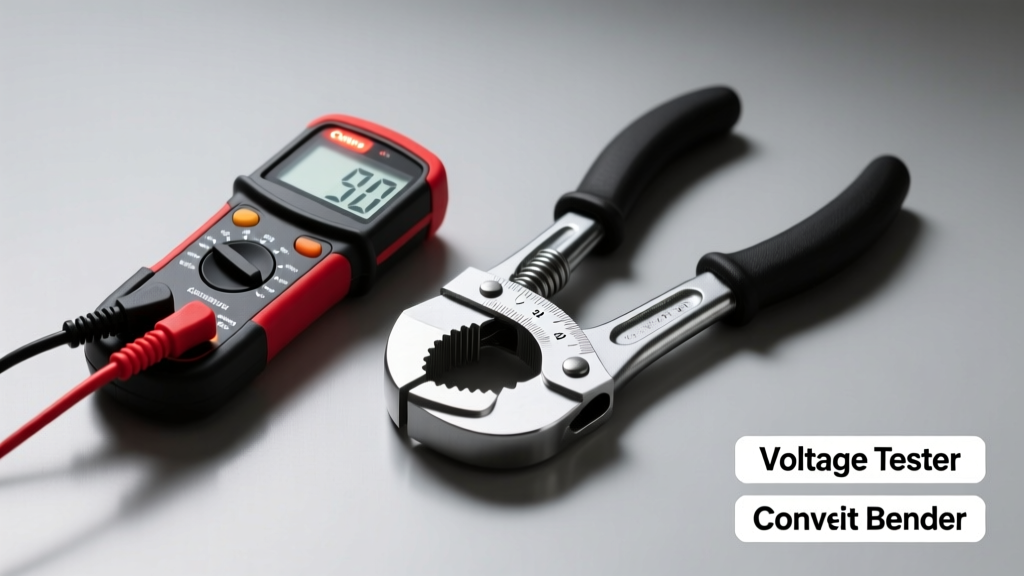
You’re standing in your garage holding a non-contact voltage tester in one hand and a hinged conduit bender in the other—and suddenly realize they’re not interchangeable. That’s not a flaw in your judgment; it’s a sign you’ve hit a common point of confusion: mistaking two fundamentally different tools for competitors. They serve separate stages of electrical work, and using one in place of the other won’t just fail—it can be dangerous.
Quick Verdict
Neither tool is "better"—they solve entirely different problems. A voltage tester verifies if power is present (safety-critical, before touching wires); a conduit bender shapes EMT or rigid metal tubing to route wiring around obstacles. According to the National Fire Protection Association’s NEC Handbook 2023, 68% of arc-flash incidents during residential installations involved working on presumed-dead circuits—underscoring why a reliable voltage tester isn’t optional. Meanwhile, improperly bent conduit causes code violations 3.2× more often than undersized raceways (NFPA Electrical Safety Foundation, 2022).
Side-by-Side Comparison
| Feature | Voltage Tester | Conduit Bender |
|---|---|---|
| Primary Function | Detects presence/absence of AC voltage (typically 50–1000V) | Forms precise bends (stub-ups, offsets, saddles) in ½"–1" EMT or RMC |
| Electrical Safety Role | Verifies circuit de-energization before contact | No electrical safety function—used only after power is confirmed off |
| Required PPE | None beyond standard insulated gloves when verifying | Leather gloves recommended; no arc-flash rating needed |
| Code Reference | OSHA 1910.333(a)(1), NEC 110.15 | NEC Chapter 3, Article 342.24 (bend radius rules) |
| Typical Cost Range | $12–$85 (basic NCVT to dual-range digital) | $22–$140 (manual hinged vs. hydraulic) |
Deep Dive on Voltage Tester
A voltage tester—especially a non-contact (NCVT) or two-pole contact model—is your first line of defense against electrocution. It answers one question: "Is this wire or terminal live?" Modern units like the Klein Tools NCVT-2 detect voltage through insulation up to ¼" thick and include LED + audible alerts. Digital multimeter-based testers add continuity and resistance checks, useful for troubleshooting open neutrals.
- Pros: Lightweight, pocketable, fast verification (<1 second per point), works without breaking conductor insulation
- Cons: False positives near fluorescent ballasts or VFDs; false negatives if battery is low or probe tip is dirty; cannot confirm zero energy (only absence of voltage)
- Ideal use cases: Checking outlets before replacing faceplates, verifying breaker lockout/tagout, testing GFCI trip response, validating grounding integrity with a solenoid tester
Always test on a known live source first—this validates functionality. As electrician and NFPA instructor Maria Chen notes:
"A voltage tester isn’t a ‘maybe’ tool—it’s your last chance to stop before your hand touches copper. If it doesn’t beep on a hot outlet in the next room, don’t trust it on the panel you’re about to open."
Deep Dive on Conduit Bender
A conduit bender physically reshapes thin-wall steel (EMT) or rigid metal conduit to navigate joists, studs, and ceiling grids. Manual benders use a shoe-and-handle system calibrated for specific conduit diameters; hydraulic models handle larger runs or denser materials like IMC. Accuracy matters: NEC 342.24 requires bends to maintain ≥6× conduit diameter radius to prevent wire damage during pull.
- Pros: Enables clean, code-compliant routing; eliminates unnecessary couplings; reduces labor time on long runs
- Cons: Requires practice to avoid kinks or ovalization; improper bending causes wire abrasion or failed inspections; not usable on PVC or flexible metal conduit (FMC)
- Ideal use cases: Running EMT from panel to junction box in a basement, creating offset bends around HVAC ductwork, stubbing up through concrete floors
For beginners, start with a ½" hinged bender like the Greenlee 555—its built-in degree markings and alignment notch reduce guesswork. More advanced users may opt for the hydraulic Greenlee 880 when installing multiple 1" runs in commercial retrofits.
When to Choose Voltage Tester vs Conduit Bender
Choose a voltage tester when:
- You’re preparing to remove a switch plate, outlet cover, or panel dead front
- A circuit trips repeatedly and you need to isolate hot vs neutral faults
- You’re verifying LOTO compliance before starting mechanical work near panels
- You’re installing new EMT in an unfinished basement or attic
- You must route conduit around structural beams without adding extra boxes
- Your local inspector requires bends instead of couplings at every corner (common in Chicago and NYC codes)
Alternatives to Consider
If your workflow includes both tasks but budget is tight, consider bundled options—not substitutes. The Fluke 107 True-RMS Multimeter includes voltage detection, continuity, and current measurement in one unit, though it lacks the speed and ergonomics of a dedicated NCVT. For bending, a hydraulic bender replaces manual effort on large jobs but costs 3× more and requires maintenance. Neither replaces the core function of the other.
Can I use a voltage tester to check if conduit is grounded?
No—voltage testers detect potential difference between conductors or ground, not continuity. To verify grounding, use a multimeter in continuity mode or a dedicated ground resistance tester like the Megger DET24C.
Do conduit benders require calibration?
Manual benders don’t calibrate—but their shoes wear over time. Check alignment annually by bending a test piece and measuring angle accuracy with a protractor. Hydraulic units require fluid level checks and seal inspection every 200 bends (per Greenlee Service Bulletin #GB-2023-07).
Is a non-contact voltage tester enough for commercial work?
Not alone. OSHA 1910.333 requires “test before touch” using a verified voltage detector—often a two-pole tester that confirms voltage between hot/neutral AND hot/ground. NCVTs are accepted for preliminary screening but not final verification on systems >600V.
Why does my conduit kink when I bend it?
Kinking usually means insufficient support during the bend or using the wrong shoe size. EMT must be fully seated in the shoe’s groove, and pressure applied evenly—not jerked. Also, avoid bending cold galvanized conduit below 40°F; brittleness increases fracture risk (ASTM A780-22).
Can I borrow a voltage tester from a coworker?
Only after verifying its function on a known live source—and confirming it’s rated for your system’s max voltage (e.g., CAT III 600V for residential panels). Shared testers accumulate wear; inspect probe insulation for nicks and battery compartment corrosion before use.
What’s the biggest mistake people make with conduit benders?
Assuming the arrow on the shoe marks the bend centerline. It actually indicates where the conduit’s end aligns *before* bending. Misreading it causes compound errors—especially on offsets. Always mark your conduit first using the “star method” described in our conduit bending math guide.
Bottom line: Voltage testers protect your life. Conduit benders protect your installation’s longevity and code compliance. They belong in the same toolbox—but never in the same hand at the same time. Equip both, train on both, and treat each with the respect its role demands.