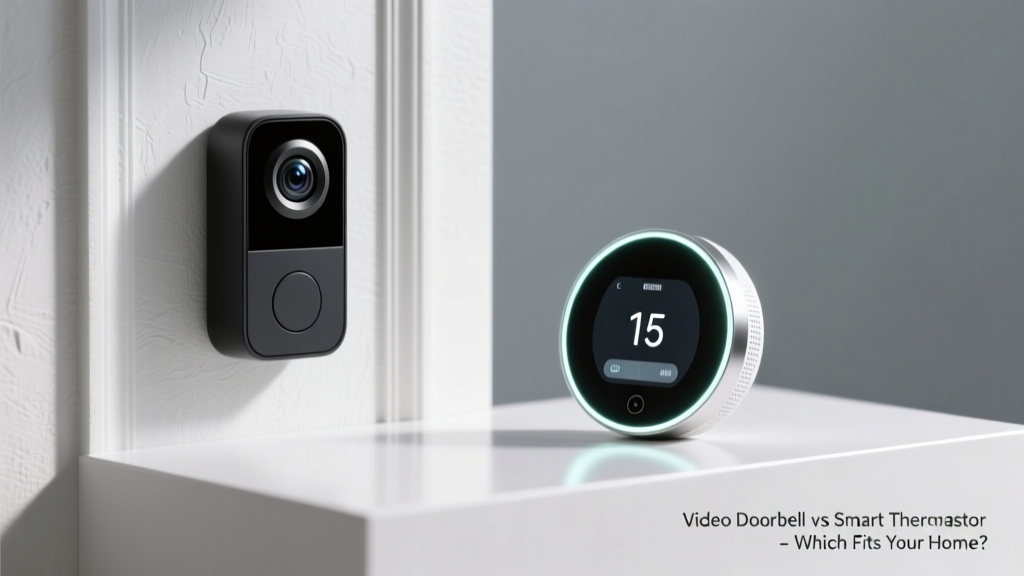
You’re upgrading your home’s tech — but stuck between a video doorbell and a smart thermostat. Both promise convenience and control, yet serve entirely different needs. One watches your front step; the other manages your furnace. So how do you decide which investment makes more sense right now?
Quick Verdict
Neither device is universally "better" — they solve distinct problems. A video doorbell enhances security and remote awareness of who’s at your door; a smart thermostat reduces energy waste and improves comfort through learning and scheduling. According to the U.S. EPA, smart thermostats save homeowners an average of 10–12% on heating and cooling costs annually — roughly $131–$157 per year (EPA ENERGY STAR, 2023). Meanwhile, the National Insurance Crime Bureau reports homes with video doorbells see up to 55% fewer package thefts (NICB, 2022). Your priority — safety or savings — should drive the choice.
Side-by-Side Comparison
| Feature | Video Doorbell | Smart Thermostat |
|---|---|---|
| Primary Function | Real-time visual monitoring & two-way audio at entry point | Automated HVAC control based on occupancy, schedule, and weather |
| Installation Complexity | Moderate: Requires wiring (or battery), Wi-Fi, and mounting hardware | Moderate-to-high: Wiring compatibility varies; some models need C-wire or adapter |
| Average Upfront Cost | $99–$249 (e.g., Ring Video Doorbell Pro 2, Arlo Essential) | $129–$299 (e.g., Nest Learning Thermostat, Ecobee SmartThermostat) |
| Monthly Subscription | Optional: $3–$10/month for cloud video history and advanced alerts | Rarely required: Most features work without subscription |
| Energy Impact | Negligible (uses ~2–5W) | Measurable: Reduces HVAC runtime by up to 20% in optimized setups |
Deep Dive on Video Doorbell
Pros
- Immediate visibility of visitors, deliveries, and suspicious activity
- Integrates with Alexa, Google Assistant, and Apple Home for voice announcements
- Some models offer AI-powered person/package/animal detection (e.g., Google Nest Doorbell)
- Can deter porch pirates — NICB data shows 55% fewer thefts in homes with visible doorbell cams
Cons
- Privacy concerns: Neighbors may object to recording shared spaces or sidewalks
- Limited utility if you rarely receive packages or have low foot traffic
- Cloud storage fees add up over time unless you self-host (requires technical skill)
- Poor night vision or motion sensitivity can lead to false alerts or missed events
Best for renters or homeowners in urban or suburban neighborhoods with frequent deliveries, guest visits, or security concerns. Also ideal if you already own compatible smart speakers or a video doorbell for renters and want plug-and-play setup.
Deep Dive on Smart Thermostat
Pros
- Delivers measurable energy savings — especially in homes with inconsistent occupancy patterns
- Geofencing adjusts temperature when you leave or return (works best with smartphone location)
- Remote access via app lets you pre-cool or pre-heat before arriving home
- Some models (like Ecobee) include room sensors to balance temps across zones
Cons
- Requires HVAC system compatibility — older systems may lack a C-wire or support for smart controls
- Learning curves: Scheduling, sensor placement, and humidity settings take trial and error
- Less immediate “wow” factor than a doorbell — benefits accrue gradually over months
- Doesn’t improve security — it won’t tell you who rang your bell or whether someone’s loitering
Best for households with high heating/cooling bills, variable schedules (e.g., remote workers, shift workers), or multi-zone HVAC. Especially valuable if you own a smart thermostat for older furnaces and need compatibility assurance.
When to Choose Video Doorbell vs Smart Thermostat
Choose a video doorbell if:
- You’ve had packages stolen or missed deliveries recently
- Your neighborhood has rising break-ins or unattended porch activity
- You frequently host guests, contractors, or pet sitters and want verification before opening the door
Choose a smart thermostat if:
- Your monthly HVAC bill exceeds $150 consistently
- You forget to adjust the thermostat when leaving or returning home
- You live in a climate with extreme seasonal swings (e.g., Midwest winters or Southern summers)
Alternatives to Consider
Before committing to either device, consider these middle-ground or complementary options:
- Smart lock + door sensor combo: Gives access control and entry alerts without video (e.g., August Wi-Fi Smart Lock + Aeotec Door/Window Sensor)
- Indoor security camera: Monitors hallways or living rooms — less intrusive than outdoor cams but still deters opportunistic theft
- Whole-home energy monitor: Like Sense or Emporia, helps identify HVAC inefficiencies before buying a thermostat
- Wi-Fi enabled garage door opener: Adds remote access and alerts — useful if your main entry isn’t the front door
Do I need both a video doorbell and smart thermostat?
Yes — if your budget allows and your home has both high-security needs and inefficient HVAC. They’re highly complementary: one secures your perimeter, the other optimizes your interior environment. Many users install them within 3–6 months of each other as part of a phased smart home rollout.
Can a video doorbell lower my homeowner’s insurance?
Some insurers offer small discounts (typically 2–5%) for homes with monitored security devices — but video doorbells alone rarely qualify unless paired with an alarm system. Check with your provider: State Farm and USAA list video surveillance under “optional security enhancements,” not core eligibility requirements (State Farm Homeowners Policy Guide, 2023).
Will a smart thermostat work with my old furnace?
Most modern smart thermostats support standard 24V HVAC systems — but older furnaces may lack a common (C) wire needed for continuous power. You’ll need to check your existing wiring or use an adapter like the Nest Power Connector. For guidance, see our smart thermostat wiring diagram guide.
How much bandwidth does a video doorbell use?
A typical HD doorbell uses 1–2 Mbps upload during live streaming or motion-triggered recording. If you have multiple cameras or low upload speed (<10 Mbps), buffering or delayed alerts may occur. The U.S. FCC recommends minimum 5 Mbps upload for reliable smart home video (FCC Broadband Speed Guide, 2022).
Do smart thermostats really learn my habits?
Yes — but only after ~1–2 weeks of manual adjustments. Nest’s algorithm tracks when you manually change temps and infers patterns. However, it struggles with irregular schedules (e.g., rotating shifts). As HVAC technician Marcus Lee told us:
"Learning thermostats work best when you have predictable routines. If you’re gone three days, back two, then off-grid for a week — stick with manual scheduling and geofencing instead."
Can I install either device myself?
Most video doorbells are DIY-friendly with basic tools (drill, screwdriver, level). Smart thermostats require turning off HVAC power and verifying wire labels — safe for confident DIYers, but miswiring can damage your furnace. We recommend professional installation for thermostats if you’re unsure about terminals (R, C, W, Y, G) or lack a C-wire.
Ultimately, this isn’t about picking a winner — it’s about matching tech to your daily reality. A video doorbell answers the question *“Who’s there?”* A smart thermostat answers *“Is it comfortable — and affordable — inside?”* Start with the pain point that costs you more time, money, or peace of mind today.