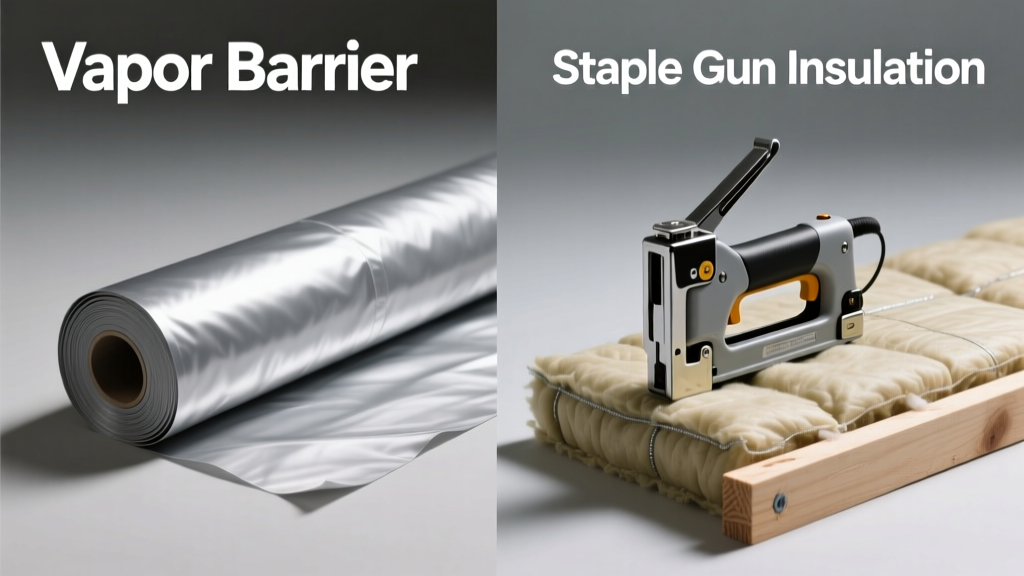
You’re standing in an unfinished basement or attic, roll of faced fiberglass in one hand, plastic sheeting in the other, and a staple gun humming on the workbench. You need moisture control and thermal resistance—but which method actually delivers? It’s not just about what’s easiest; it’s about what lasts, complies with code, and prevents mold in your climate zone.
Quick Verdict
Vapor barriers (6-mil polyethylene) are essential moisture blockers in cold climates but risk trapping moisture if misapplied. Staple-gun-applied insulation—typically kraft-faced batts—is faster to install and offers integrated vapor retardency (Class II), but only when seams and edges are sealed properly. Neither is universally 'better'; the right choice depends on your assembly, climate, and whether you’re insulating a wall cavity, rim joist, or crawlspace ceiling. According to the U.S. EPA, improperly installed vapor barriers contribute to 37% of residential moisture failures in mixed-humid zones (EPA Indoor Air Quality Tools for Schools, 2022).
Side-by-Side Comparison
| Feature | Vapor Barrier (6-mil Poly) | Staple-Gun-Applied Insulation (Kraft-Faced Batts) |
|---|---|---|
| Primary function | Moisture diffusion barrier (Class I, ≤0.1 perm) | Thermal insulation + moderate vapor retarder (Class II, 0.1–1.0 perm) |
| Typical installation method | Stapled or taped over studs *after* insulation is in place | Stapled directly to stud faces with flanges folded and fastened |
| Permeability (perms) | 0.03–0.06 | 0.4–0.7 (kraft facing only) |
| Code compliance (IRC 2021) | Required on interior side in Climate Zones 5–8 | Permitted as vapor retarder in Zones 1–4; limited use in Zone 5 without supplemental barrier |
| Average labor time (per 100 sq ft) | 22–28 minutes (cutting, sealing seams, taping edges) | 14–18 minutes (stapling face + flanges) |
Deep Dive on Vapor Barrier
A vapor barrier is not insulation—it’s a standalone moisture management layer. Most commonly 6-mil polyethylene sheeting, it’s installed on the warm-in-winter side of the wall (i.e., interior surface in cold climates) to prevent interstitial condensation inside wall cavities.
Pros
- Unmatched permeance control: blocks >99% of water vapor diffusion
- Low-cost material ($0.12–$0.18/sq ft wholesale)
- Required by IRC for framed walls in Climate Zones 6–8 unless using smart retarders or exterior insulation
Cons
- No R-value—adds zero thermal performance
- Punctures easily during drywall installation; staples can tear it if overdriven
- Risk of condensation *behind* the barrier if air leaks exist or if used in hot-humid climates (e.g., Houston or Atlanta)
Best for: New construction in northern regions (e.g., Minnesota, Maine), unconditioned attic kneewalls, or retrofitting older homes with no existing vapor control and high indoor humidity (e.g., homes with humidifiers or indoor pools).
Deep Dive on Staple-Gun Insulation
This refers to friction-fit fiberglass or mineral wool batts with kraft paper facing—installed by stapling the paper flange to the face of wood studs. The facing acts as a Class II vapor retarder and helps hold the batt in place.
Pros
- Dual function: provides R-13 to R-21 *and* moderate vapor control
- Faster installation than separate barrier + unfaced batts
- Less prone to gaps at edges when flanges are properly folded and stapled every 6–8 inches
Cons
- Kraft facing degrades if exposed to moisture during construction (e.g., rain-soaked framing)
- Not suitable as sole vapor control in cold climates without additional interior detailing (e.g., caulked drywall seams)
- Cannot be compressed without sacrificing R-value—stapling too tightly pulls the batt away from the cavity
Best for: Remodels in Climate Zones 3–4 (e.g., Tennessee, Kansas), garage walls, and conditioned crawlspaces where speed and simplicity matter more than ultra-low perm ratings.
When to Choose Vapor Barrier vs Staple-Gun Insulation
Choose a dedicated vapor barrier if you’re building in Climate Zone 7 and installing R-15 unfaced fiberglass—code requires ≤0.1 perm on the interior. Choose staple-gun insulation if you’re replacing insulation in a 2x4 exterior wall in Nashville and want to avoid adding a second layer that complicates drywall installation.
Also consider this: In a vented attic with cellulose blow-in, neither is needed—the roof deck and ventilation handle moisture. But in a sealed attic with spray foam underside, vapor barriers are prohibited—smart retarders like MemBrain are preferred.
"Over-restricting vapor movement is just as dangerous as under-restricting it. The goal isn’t to stop all diffusion—it’s to keep drying potential greater than wetting potential." — Building Science Corporation, Understanding Vapor Barriers, 2020
Alternatives to Consider
Neither option fits every assembly. Here are three field-tested alternatives:
- Closed-cell spray foam (R-6.5/inch, 0.02 perm): eliminates need for separate barrier in most above-grade walls
- Intelligent vapor retarders (e.g., ProClima Intello Plus): adjust permeance based on humidity—ideal for mixed climates
- Exterior rigid foam (e.g., 2" XPS): moves the condensing surface outside the sheathing, reducing interior vapor control needs
Can I use a vapor barrier with faced insulation?
No—you’d create a double vapor barrier, trapping moisture between layers. If you install kraft-faced batts, skip the poly sheeting. If you use unfaced batts in Zone 7, add poly—but never both.
Does staple gun insulation work with metal studs?
Not reliably. Kraft facing doesn’t adhere well to cold metal, and staples pull out easily. Use unfaced batts with adhesive or mineral wool boards secured with clips instead—see our guide on insulation for metal studs.
What if my wall already has plastic behind drywall?
Don’t add another layer. Instead, verify integrity: repair tears with Tuck Tape, seal outlets with vapor-rated gaskets, and ensure HVAC ducts aren’t leaking humid air into the cavity. Retrofitting a second barrier invites disaster.
Is vapor barrier required for basement walls?
Only on the interior side of insulated foundation walls in cold climates—but only if using fibrous insulation. For basement walls insulated with 2" EPS or XPS on the interior, the foam itself serves as the retarder (0.3–1.1 perm), making poly redundant.
How do I test if my vapor barrier is working?
You can’t visually confirm performance—but you *can* check for telltale signs: condensation on windows in winter, musty smells near baseboards, or peeling paint on interior walls. A hygrometer reading above 60% RH indoors consistently suggests vapor drive issues—not necessarily barrier failure, but system imbalance.
Do building inspectors check vapor barriers?
Yes—in Climate Zones 5–8, they’ll verify placement (interior side), continuity (sealed seams), and penetration sealing (around wires, pipes). Photos taken before drywall go up often satisfy requirements. In Zone 4, many jurisdictions accept kraft-faced batts alone.
If you’re weighing options for a specific room—like a bathroom wall with a steam shower or a vented attic floor—the optimal solution shifts. Always pair your choice with air sealing: a perfect vapor barrier means little if humid air bypasses it through gaps around outlets or top plates.