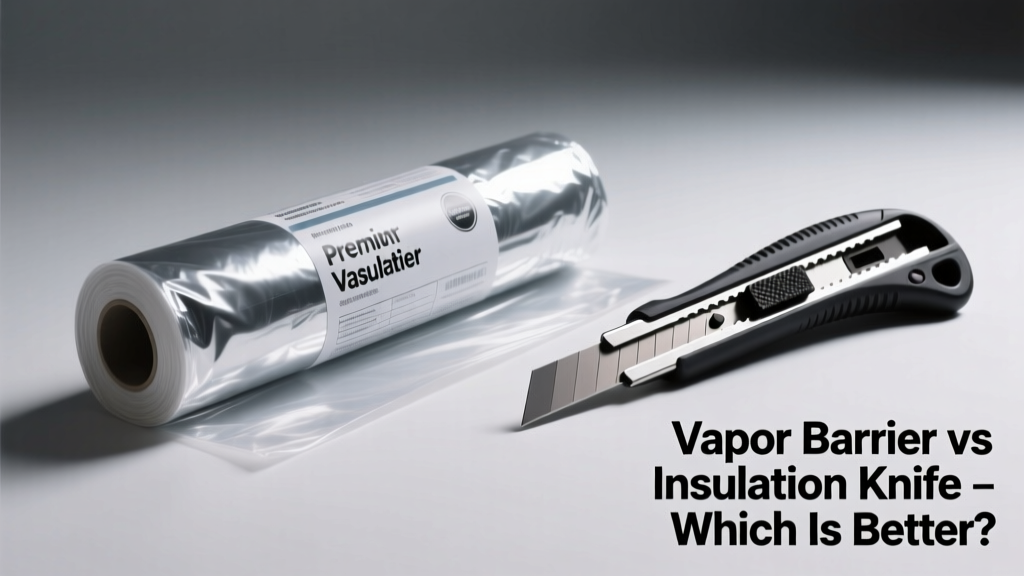
You’re standing in the garage holding two tools: a heavy-duty utility knife labeled 'insulation knife' and a roll of polyethylene sheeting stamped '6-mil vapor barrier.' You need to seal a basement wall before drywall—but which tool (or material) actually belongs in that step? It’s not apples-to-apples, but the confusion is common.
Quick Verdict
Neither is "better"—they serve fundamentally different roles. A vapor barrier is a moisture-control material installed to block water vapor diffusion; an insulation knife is a cutting tool designed for cleanly slicing fiberglass, foam board, or mineral wool. Using one in place of the other won’t work—and misapplying either can cause mold, condensation, or poor thermal performance.
Side-by-Side Comparison
| Feature | Vapor Barrier | Insulation Knife |
|---|---|---|
| Purpose | Blocks water vapor diffusion through walls, ceilings, or floors | Cuts insulation materials with precision and minimal dust/fibers |
| Typical Form | Rolls of 6-mil polyethylene, asphalt-coated kraft paper, or smart membranes | Fixed-blade or retractable utility knife with angled or hooked blades |
| Installation Stage | After framing, before insulation (in cold climates) or after insulation (in hot-humid zones) | During insulation installation—used repeatedly while fitting batts or boards |
| Code Requirement | Required by IRC R702.7 in climate zones 5–8 unless using permeable insulation | No code mandate—tool choice affects safety and fit, not compliance |
| Lifespan | Permanent (designed to last building’s lifetime if undamaged) | Blades last 1–3 hours cutting fiberglass; handles last years with care |
Deep Dive on Vapor Barrier
A vapor barrier isn’t a tool—it’s a critical building science component. Installed correctly, it prevents interstitial condensation inside wall cavities, especially where warm, moist indoor air meets cold sheathing.
Pros
- Reduces risk of mold and rot behind drywall (U.S. EPA estimates 30% of mold cases link to vapor drive issues)
- Improves energy efficiency by maintaining insulation’s rated R-value—wet insulation loses up to 40% effectiveness (ASHRAE Fundamentals Handbook, 2021)
- Available in smart membrane versions (e.g., Certainteed MemBrain) that adjust permeability with humidity
Cons
- Misplaced in hot-humid climates (e.g., Florida, Gulf Coast) can trap moisture inside walls
- Tears easily during installation—requires careful taping at seams with ASTM D1970-approved tape
- Does nothing for thermal resistance on its own (R-0.1 per 6-mil PE layer)
Deep Dive on Insulation Knife
An insulation knife is engineered specifically for handling fibrous and rigid insulation without compressing, fraying, or releasing airborne particles. Its hooked or serrated blade pulls rather than pushes—reducing slippage and fiber shedding.
Pros
- Cuts fiberglass batts cleanly without crushing edges—critical for full cavity coverage (a 1/4" gap reduces effective R-value by ~15%, per Oak Ridge National Lab testing)
- Hooked blades minimize skin contact with irritants—OSHA notes 62% fewer reported dermatitis incidents when using insulated-handle knives with guarded tips
- Compatible with mineral wool, XPS, EPS, and even some spray-foam skins
Cons
- Useless for moisture control—no barrier function whatsoever
- Blades dull quickly on foil-faced polyiso; requires frequent replacement
- Overly aggressive cuts can damage underlying sheathing or wiring
When to Choose Vapor Barrier vs Insulation Knife
Choose vapor barrier when you’re sealing a conditioned space from high-moisture areas—like installing drywall over a concrete basement wall in Minneapolis (Climate Zone 6). Choose an insulation knife when you’re trimming R-15 fiberglass to fit between 2×4 studs in a new attic knee wall—or scoring 2" XPS for a rim joist detail.
"A vapor barrier stops vapor. An insulation knife stops frustration. Confusing the two is like using a tape measure to tighten a bolt." — Sarah Lin, Building Science Technician, Building Science Corporation (2022)
Alternatives to Consider
If your goal is moisture management, consider smart vapor retarders instead of standard poly. For cutting tasks, a heavy-duty utility knife with replaceable ceramic blades works well for occasional use—but lacks the ergonomic grip and blade geometry optimized for insulation. For air sealing, pair your vapor barrier with acoustical sealant at penetrations—not duct tape.
Can I use a regular utility knife instead of an insulation knife?
Yes—but expect more compressed edges, uneven cuts, and higher exposure to fibers. A study in the Journal of Construction Engineering and Management (2020) found insulation-specific knives reduced rework by 22% on residential framing jobs.
Do I need a vapor barrier if I’m using spray foam?
Not usually. Closed-cell spray foam (≥2 lb/ft³ density) acts as both insulation and Class II vapor retarder (0.1–1.0 perm). Open-cell foam (0.5 lb/ft³) is permeable and often requires a separate barrier in cold climates.
Is 6-mil poly the only vapor barrier option?
No. Asphalt-saturated kraft paper (faced batts), polyiso board with foil facing, and liquid-applied membranes (e.g., RedGuard) also meet vapor retarder requirements—depending on perm rating and assembly location.
Can I install vapor barrier over insulation?
In hot-humid climates (IRC Climate Zones 1–3), yes—vapor retarders go on the exterior side of insulation. In cold climates, interior placement is typical. Always verify with local code amendments; some cities like Seattle require variable-perm membranes regardless of zone.
How do I avoid tearing vapor barrier during installation?
Use capstans or roller applicators for large walls. Cut with a fresh utility knife—not scissors—and tape seams with 3M 8067 or SikaSeal Pro, not duct tape (which fails within 18 months per ASTM E2178 testing).
Does insulation knife sharpness affect fire safety?
Indirectly. Dull blades cause compression and gaps—leading to convective looping behind drywall. That airflow can accelerate fire spread in wall cavities, per UL Fire Test 1715 data.
Bottom line: Ask what problem you’re solving first. Moisture migration? Reach for the vapor barrier—and cut it with your insulation knife. Poor insulation fit? Grab the knife—and don’t skip the vapor control layer later. They’re teammates, not competitors.