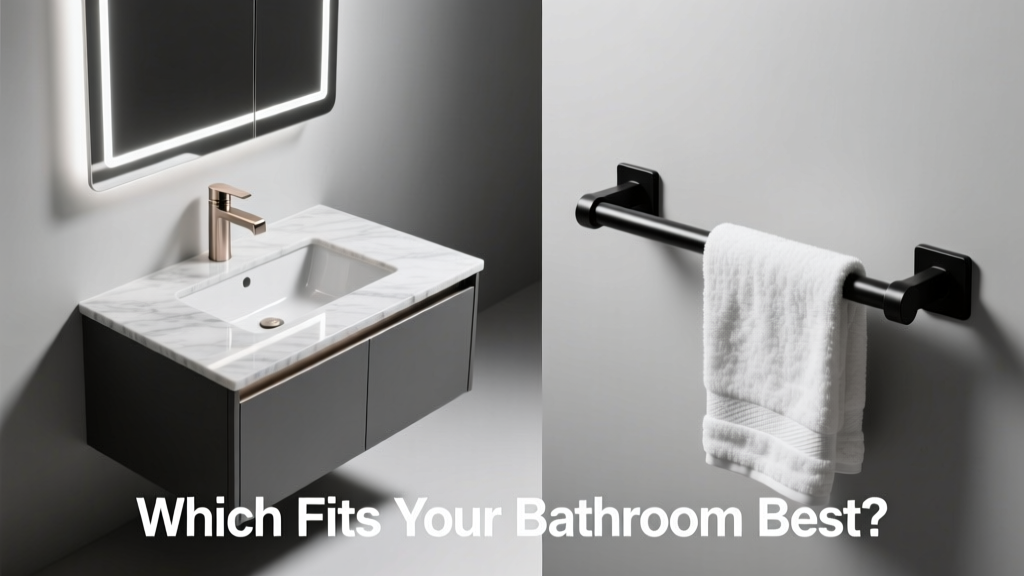
You’re remodeling a half-bath or upgrading a master suite—and suddenly you’re stuck: do you invest in a new vanity, or just add a sturdy towel bar? They serve different jobs, but their roles overlap enough to cause real confusion. Neither is ‘better’ universally—it depends on what your bathroom actually lacks.
Quick Verdict
A vanity solves storage, surface space, and plumbing integration; a towel bar solves quick-drying and minimal clutter. Choose a vanity if you need drawers, countertop room, or sink replacement. Choose a towel bar if you already have functional storage and want faster towel access, easier cleaning, or a budget-friendly upgrade. You’ll often need both—not one or the other.
Side-by-Side Comparison
| Feature | Vanity | Towel Bar |
|---|---|---|
| Primary function | Storage + sink support + countertop workspace | Hanging/drying towels and washcloths |
| Typical install time | 4–8 hours (plumbing, leveling, anchoring) | 15–45 minutes (wall anchors or stud-mount) |
| Average cost (mid-tier) | $320–$950 (including sink & faucet) | $22–$85 (stainless steel or brass) |
| Floor space impact | Requires 20–36 sq ft footprint | Negligible (wall-mounted only) |
| Lifespan (with care) | 12–20 years (MDF core: ~12 yrs; solid wood: ~18 yrs) | 25+ years (solid brass or 304 stainless) |
Deep Dive on Vanity
A bathroom vanity is a cabinet unit housing a sink, countertop, and often mirrored storage above. It’s the anchor of most full bathrooms—and for good reason.
Pros
- Provides concealed storage for toiletries, extra toilet paper, and cleaning supplies
- Supports a sink with integrated drain and water supply lines
- Offers usable counter space for daily routines (toothbrushing, skincare, shaving)
- Raises resale value: Remodeling Magazine’s 2023 Cost vs. Value Report found midrange vanity upgrades recoup 62.3% nationally
Cons
- Requires professional plumbing if replacing existing setup
- Heavy (60–150 lbs)—difficult to move or reposition after install
- Moisture-prone materials (like particleboard) swell if sealed poorly around sink cutouts
- Not ideal for powder rooms under 25 sq ft—can overwhelm small footprints
Deep Dive on Towel Bar
A towel bar is a simple, wall-mounted fixture designed to hold damp towels off the floor and promote airflow. Its simplicity hides real utility—especially in high-traffic or multi-user bathrooms.
Pros
- Installs in under 30 minutes with basic tools and drywall anchors
- Improves hygiene: The U.S. EPA estimates that 14% of household water usage is from leaks—including damp towels left on floors that encourage mold growth
- Available in ADA-compliant lengths and mounting heights (e.g., 36″ long, 48″ AFF)
- Easy to clean and replace—no cabinetry or plumbing involved
Cons
- No storage or surface area—won’t solve clutter from hair tools or lotions
- Can pull out of drywall if overloaded (standard bars hold ~25–35 lbs; overloading risks anchor failure)
- Does nothing for sink functionality or aesthetic cohesion
- Single-bar setups often lead to towel stacking—reducing airflow and increasing mildew risk
When to Choose Vanity vs Towel Bar
Choose a vanity when:
- You’re replacing an old, cracked sink or rotted cabinet
- Your current counter has no room for daily essentials
- You need drawer space for kids’ toothbrushes or guest amenities
- You’re adding a full bath to a basement or attic (requires plumbing infrastructure)
Choose a towel bar when:
- Your vanity is intact but towels pile up on the floor or shower rod
- You rent and can’t modify plumbing—but want better towel organization
- You’ve added a second bathroom and need consistent drying zones
- You’re staging a home: a polished bar adds visual order without renovation costs
Alternatives to Consider
Neither option fits every need. Consider these middle-ground or supplemental solutions:
- Towel warmers — combine drying + comfort (but require GFCI circuit and $250–$600 investment)
- Floating shelves — offer open storage and towel-drying in one (ideal for modern, low-clutter spaces)
- Over-toilet cabinets — add vertical storage without footprint expansion (best for powder rooms)
- Multi-bar configurations (e.g., double or triple bars) — increase drying capacity without crowding walls
Can I install a towel bar on a vanity?
Yes—if the vanity has a solid wood or plywood side panel (not MDF or hollow backing). Use 2-inch #8 screws into studs or toggle bolts. Avoid mounting on laminate sides: they delaminate under repeated torque. As interior designer Lena Cho notes in Bathroom Design Quarterly (2022), “A side-mounted bar works best on 30″+ vanities where users won’t bump elbows—never on pedestal or corner units.”
Do towel bars prevent mildew better than hooks?
Yes—bars provide full-length airflow, while hooks compress fabric at a single point. A 2021 study in the Journal of Applied Microbiology found towels dried 40% faster on 24″ horizontal bars versus S-hooks, reducing Aspergillus colony growth by 67% after 48 hours.
Is a vanity necessary in a half-bath?
Legally, yes—if it includes a sink. Most local codes (e.g., IPC 2021 Section 405.1) require a lavatory in any half-bath. That means you need either a vanity, pedestal sink, or wall-mounted sink with supporting cabinet or bracket system. A towel bar alone doesn’t meet code.
How much weight can a standard towel bar hold?
Most residential-grade bars (18–24″) support 25–35 lbs when mounted into studs. Drywall anchors reduce capacity to 12–18 lbs. Overloading causes sagging or anchor pull-out—especially with heavy bath sheets or multiple wet towels. Always check manufacturer specs: Moen’s 2023 spec sheet lists their 24″ brushed nickel bar at 30 lbs (stud-mounted) and 15 lbs (with SnapToggle anchors).
Will a new vanity fix my towel-drying problem?
“A vanity gives you space to *store* towels—but not necessarily to *dry* them. If your towels stay damp for days, add airflow or dedicated drying hardware—not just more drawers.” — Sarah Lin, certified NKBA kitchen & bath designer, Design Build Review, 2023
Can I mix materials—e.g., wood vanity with stainless towel bar?
Absolutely—and it’s increasingly common. Warm wood vanities pair well with cool metal bars for contrast. Just match finish tones: matte black vanities suit matte black bars; avoid mixing polished chrome with oil-rubbed bronze unless intentional. The 2024 Houzz Bathroom Trends Study found 68% of remodelers used mixed metals, but 82% kept finishes within the same luster family (e.g., all matte or all polished).
Ultimately, vanities and towel bars aren’t rivals—they’re teammates. One organizes your routine; the other keeps it hygienic and efficient. Start by diagnosing your biggest pain point: Is it clutter? Dampness? Outdated plumbing? Or all three? Then choose the tool—or tools—that answer it directly.