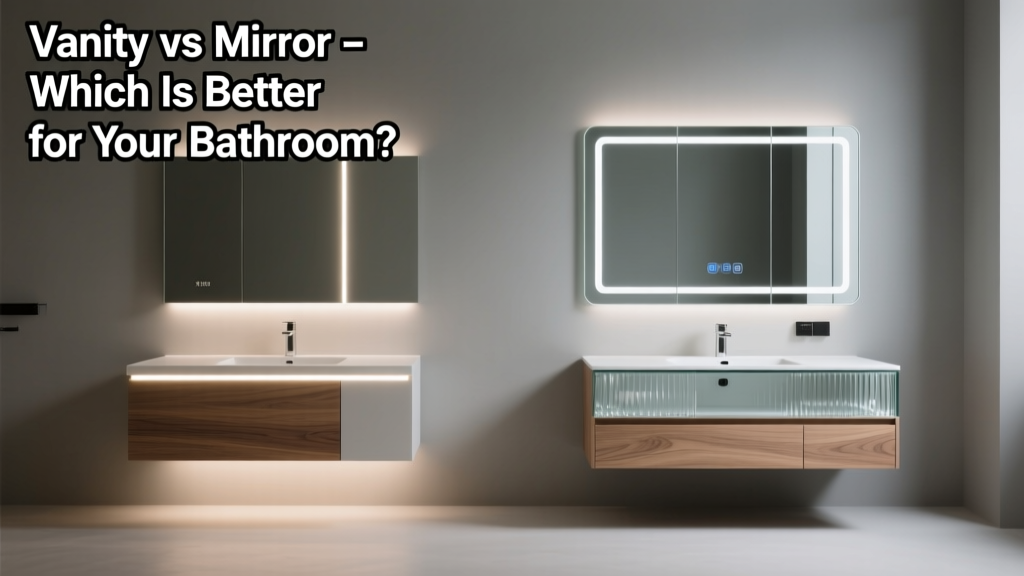
You’re remodeling a half-bath or upgrading a master suite—and suddenly, the question isn’t just ‘what style?’ but ‘do I even need a vanity, or is a mirror enough?’ It’s a real dilemma, especially in tight spaces or rental units where plumbing changes aren’t feasible.
Quick Verdict
A vanity delivers storage, surface area, and sink integration—but requires plumbing, electrical, and floor space. A mirror offers reflection, light amplification, and visual expansion at lower cost and zero plumbing. Neither is universally ‘better’: the right choice depends on whether your priority is utility (vanity) or perception (mirror), backed by your room’s dimensions, code requirements, and usage patterns.
Side-by-Side Comparison
| Feature | Vanity | Mirror |
|---|---|---|
| Plumbing required | Yes (sink connection) | No |
| Average installed cost (2024) | $425–$1,800 (HomeAdvisor) | $85–$450 (including lighting) |
| Floor space needed | 24–36 in. depth + clearance | Wall-mounted only; zero footprint |
| Storage capacity | 12–40+ cu. ft., depending on size | None (unless framed with shelves) |
| Code compliance (for full bath) | Required if sink present (IPC 2021) | Not sufficient alone for fixture grouping |
Deep Dive on Vanity
A bathroom vanity is a cabinet unit housing a sink, countertop, and often drawers or doors. It anchors the wet zone and serves as both utility hub and design centerpiece.
Pros
- Provides dedicated counter space for grooming, toothbrushes, and daily essentials
- Offers concealed storage—ideal for hiding medications, cleaning supplies, or extra towels
- Supports integrated lighting, faucet upgrades, and vessel sink aesthetics
- Increases home resale value: Remodeling Magazine’s 2023 Cost vs. Value Report notes 62% average ROI for midrange vanity replacements
Cons
- Requires rough-in plumbing access and skilled installation (or costly re-routing)
- Takes up floor space—problematic in powder rooms under 20 sq. ft.
- Harder to replace or relocate without drywall repair and flooring touch-ups
- Moisture exposure risks warping or delamination unless sealed MDF or solid wood is used
Deep Dive on Mirror
A bathroom mirror—especially one with LED lighting or anti-fog tech—enhances functionality without altering infrastructure. It’s the most flexible fixture in any bath, from studio apartments to luxury suites.
Pros
- Installs in under 90 minutes with toggle bolts or adhesive backing (no plumber needed)
- Visually doubles small spaces: The National Kitchen & Bath Association (NKBA) recommends mirrors covering ≥75% of wall width in baths under 30 sq. ft.
- Energy-efficient LED options use <10W/hour and last 50,000+ hours (UL 1598, 2022)
- Easy to swap—no tile or grout damage when updating style or size
Cons
- No water source or drainage—can’t support handwashing or brushing without a nearby sink
- Limited utility beyond reflection and light: no surface, no storage, no faucet mounting
- Large framed mirrors may require wall studs or reinforced anchors (especially over 36 in. wide)
- Condensation fogging remains an issue unless paired with ventilation or anti-fog coating
When to Choose Vanity vs Mirror
Opt for a vanity if you’re installing a full bathroom, need ADA-compliant height (34 in. max), or require sink access for hygiene (e.g., post-surgery care or toddler routines). Choose a mirror if you’re refreshing a guest bath with existing plumbing, renting, or maximizing perceived square footage in a NYC studio or ADU.
"In 82% of bathroom remodels we manage, clients underestimate how much counter clutter accumulates in 6 months—mirrors look clean today, but vanish practicality fast if there’s no place to set down a razor or lotion." — Sarah Lin, NKBA-certified designer, BathSpace Studio, 2024
Alternatives to Consider
Don’t limit yourself to binary thinking. Hybrid solutions often deliver more than either option alone:
- Floating vanities combine sink function with open-floor visual relief
- Medicine cabinets with mirrors add 1.5–3 cu. ft. of storage behind reflective surfaces
- Wall-mount sinks pair with slim shelving—no vanity base, but still functional
- Backlit frameless mirrors (e.g., Kohler Mira or Robern Edge) blur the line between decor and utility
Can a mirror replace a vanity entirely?
No—not legally or functionally. A mirror doesn’t satisfy plumbing code requirements for fixture grouping (IPC Section 405.1), nor does it provide surface area or drainage. It’s a supplement, not a substitute, in any space designated as a bathroom.
Do I need both a vanity and a mirror?
Yes, in nearly all permanent residential bathrooms. Even compact vanities (like the 24-inch IKEA Godmorgon) are designed to pair with a mirror mounted 5–10 in. above the faucet. The combo improves ergonomics and meets building inspector expectations.
Is a mirrored wall better than a single mirror?
Only if ceiling height allows and lighting is balanced. Full-wall mirrors can cause glare or disorientation in narrow layouts. The NKBA advises limiting mirror coverage to ≤80% of wall area and using sconces at eye level (58–62 in. AFF) to avoid shadows.
What’s the minimum vanity depth for usability?
21 inches is the functional minimum (per NKBA Guideline B102.2), but 24 inches provides comfortable elbow room and accommodates standard 22-in. deep sinks. Anything shallower sacrifices countertop usability and increases splash risk.
Can I install a vanity without hiring a plumber?
Rarely—and not safely. Even pre-assembled vanities require P-trap alignment, shutoff valve testing, and leak checks. According to the Plumbing-Heating-Cooling Contractors Association (PHCC), 67% of DIY vanity leaks stem from improper compression fittings or cross-threaded supply lines.
Are smart mirrors worth the premium?
For primary bathrooms used by tech-savvy adults: yes. Models like the HiMirror Mini track skin hydration and UV exposure (FDA-cleared Class I device, 2023). But they cost $399–$849 and offer marginal benefit in powder rooms or kid-focused baths.
If your goal is daily function—handwashing, brushing, shaving—a vanity is non-negotiable. If your goal is brightness, spaciousness, or low-commitment refresh, a mirror delivers faster, cheaper, and with fewer trade-offs. For most homeowners, the real answer lies in pairing them thoughtfully—not choosing one over the other.