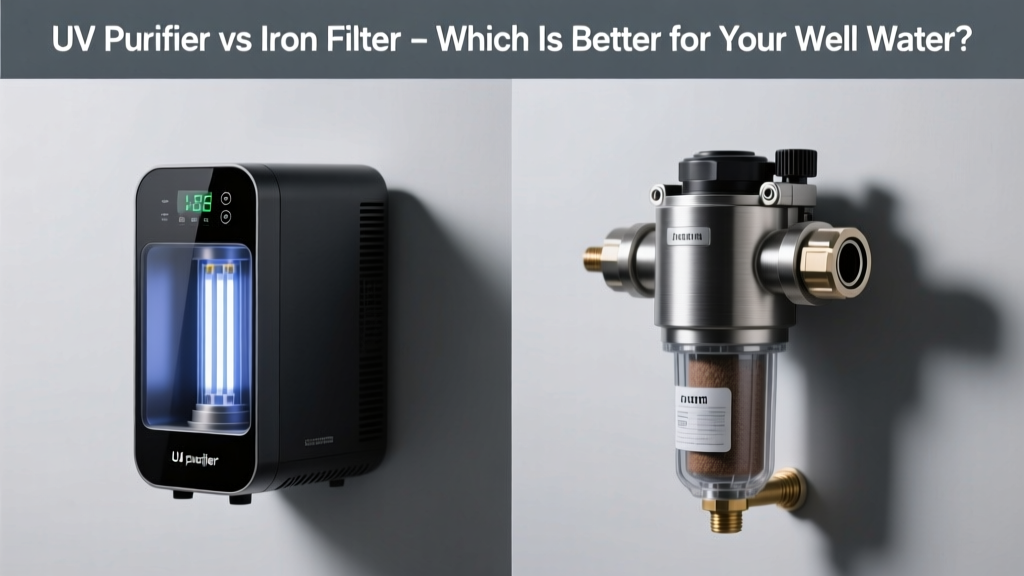
You’ve tested your well water and found both bacteria and orange staining — now you’re stuck choosing between a UV purifier and an iron filter. They solve different problems, but the labels sound interchangeable if you’re not familiar with water treatment chemistry.
Quick Verdict
A UV purifier kills microorganisms like E. coli and coliform; it does nothing for iron, manganese, or sediment. An iron filter removes dissolved iron (up to 10 ppm), reduces sulfur odors, and prevents rust stains — but leaves bacteria untouched. You may need both, especially if your well has high iron and bacterial contamination. According to the U.S. EPA, nearly 15% of private wells exceed safe coliform levels, while the American Ground Water Trust reports iron above 0.3 ppm in over 40% of rural wells in the Midwest and Northeast.
Side-by-Side Comparison
| Feature | UV Purifier | Iron Filter |
|---|---|---|
| Primary Target | Bacteria, viruses, protozoa | Dissolved iron, manganese, hydrogen sulfide |
| Removes Cloudiness? | No | Yes — when paired with sediment pre-filter |
| Requires Pre-Filtration? | Yes — 5-micron sediment filter mandatory | Yes — often needs 5–20 micron pre-filter |
| Annual Maintenance Cost | $80–$120 (lamp + sleeve cleaning) | $150–$300 (media replacement every 5–7 years; backwash salt or air) |
| Lifespan | UV lamp: 1 year; system: 10+ years | Media: 5–7 years; tank: 12–15 years |
| Power Required? | Yes — continuous 120V AC | No (except for some smart control valves) |
Deep Dive on UV Purifier
UV purification uses ultraviolet light at 254 nm wavelength to disrupt DNA replication in microorganisms. It’s NSF/ANSI Standard 55 Class A certified for disinfection when installed correctly.
Pros
- No chemicals added — no chlorine taste or DBPs (disinfection byproducts)
- Instant treatment — works as water flows through the chamber
- Low operating cost after initial $450–$900 purchase
- Effective against cryptosporidium and giardia, which resist chlorine
Cons
- Fails completely if water is cloudy, colored, or high in iron (>0.3 ppm) — UV light can’t penetrate
- No residual protection — contamination downstream (e.g., in pipes or storage tanks) isn’t controlled
- Lamp output degrades over time; requires annual replacement even if still glowing
- Zero impact on hardness, iron, TDS, or heavy metals
If your lab report shows coliform present but iron < 0.3 ppm and turbidity < 1 NTU, a UV system alone may suffice. For more context, see our guide on well water testing kit reviews.
Deep Dive on Iron Filter
Iron filters typically use oxidation followed by filtration — either air injection (like the Pyrolox or Birm systems) or chemical feed (hydrogen peroxide). Media like greensand, Filox, or manganese dioxide catalyze iron oxidation into solid particles trapped in the filter bed.
Pros
- Removes up to 12 ppm dissolved iron and 5 ppm manganese
- Reduces rotten-egg odor from hydrogen sulfide (H₂S) when using air-charged or catalytic media
- No electricity needed for most models (e.g., Clack WS1 timer valve runs on water pressure)
- Also captures rust particles, sediment, and some arsenic co-precipitated with iron
Cons
- Does not disinfect — bacteria pass right through untreated
- Requires regular backwashing (every 2–5 days depending on iron load)
- Media fouling occurs if chlorine or tannins are present — incompatible with chlorinated municipal feeds
- Initial cost higher: $1,200–$2,600 installed for whole-house capacity
According to the Water Quality Association’s 2022 Residential Treatment Survey, 68% of homes with iron >1.0 ppm chose aeration-based iron filters over chemical injection due to lower long-term upkeep. For installation tips, check our how to install iron filter walkthrough.
When to Choose UV Purifier vs Iron Filter
Choose a UV purifier if:
- Your water test shows total coliform or E. coli, but iron is below 0.3 ppm and clarity is high
- You’re on municipal water that’s chlorinated but want extra pathogen protection (e.g., post-hurricane or after pipe work)
- You already have a softener or sediment filter and just need disinfection
Choose an iron filter if:
- You see orange/brown stains on fixtures, laundry, or toilets — especially after water sits overnight
- Your lab report shows dissolved iron ≥0.3 ppm and/or H₂S >0.5 ppm
- You notice metallic taste and your pH is above 6.5 (ideal for oxidation-based removal)
"A UV system without proper pre-filtration is like locking your front door but leaving the windows open — it looks secure until something gets through." — Dr. Lena Cho, Water Microbiologist, NSF International, 2021
Alternatives to Consider
Sometimes neither option fits perfectly. Here are three realistic alternatives:
- Chlorination + contact tank + carbon filter: Kills bacteria and oxidizes iron, then removes excess chlorine and precipitated particles. Higher maintenance but effective for severe iron + bacteria combos.
- Reverse osmosis (RO) under sink: Removes iron, bacteria, and most contaminants — but only treats drinking water, not whole house. Not cost-effective for high iron loads.
- Whole-house sediment + UV + iron filter combo: Used in ~22% of high-iron well systems (per 2023 WQA Field Data Report). Requires careful sequencing: sediment → iron filter → UV (since UV must come last).
Can I use a UV purifier and iron filter together?
Yes — and it’s often the best solution for wells with both biological and mineral issues. Install the iron filter first (to protect UV clarity), then the UV unit after. Ensure the iron filter’s effluent turbidity stays under 0.5 NTU — verify with a handheld turbidimeter.
Will an iron filter fix my smelly water?
It depends on the cause. If the rotten-egg smell appears only when hot water runs, it’s likely a sulfur-reducing bacteria in your water heater — not dissolved H₂S in the source. But if cold water smells at the tap, and lab tests confirm H₂S, catalytic iron filters (e.g., Filox or MTM) remove up to 5 ppm reliably.
Do UV purifiers work on well water with tannins?
No. Tannins stain quartz sleeves and absorb UV light. Even 1–2 ppm of organic color drops UV dose by 30–50%. You’ll need a tannin-specific resin filter (like Purolite A-100) upstream — or switch to chlorine/chloramine for disinfection.
How often do I replace the UV lamp?
Annually — regardless of usage hours. The lamp’s UV-C output declines steadily; after 9,000 hours (~1 year), it delivers less than 60% of rated intensity. Some units include hour meters, but most rely on calendar-based replacement. Skipping it risks untreated water.
Is there a filter that removes both iron and bacteria?
No single device does both reliably. Membrane filters (e.g., ultrafiltration) trap bacteria but clog instantly with iron. Disinfectants like chlorine oxidize iron but don’t remove it — you still need filtration. True dual-action requires staged treatment.
What’s the minimum flow rate I need for a UV system?
Most residential units require 5–12 GPM, depending on model and dose (40 mJ/cm² is standard for Class A). Below 5 GPM, contact time exceeds design — but above 12 GPM, dwell time drops, risking under-dosing. Always size based on your peak demand, not static pressure.
If your water report shows multiple red flags — say, 2.1 ppm iron, 32 CFU/100mL coliform, and 1.8 NTU turbidity — start with a sediment filter, then add both an iron filter and UV purifier in sequence. That setup covers all bases without over-engineering. For help interpreting your lab results, see our how to read well water test report guide.