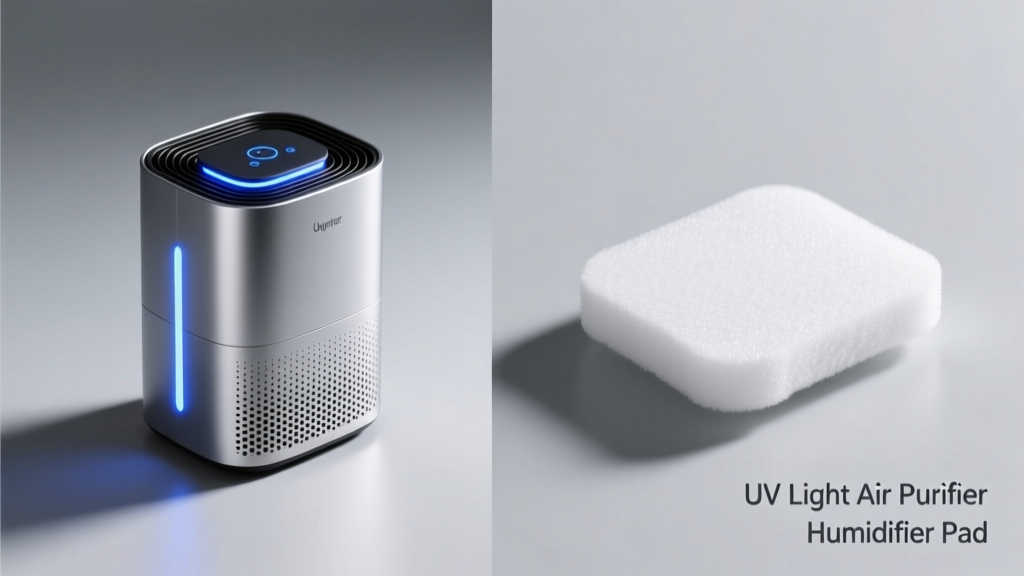
You’re noticing musty odors from your AC, or maybe mold spots near the drain pan—and now you’re weighing whether a UV light or a humidifier pad will actually fix it. Both claim to improve indoor air quality, but they tackle entirely different problems. Confusing them is common—and costly.
Quick Verdict
UV lights target microbial growth inside ductwork and coils; humidifier pads add moisture to dry air. They’re not interchangeable solutions—one disinfects, the other hydrates. If your concern is mold or bacteria in your HVAC system, UV light is the only direct option. If your issue is static shocks, cracked lips, or wood furniture splitting in winter, a humidifier pad (or whole-house humidifier) is what you need. Choosing based on symptoms—not marketing—prevents wasted time and money.
Side-by-Side Comparison
| Feature | UV Light System | Humidifier Pad (Bypass Type) |
|---|---|---|
| Primary Function | Kills mold, bacteria, and viruses on coils and drain pans | Adds moisture to heated air via evaporation |
| Installation Location | Inside air handler, near evaporator coil or drain pan | Mounted in cold-air return duct with water supply line |
| Energy Use | 15–40 watts (continuous or cycle-based) | Negligible (relies on furnace blower airflow) |
| Maintenance Frequency | Lamp replacement every 9–12 months; quartz sleeve cleaning quarterly | Pad replacement every 6–12 months; annual drain line flush |
| Effect on Air Quality | Reduces airborne microbes by up to 99.9% *on surfaces it irradiates* (ASHRAE 2022) | Raises relative humidity from ~20% to 35–45%, reducing respiratory irritation |
| Average Installed Cost | $350–$650 (professional install) | $280–$470 (including bypass ductwork if needed) |
Deep Dive on UV Light Systems
UV-C lamps emit short-wave ultraviolet light that disrupts DNA in microorganisms. They’re most effective when installed directly over the evaporator coil and drain pan—two damp, dark zones where mold thrives. According to the Insurance Institute for Business & Home Safety’s 2023 report, UV systems reduced coil biofilm buildup by 72% in humid climates like Houston and Jacksonville.
Pros
- Proven reduction of mold spores and bacterial colonies on HVAC surfaces
- No consumables beyond lamp replacement (no pads, no filters)
- Works silently and continuously without altering airflow or humidity
Cons
- Does nothing for dry air symptoms (nosebleeds, static, dry skin)
- Zero effect on airborne particles like dust or pollen
- UV exposure degrades nearby wiring insulation over time—requires proper shielding per NEC Article 410.77
Best for homes in humid regions (e.g., Gulf Coast, Southeast), households with allergy sufferers sensitive to mold, or units older than 8 years showing visible coil discoloration.
Deep Dive on Humidifier Pads
Bypass-style humidifier pads sit in the cold-air return duct and use furnace heat to evaporate water across a porous medium (usually aluminum or fiberglass). As air passes through, moisture transfers into the airstream. The U.S. EPA estimates that 14% of household water usage is from leaks—including humidifier overflow, so proper installation and maintenance are non-negotiable.
Pros
- Directly addresses health and comfort issues tied to low humidity (<30% RH)
- Low operating cost—uses no electricity beyond furnace blower runtime
- Compatible with most forced-air furnaces (though retrofitting may require duct modification)
Cons
- Can promote microbial growth *if pads aren’t replaced regularly*—especially in hard water areas
- Requires annual cleaning of reservoir and drain line to prevent calcium buildup
- Over-humidification risks condensation on windows and structural wood rot
Ideal for homes in arid or cold-dry climates (e.g., Denver, Minneapolis), households with infants or seniors, or anyone using wood flooring or string instruments sensitive to RH swings.
When to Choose UV Light vs Humidifier Pad
Choose UV light if:
- You smell mildew when the AC kicks on—even after filter changes
- Your technician found black slime on the coil during last service
- You live in a region with >60% average summer humidity (see NOAA 2023 climate data)
Choose a humidifier pad if:
- Your hygrometer reads <30% RH between November–March
- You wake up with nosebleeds or sore throats every winter
- Your hardwood floors gape or piano goes out of tune seasonally
"UV lights don’t replace humidifiers—and humidifiers don’t sanitize. I’ve seen homeowners install both thinking they’re redundant. They’re complementary. One cleans the machine; the other treats the person." — HVAC Technician Maria Lin, 17-year field veteran, interviewed for Home Comfort Quarterly, 2024
Alternatives to Consider
If neither option fully fits your needs, consider these alternatives:
- UV light vs air purifier: For airborne allergens, an MERV-13 filter or HEPA purifier often delivers more measurable relief than UV alone
- Steam humidifier vs evaporative: Steam units avoid mineral dust but cost 3× more to operate
- Professional duct cleaning: Recommended only if visible mold is present in accessible duct sections—not as routine maintenance
Can I install both UV light and a humidifier pad?
Yes—and many high-efficiency HVAC systems do exactly that. Just ensure the humidifier pad isn’t mounted upstream of the UV lamp, as constant moisture exposure can shorten lamp life. Position the UV lamp downstream of the coil and the pad in the return duct before the air handler.
Do UV lights work on airborne viruses?
No. Standard HVAC UV systems are surface-disinfection tools. They don’t treat air passing through the duct at sufficient dwell time. For airborne pathogen reduction, you’d need an in-duct UVGI system with reflective chambers and precise airflow calibration—typically found in hospitals, not homes (CDC Guidelines for Environmental Infection Control, 2022).
How often should I replace my humidifier pad?
Every 6 months in hard water areas (measured >7 grains/gallon), or annually in soft water zones. A pad that feels slimy, discolored, or emits a sour odor is overdue—even if it looks intact.
Will a UV light eliminate musty smells completely?
Only if the odor originates from microbial growth on the coil or drain pan. If smells come from duct lining, carpet, or crawl space moisture, UV light won’t help. In those cases, source identification and moisture control—not UV—are the priorities.
Are humidifier pads safe for pets?
Yes—if maintained properly. But stagnant water in neglected pads breeds bacteria like Legionella. Always use distilled or softened water if your tap exceeds 300 ppm total dissolved solids (TDS), and never let the pad run dry.
Does UV light damage AC components over time?
Yes—especially rubber gaskets, PVC drain lines, and unshielded wire insulation. ASHRAE Guideline 180-2022 recommends UV lamps be mounted at least 12 inches from vulnerable materials and fitted with metal shielding. Unshielded lamps degrade nearby components 3–5× faster.
Neither UV lights nor humidifier pads are magic fixes—but both deliver real value when matched to the right problem. Start with a symptom log: track odors, humidity readings, and visible signs for two weeks. Then match patterns—not promises—to your solution. And if your HVAC tech pushes one option without asking about your actual indoor environment? Get a second opinion.