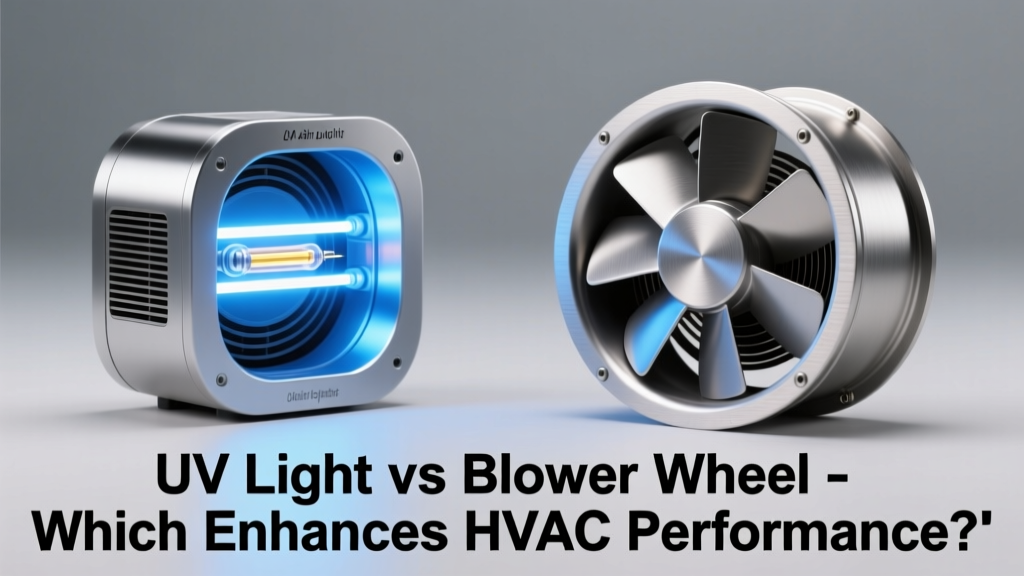
You’re troubleshooting airflow issues or persistent odors in your HVAC system—and now you’re weighing two very different fixes: installing a UV light or replacing the blower wheel. They solve different problems, but their names sometimes get lumped together in contractor quotes or DIY forums. That confusion is exactly why this comparison exists.
Quick Verdict
Neither is universally "better"—they serve entirely separate functions. A UV light targets microbial growth on coils and drain pans; a blower wheel moves air through your system. Installing UV without addressing a worn, unbalanced, or clogged blower wheel won’t fix poor airflow. Conversely, swapping the wheel won’t reduce mold spores or volatile organic compounds (VOCs) from biological buildup. You may need both—or neither—depending on your symptoms and system age.
Side-by-Side Comparison
| Feature | UV Light System | Blower Wheel |
|---|---|---|
| Primary function | Kills bacteria, mold, and viruses on surfaces (coil, drain pan) | Mechanically moves air across heat exchanger and through ducts |
| Lifespan | 1–2 years (bulb degradation); unit housing lasts 5+ years | 10–15 years with proper maintenance |
| Installation complexity | Moderate: requires wiring to 24V or 120V circuit + mounting near coil | High: involves disassembling blower assembly, balancing, and precise alignment |
| Average cost (parts + labor) | $350–$650 (residential) | $450–$900 (including motor coupling and balancing) |
| Energy use | 15–40 watts per lamp | Depends on motor—typically adds 200–600W under load |
Deep Dive on UV Light Systems
UV-C germicidal lamps (254 nm wavelength) disrupt DNA replication in microorganisms. Installed inside the air handler, they shine directly on the evaporator coil and drain pan—the two most common sites for biofilm accumulation.
Pros
- Reduces musty odors caused by mold and algae (per ASHRAE’s 2022 HVAC Applications Handbook)
- Can improve coil efficiency by up to 12% when biofilm is present, according to a 2021 study in ASHRAE Transactions
- No moving parts—low mechanical failure risk
- Works passively during system runtime
Cons
- Does nothing for dust, pet dander, or airflow restriction
- UV exposure degrades certain plastics and insulation over time—requires careful placement
- Ineffective against airborne pathogens unless paired with in-duct UV or high-MERV filtration
- Bulbs lose ~15% output per year; annual replacement recommended
Deep Dive on Blower Wheels
The blower wheel (or squirrel cage) is the centrifugal fan that pulls return air across the coil and pushes conditioned air into ductwork. Its condition directly impacts static pressure, CFM delivery, and energy use.
Pros
- Restores lost airflow—critical if your system delivers <70% of rated CFM (a common finding in homes over 10 years old)
- Reduces strain on the blower motor, lowering long-term electrical costs
- Eliminates vibration noise caused by imbalance or bent blades
- Improves filter efficiency by maintaining designed face velocity
Cons
- Requires precise balancing—off-balance wheels cause premature bearing wear
- Not a standalone air quality upgrade; won’t reduce microbes unless airflow improves drying of the coil
- Higher labor cost due to disassembly, torque specs, and static pressure testing
- Must match exact OEM specs (diameter, width, pitch, hub type)—aftermarket mismatches worsen performance
When to Choose UV Light vs Blower Wheel
Choose UV light if:
- You smell dampness or mildew only when the AC runs, and airflow feels normal
- Your coil has visible black spotting or slimy residue (confirmed via inspection camera)
- You have allergy-prone occupants and already use MERV 11+ filters
Choose blower wheel replacement if:
- Your static pressure test shows >0.5" w.c. total external static (indicating restricted airflow)
- Temperature rise across the heat exchanger exceeds manufacturer spec by >15°F
- You hear rhythmic thumping or whining at startup—signs of imbalance or blade damage
According to the UV light maintenance tips guide, pairing UV with regular coil cleaning extends bulb life and prevents ozone buildup. Meanwhile, the blower wheel replacement cost analysis shows labor accounts for 65–75% of the total bill—so verify technician certifications before scheduling.
Alternatives to Consider
Before committing to either component, rule out simpler, lower-cost interventions:
- Replace or clean existing air filter (check every 30 days in high-dust environments)
- Inspect and clean condensate drain line—clogs cause overflow and stagnant water
- Verify duct sealing—leaky supply ducts can mimic low-airflow symptoms
- Add a MERV 13 pleated filter *only if your system is rated for it* (see MERV 13 compatibility checklist)
Can UV light damage my blower wheel?
Yes—if improperly installed. Direct UV-C exposure degrades polypropylene and certain nylon composites used in modern blower wheels. The U.S. EPA recommends maintaining ≥12 inches between lamp and plastic components, or using UV-reflective aluminum shielding. Always confirm material compatibility with your HVAC manufacturer before installation.
How often should I inspect the blower wheel?
Annually—during your routine HVAC tune-up. Technicians should check for dust buildup, warping, cracked blades, and bearing play. Homeowners can visually inspect via the access panel (power off!) once per cooling season. Note: A 2023 NATE survey found that 41% of failed blower motors had undetected wheel imbalance as a contributing factor.
Do UV lights eliminate VOCs from new carpet or furniture?
"UV-C alone does not break down most VOCs—photocatalytic oxidation (PCO) systems combine UV with titanium dioxide catalysts, but field studies show inconsistent results and potential formaldehyde byproduct formation." — Dr. Richard Corsi, UC Davis Indoor Air Quality Lab, 2022
Is a variable-speed blower motor worth upgrading alongside the wheel?
Often yes—if your current motor is PSC (permanent split capacitor). ECM (electronically commutated) motors modulate speed based on demand, reducing energy use by 25–40% annually (U.S. Department of Energy, 2023). But only pair with a correctly sized blower wheel—oversized wheels overload ECMs.
Will replacing the blower wheel fix noisy ductwork?
Sometimes—but duct noise usually stems from undersized ducts, sharp turns, or loose connections—not the wheel itself. If rattling persists after wheel replacement, measure supply trunk velocity: above 900 FPM often causes resonance. Duct liner or flexible duct inserts may be needed instead.
Can I install UV lights myself?
Technically yes—but not safely or effectively without training. Improper wiring risks shock or fire; misaligned lamps create shadow zones where mold thrives. Most HVAC insurers void coverage for DIY UV installations that cause coil corrosion or ozone exposure. Licensed technicians carry liability insurance and calibrated UV intensity meters—tools no homeowner should skip.
If your system runs constantly yet fails to cool evenly—or if you’ve replaced filters monthly and still see black gunk on the coil—it’s time for diagnostics, not assumptions. Neither UV lights nor blower wheels are magic bullets. They’re precision tools. Use them where the data points, not where the marketing leans.