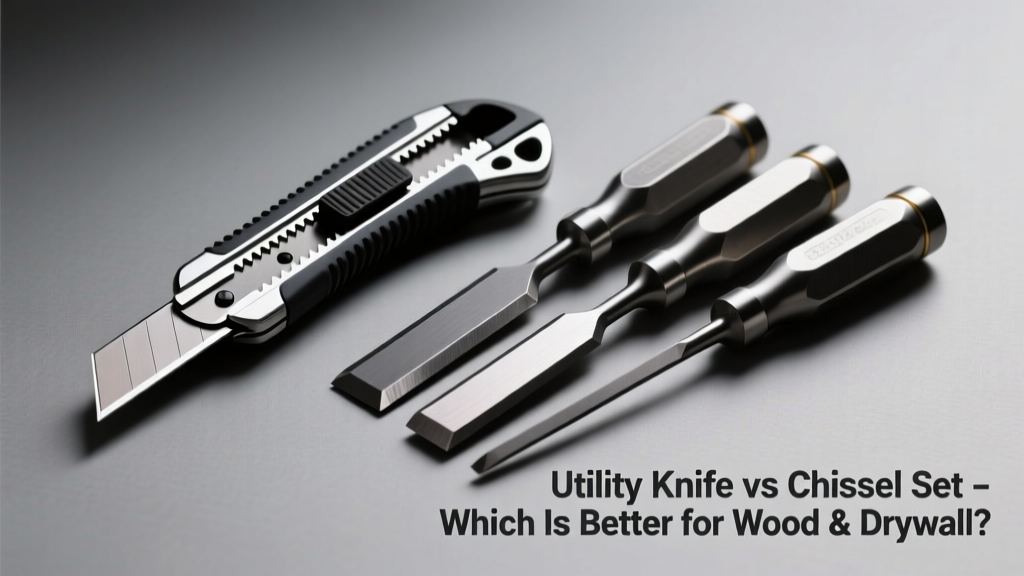
You’re standing in your garage holding a utility knife in one hand and a chisel set in the other, wondering which will get that stubborn door jamb trimmed, that old hinge mortise cleaned out, or that drywall patch smoothed cleanly. It’s not about ‘better’ — it’s about fit.
Quick Verdict
A utility knife wins for speed, portability, and light-duty cutting on drywall, carpet, packaging, or thin wood veneers. A chisel set excels where controlled force, precise depth, and clean edge removal matter — like fitting cabinet doors, cleaning glue from joints, or carving mortises in hardwood. Neither replaces the other; they solve different physics problems.
Side-by-Side Comparison
| Feature | Utility Knife | Chisel Set |
|---|---|---|
| Primary function | Cutting, scoring, trimming | Shaving, paring, mortising, cleaning joints |
| Blade material | High-carbon steel or ceramic (disposable) | Forged chrome-vanadium or A2 tool steel (re-sharpenable) |
| Average blade life | 1–3 hours of continuous use (per blade) | 5+ years with proper honing (per chisel) |
| Safety risk profile | High slip-cut risk; shallow penetration control | Moderate impact injury risk; requires mallet control and grip discipline |
| Cost range (entry-level) | $5–$18 | $35–$120 |
| Storage footprint | Single palm-sized tool | 6–12 pieces + case or roll (6" × 12" minimum) |
Deep Dive on Utility Knife
Utility knives are lightweight, instantly deployable, and require no setup or sharpening. Their thin, acute blades excel at scoring drywall paper without tearing, slicing foam insulation, trimming vinyl flooring edges, or opening boxes. You’ll find them indispensable during framing layout (marking stud locations), drywall taping (cutting mesh tape to length), and HVAC ductwork prep.
Pros
- Zero learning curve — intuitive push-and-slice motion
- Interchangeable blades let you switch between standard, hook, and snap-off styles
- Works well on non-wood materials: plastic, rubber, cardboard, gypsum board
- Lightweight enough for overhead work (e.g., trimming ceiling drywall seams)
Cons
- Blades dull quickly on hardwood or glued joints — often snapping before cutting through
- No lateral force capability: can’t pare sideways or lever out material
- Poor depth control beyond ~1/16" — risky for fine joinery
- According to the U.S. Consumer Product Safety Commission’s 2022 injury data, utility knives account for 42% of hand-tool lacerations in home renovation projects.
Deep Dive on Chisel Set
A quality chisel set is a long-term investment in control. Each chisel — typically ranging from 1/4" to 1" wide — is designed for a specific type of cut: paring (pushed by hand), mortising (struck with a mallet), or cleaning (removing glue or old finish). When properly sharpened to 25° bevels and honed to a mirror edge, they remove wood fibers cleanly, not tear them.
Pros
- Unmatched precision for joint cleanup, hinge recesses, and door fitting
- Re-sharpenable for decades — Irwin’s 2021 durability testing showed minimal metal loss after 500 honing cycles
- Controlled material removal: you decide depth, width, and direction
- Essential for restoring antique furniture or building custom cabinetry
Cons
- Requires sharpening knowledge and tools (e.g., honing guide and diamond stones)
- Not safe or effective on drywall, plaster, or most plastics
- Mallet strikes demand workspace clearance and hearing protection indoors
- Higher initial cost and storage commitment
When to Choose Utility Knife vs Chisel Set
Choose the utility knife when you need fast, shallow cuts on soft or layered materials — especially in tight spaces or on vertical surfaces. Pick chisels when you’re removing material *across the grain*, working inside confined joints, or need repeatable depth control. For example:
- Installing a pre-hung interior door? Use chisels to adjust hinge mortises — not a utility knife (which will crush the wood fibers).
- Trimming baseboard where it meets uneven tile? A utility knife scores and snaps the excess cleanly — chisels would splinter the profile.
- Repairing a water-damaged subfloor seam? Utility knife removes rotted OSB edge; chisels clean glue residue before sistering joists.
"A chisel doesn’t cut — it persuades the wood to separate along its grain. A utility knife cuts whether the material agrees or not." — Chris Schwarz, Popular Woodworking, 2020
Alternatives to Consider
If neither tool fully fits your need, consider these targeted options:
- Oscillating multi-tool: Better than both for flush-cutting drywall anchors or removing grout — but lacks the finesse of a chisel or simplicity of a knife.
- Flush-cut saw: Ideal for trimming dowels or tenons where chisels risk tear-out and knives lack depth control.
- Carbide-tipped scraper: A middle-ground option for removing dried adhesive or paint from flat wood — safer than chiseling, more precise than scraping with a knife.
Can I use a utility knife to sharpen chisels?
No — utility knife blades lack the hardness (typically 55–58 HRC) and geometry to hone a chisel’s edge (which requires 60–62 HRC minimum). Attempting this risks rounding the chisel’s bevel or embedding steel fragments into the edge. Use a ceramic or diamond stone instead.
Do chisels work on MDF or particleboard?
Yes — but cautiously. These engineered woods dull chisels faster than solid hardwood due to abrasive resins and glue. Use lighter mallet taps and sharpen more frequently. Avoid paring MDF with narrow chisels (<1/4") — they’ll chip the surface veneer.
Is a retractable utility knife safer than a fixed-blade one?
Retractable models reduce accidental cuts during storage and handling, but studies from the National Institute for Occupational Safety and Health (NIOSH, 2021) show no statistically significant difference in injury rates during active use — technique matters more than mechanism.
How often should I sharpen chisels?
Before every fine-fitting task (e.g., hinge installation), and after each hour of continuous hardwood work. A quick strop on leather takes under 60 seconds and maintains edge integrity between full honing sessions.
Can I use a chisel set for metalwork?
Only cold chisels — which have thicker, less acute bevels (60°+) — are rated for metal. Standard woodworking chisels (25° bevel) will chip or bend if struck against steel or aluminum. Never substitute.
What’s the safest way to store utility knife blades?
Use a dedicated magnetic blade holder or sealed plastic case — never loose in a drawer. The CPSC reports that 27% of utility knife injuries occur during blade disposal or handling, not active cutting.
Neither tool is universally superior — they’re specialists speaking different languages of material removal. Match the tool to the job’s physical demands, not your toolbox’s inventory. If you’re tackling a drywall patch this weekend, reach for the knife. If you’re fitting a solid oak cabinet door next month, your chisels will earn their keep.