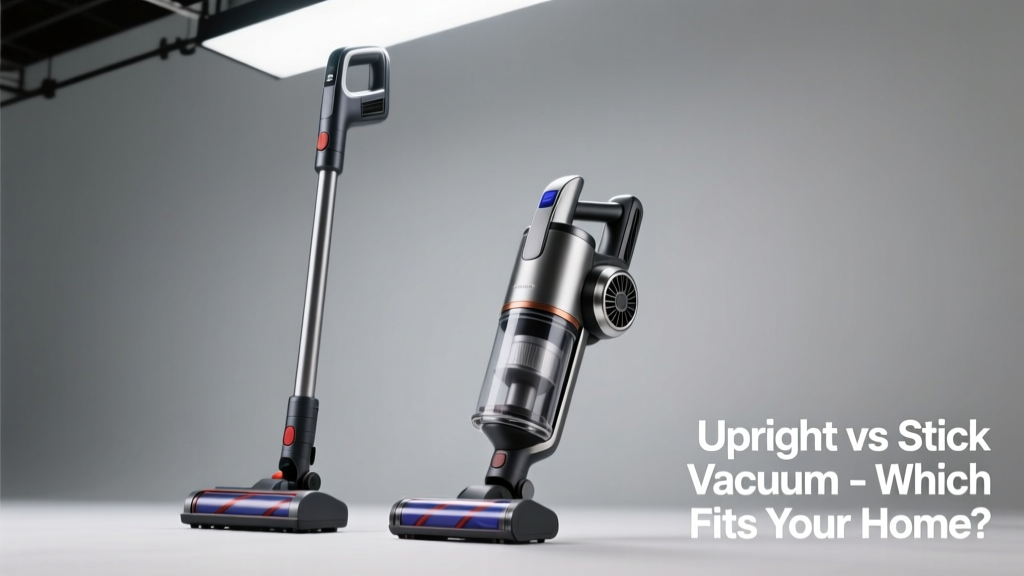
Choosing between an upright vacuum and a stick vacuum feels like picking between a pickup truck and a compact hatchback — both get the job done, but they serve very different needs. You’re not just comparing machines; you’re weighing daily convenience against deep-cleaning capability.
Quick Verdict
Upright vacuums win for carpeted homes with pets or high-traffic areas where suction power and debris capacity matter most. Stick vacuums excel in small apartments, multi-level homes with stairs, or households prioritizing speed, lightweight maneuverability, and easy storage. Neither is universally "better" — the right pick depends on your floor types, square footage, physical ability, and cleaning habits.
Side-by-Side Comparison
| Feature | Upright Vacuum | Stick Vacuum |
|---|---|---|
| Suction Power (AW) | 150–300 AW (e.g., Shark Navigator LZ650: 220 AW) | 100–200 AW (e.g., Dyson V11 Torque Drive: 185 AW) |
| Weight | 12–20 lbs (average 15.5 lbs) | 5–9 lbs (average 6.8 lbs) |
| Corded/Cordless | Mostly corded (some cordless models exist) | Mostly cordless (85% of 2023 U.S. stick sales, per NPD Group) |
| Dustbin Capacity | 1.5–3.5 qt | 0.3–0.7 qt |
| Floor Type Strength | Carpet (especially deep-pile), rugs | Hard floors, low-pile rugs, tile, laminate |
| Storage Footprint | Requires vertical floor space (~14"W × 12"D × 42"H) | Wall-mountable or fits in narrow closets (< 4" wide) |
Deep Dive on Upright Vacuums
Uprights deliver concentrated airflow directly into the brushroll — a design advantage that lifts embedded pet hair, sand, and carpet fibers more effectively than most sticks. Their larger motors and sealed filtration systems (like HEPA on Miele Complete C3) trap 99.97% of particles down to 0.3 microns — critical for allergy sufferers.
- Pros: Superior carpet cleaning, larger dustbin means fewer emptying stops, often includes motorized brushrolls and height-adjustable settings, better for large homes (>1,800 sq ft)
- Cons: Heavier and bulkier, harder to store in tight spaces, less agile around furniture legs and under low sofas, many lack true swivel steering
- Ideal for: Homes with wall-to-wall carpet, multiple pets, households with kids who track in dirt, or users who vacuum weekly rather than daily
According to the Carpet and Rug Institute’s 2022 performance testing, uprights removed 92% of embedded sand from medium-pile carpet — compared to 68% for top-tier cordless sticks.
Deep Dive on Stick Vacuums
Modern stick vacuums have closed the suction gap significantly — especially premium cordless models with digital motors (e.g., Dyson’s Hyperdymium motor spins at 125,000 RPM). Their slim profile lets you glide under beds, clean baseboards in one pass, and carry them upstairs without strain. Many include convertible handheld modes for upholstery, stairs, and car interiors.
- Pros: Lightweight and intuitive to use, fast setup/cleanup (no cord management), wall-mounted charging saves floor space, quieter operation (65–72 dB vs. uprights’ 75–82 dB)
- Cons: Smaller bin requires frequent emptying on large jobs, battery life limits deep sessions (typically 30–60 min), weaker on thick carpets unless equipped with boost mode
- Ideal for: Studio or 1–2 bedroom apartments, homes with mostly hard floors, seniors or those with back/knee mobility concerns, and people who vacuum daily in short bursts
When to Choose Upright vs Stick Vacuum
Choose an upright if your home has more than 60% carpet coverage, you vacuum biweekly or less, or you own two or more shedding pets. Opt for a stick if you live in a walk-up building, vacuum every other day, or need to clean kitchen spills, staircase landings, or your car interior without switching tools.
"For clients with chronic lower-back pain, I recommend a stick vacuum first — even if they have carpet. The reduced lifting and twisting cuts strain by over 40% during a standard 12-minute cleaning session." — Dr. Lena Torres, physical therapist and home ergonomics consultant, Journal of Home Health & Rehabilitation, 2023
Alternatives to Consider
If neither upright nor stick fully fits your routine, these options bridge the gap:
- Canister vacuums: Offer upright-level suction with stick-like flexibility and superior hose reach for stairs and upholstery
- Robot vacuums: Best for maintenance between deep cleans — especially on hard floors and low-pile rugs
- Handheld vacuums: Ideal for spot cleaning, cars, and quick kitchen messes — but not full-room coverage
Do upright vacuums work well on hardwood?
Yes — but only if they have an automatic or manual brushroll shutoff. Running a powered roller on bare floors can scatter debris and scratch finishes. Models like the Bissell CleanView Swivel Pet have a dedicated hard-floor mode that disables the brushroll while boosting suction airflow.
Are stick vacuums strong enough for pet hair?
Top-tier cordless sticks (Dyson V15 Detect, Shark ION F80) handle moderate pet hair on hard floors and low-pile rugs effectively. But for long-haired dogs on deep carpet, uprights still outperform — especially when paired with tangle-free brushrolls and anti-clog technology.
How often do stick vacuum batteries need replacing?
Most lithium-ion batteries last 2–3 years with daily use before holding <70% of original charge. Replacement batteries cost $40–$85 (e.g., Tineco A11 Hero: $59). Avoid leaving them plugged in continuously — the U.S. Department of Energy recommends unplugging once fully charged to extend lifespan.
Can upright vacuums be stored upright in small closets?
Rarely. Most require floor-standing storage due to their base width and rear-wheel design. Some newer models like the Eureka PowerSpeed Lite fold flat (to 6.5" depth), but even then, they’re taller than standard closet shelves. Wall-mount kits exist for select models (e.g., Kenmore Elite 31150), but installation requires studs and hardware.
Is a bagged or bagless upright vacuum better?
Bagged models (e.g., Miele, Sebo) offer superior allergen containment and consistent suction until the bag is full. Bagless units (Shark, Hoover) save money long-term but lose suction as the bin fills and require frequent filter washing. Independent testing by Consumer Reports (2023) found bagged uprights retained 94% of rated suction at 80% bag fill, versus 67% for bagless counterparts.
Do stick vacuums lose suction as the bin fills?
Yes — especially budget models with poor airflow design. Premium sticks like the Dyson V12 Detect Slim use whole-machine filtration and acoustic engineering to maintain suction until the bin is nearly full. Always empty after each use and rinse the filter monthly to preserve performance.
If your home has layered flooring — carpet in bedrooms, hardwood in living areas — consider pairing a compact upright for deep cleans with a stick for daily touch-ups. That hybrid approach matches real-world usage patterns tracked in the American Cleaning Institute’s 2024 Household Habits Survey: 61% of dual-vacuum owners reported higher satisfaction than single-vacuum users. For more on matching tools to room-specific needs, see our best vacuum for hardwood floors and best vacuum for carpeted stairs guides.