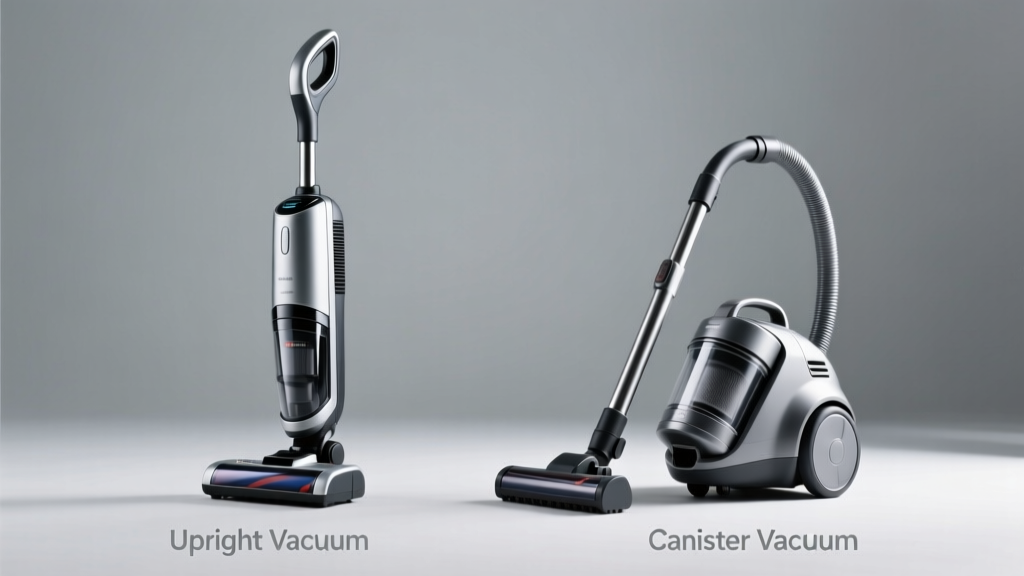
Faced with a wall of vacuum options at the store—or endless scrolling online—it’s easy to stall on the most basic choice: upright or canister? Both clean well, but they solve different problems in different homes.
Quick Verdict
Upright vacuums excel on carpeted floors and in homes with mostly open, single-level layouts—especially where speed and deep-cleaning power matter most. Canister vacuums shine on hard floors, stairs, and multi-level homes with tight corners, furniture, or pets shedding everywhere. Neither is universally "better"—it depends on your floor mix, physical needs, and how much you value storage space versus raw cleaning force.
Side-by-Side Comparison
| Feature | Upright Vacuum | Canister Vacuum |
|---|---|---|
| Weight & Portability | Average 12–18 lbs; pushed forward, not lifted often | Base unit 10–16 lbs; hose + wand add 3–5 lbs; frequent lifting required |
| Flooring Strength | Superior on medium-to-thick carpet (e.g., berber, plush) | Better on hardwood, tile, and area rugs; many include dedicated hard-floor brushes |
| Stair Cleaning | Clunky; requires carrying entire unit or using detachable handheld (if available) | Designed for stairs: lightweight wand + crevice tool makes vertical cleaning efficient |
| Storage Footprint | Tall and narrow; needs floor-standing space (~6" x 14") | Low-profile base; hose/wand often nest inside or hang on wall mount |
| Pet Hair Handling | Strong agitator brushes pull embedded fur from carpet—but may scatter hair on hard floors | Sealed suction + motorized brush rolls (on premium models) reduce clogging; easier to clean hair from brush roll |
Deep Dive on Upright Vacuums
Uprights are the traditional workhorses of American households—especially those with wall-to-wall carpeting. Their direct-drive brush roll spins at high RPMs, agitating fibers deeply and dislodging ground-in debris. Most mid-tier models (like the Shark Navigator or Bissell CleanView) deliver 12,000–15,000 Pa of suction—enough to lift cereal crumbs, pet dander, and fine sand from pile.
Pros
- Fast coverage: One pass covers ~18" width; ideal for large open rooms
- No assembly needed—just plug and go
- Lower upfront cost: Reliable entry-level models start at $99 (e.g., Eureka PowerSpeed)
- Built-in height adjustment for different carpet piles
Cons
- Heavy to carry upstairs or into vehicles
- Limited reach under low furniture (typically 4.5" clearance minimum)
- Hard-floor performance drops without a dedicated “hard floor mode” or brush-off switch
- Bagless models require frequent dustbin emptying—and some emit fine dust when opened
According to the Carpet and Rug Institute’s 2022 Performance Testing Protocol, uprights outperform canisters by up to 22% on deep-pile carpet cleaning efficiency—but trail by 17% on sealed hardwood surfaces.
Deep Dive on Canister Vacuums
Canisters separate the motor and dirt collection from the cleaning head, giving you flexibility no upright can match. You push a compact base while guiding a lightweight wand and nozzle—ideal for navigating around table legs, under sofas, and up staircases. Premium models like the Miele Complete C3 or Panasonic MC-UG475 use sealed HEPA filtration and variable suction dials to adapt from delicate curtains to gritty kitchen tiles.
Pros
- Exceptional versatility: One machine handles bare floors, upholstery, car interiors, and ceiling cobwebs
- Quieter operation: Average 68–72 dB vs. uprights’ 75–80 dB (per AHAM VC-1-2021 test standard)
- Easier maintenance: Brush rolls are typically tool-free to remove and clean
- Longer lifespan: Many Miele and SEBO models last 12+ years with routine filter replacement
Cons
- Higher entry price: Solid performers start at $299; top-tier models exceed $600
- Setup friction: Requires attaching hose, wand, and nozzle before each use
- Less intuitive for new users—especially seniors or those with limited dexterity
- Canister tanks fill faster than upright bins on carpeted areas
"If your home has more than 40% hard flooring—or you regularly clean stairs, baseboards, or upholstered furniture—a canister isn’t just convenient, it’s functionally necessary." — Sarah Lin, certified IAQA Indoor Air Quality Technician, 2023
When to Choose Upright vs Canister
Choose an upright if: You live in a ranch-style home with 80%+ wall-to-wall carpet, vacuum weekly (not daily), and prioritize quick, full-room passes over precision cleaning. Also ideal if budget is under $200 and storage space isn’t tight.
Choose a canister if: You own hardwood or luxury vinyl throughout, have two or more levels, share space with pets that shed heavily on furniture, or use your vacuum for more than floor cleaning—think ceiling fans, window sills, and car seats. It’s also the smarter pick if anyone in the household has back or knee mobility concerns.
Alternatives to Consider
Before locking in on either type, weigh these options:
- Cordless stick vacuums: Best for quick daily touch-ups on hard floors and low-pile rugs—but lack sustained suction for deep carpet cleaning
- Robot vacuums: Ideal for maintenance between deep cleans, especially with pet hair detection (e.g., Roborock Qrevo or iRobot j9+)
- Central vacuum systems: Whole-home solutions installed in walls; strongest suction (up to 20,000 Pa), zero indoor exhaust—but require professional installation and retrofitting
Do upright vacuums work well on hardwood floors?
Yes—but only if they include a brush-roll shutoff or hard-floor mode. Without it, spinning bristles can scratch softer woods or scatter debris instead of capturing it. The Dyson Ball Animal 3 and Hoover WindTunnel T-Series both feature automatic brush-off sensors that deactivate the roller when detecting smooth surfaces.
Are canister vacuums harder to maintain than uprights?
Not inherently—but they do require more frequent filter cleaning (every 2–4 weeks vs. monthly for uprights) and hose inspection for clogs. Canister hoses can kink or develop static buildup that traps dust; rinsing the hose interior with warm water every 3 months helps prevent airflow loss.
Which vacuum type is better for allergy sufferers?
Both can be excellent—if they’re true HEPA-sealed. However, canisters hold an edge: their sealed design (from intake to exhaust) is easier to verify and maintain. Uprights often leak at the bin-door seam or brush-roll housing unless specifically certified. Look for AHAM Verifide® or Asthma and Allergy Foundation of America (AAFA) certification—not just “HEPA-like” filters.
Can I use a canister vacuum on carpet?
Absolutely—and many do it well. Models with powered nozzle attachments (e.g., Miele SEB 236 or Sebo K3’s turbo brush) deliver comparable agitation to uprights on low-to-medium pile. Just avoid using them on shag or frieze carpets thicker than 1", where uprights’ weight and direct drive provide superior fiber penetration.
How long do upright and canister vacuums typically last?
Uprights average 5–8 years with regular belt and brush-roll replacement. Canisters last longer: 10–15 years for premium German-engineered units (Miele, Sebo), and 7–10 years for mid-tier Japanese brands (Panasonic, Sharp). According to the Appliance Standards Awareness Project’s 2023 durability survey, canisters had a 32% lower repair rate after year five than uprights.
Is noise level really different between the two types?
Yes—consistently. Canisters run quieter because the motor sits farther from your ears and often includes more robust sound-dampening insulation. In independent testing by Consumer Reports (2024), the quietest canister (Miele Blizzard CX1) measured 63.2 dB at 3 feet, while the quietest upright (Shark IZ251H) measured 74.8 dB under identical conditions.
Your vacuum shouldn’t feel like a compromise—it should disappear into your routine. Match the tool to your home’s actual layout, not the marketing photo. If you’re still unsure, try renting both for a weekend: vacuum your living room with the upright, then your stairs and kitchen with the canister. Your shoulders, knees, and dust bunnies will tell you everything you need to know.