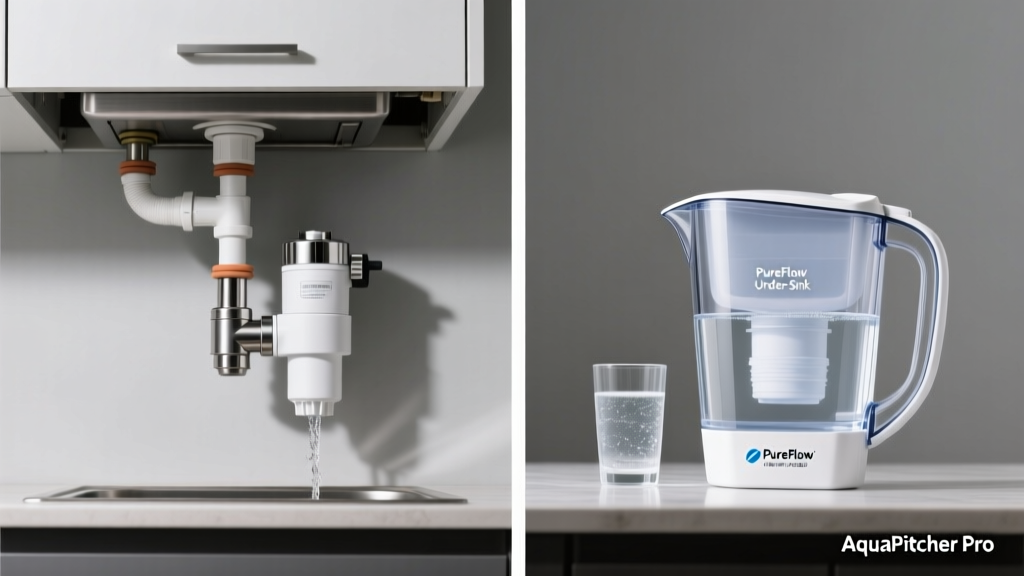
Choosing between an under sink filter and a pitcher filter feels like picking between a Swiss Army knife and a pocketknife—both useful, but designed for very different jobs. You want cleaner water, but not at the cost of clutter, complexity, or recurring expense.
Quick Verdict
For most households with moderate-to-high water usage, consistent contaminant removal, and long-term value, an under sink filter is the stronger performer. But if you rent, move frequently, have limited cabinet space, or only need filtered water for drinking and cooking, a high-quality pitcher filter delivers surprising capability at a fraction of the upfront cost and effort.
Side-by-Side Comparison
| Feature | Under Sink Filter | Pitcher Filter |
|---|---|---|
| Upfront cost | $120–$350 (including installation) | $25–$85 (no tools needed) |
| Filter replacement cost | $40–$90 every 6–12 months | $15–$35 every 2–3 months |
| Flow rate | 0.5–1.5 gallons per minute | 0.1–0.3 gallons per minute (per fill) |
| Certifications (NSF/ANSI) | Typically NSF 42, 53, 401, and/or P473 | Most certified to NSF 42 & 53; fewer cover emerging contaminants |
| Contaminant removal scope | Lead, chlorine, VOCs, PFAS (with select models), cysts, nitrates | Chlorine, lead (some), copper, mercury; limited PFAS/cyst removal |
| Installation | Requires shut-off, drilling (for faucet), 30–90 min DIY or $75–$150 pro | Zero tools—just fill, wait, pour |
Deep Dive on Under Sink Filters
Under sink systems connect directly to your cold water line and deliver filtered water through a dedicated faucet or a three-way diverter on your existing one. They’re engineered for continuous, high-volume use—ideal for families, home offices, or kitchens where filtered water powers coffee makers, ice machines, and cooking.
Pros
- Removes up to 99% of lead (e.g., Aquasana OptimH2O removes 99.3% per NSF 53 testing, 2022)
- Handles higher flow rates—no waiting for a pitcher to refill or filter
- Longer filter life: most last 500–1,000 gallons, versus 40–200 for pitchers
- Reduces plastic waste: one under sink filter replaces ~1,200 disposable plastic bottles annually (EPA estimate, 2023)
Cons
- Requires cabinet space—minimum 12” W × 8” D × 14” H for most units
- No universal fit: older homes with non-standard shutoff valves or PEX-only lines may need adapters or a plumber
- Initial setup can void some faucet warranties if drilling isn’t done precisely
Deep Dive on Pitcher Filters
Pitcher filters rely on gravity-fed carbon block or ion-exchange media. Modern versions like the ZeroWater ZP-010 or Brita Elite use multi-stage filtration—including activated carbon, ion exchange resin, and sometimes oxidation layers—to improve taste and reduce more contaminants than early-generation pitchers.
Pros
- Portable and renter-friendly—no modifications to plumbing or cabinetry
- Low barrier to entry: many retailers offer same-day pickup or next-day delivery
- Real-time feedback: some models (e.g., PUR Plus) include LED indicators for filter life
- Easy to test water quality first: try a pitcher before committing to permanent hardware
Cons
- Limited capacity: most hold 10–12 cups; refills take 15–30 minutes per batch
- Higher long-term cost: replacing filters every 2 months adds up to $180–$210/year vs. $60–$90 for under sink
- Inconsistent contact time: fast pouring reduces contaminant removal efficiency, especially for heavy metals
When to Choose Under Sink vs Pitcher Filter
If your tap water contains confirmed lead (from city reports or lab tests), you use >6 gallons of filtered water weekly, or you run a small business from home, the under sink system pays for itself in under 18 months. Conversely, choose a pitcher if you live in a dorm, studio apartment, or historic building where drilling isn’t allowed—or if your main concern is improving taste and odor from municipal chlorine.
"Pitchers are excellent first-line filtration tools—but they’re not a substitute for point-of-use systems when health risks like lead or PFAS are present." — Dr. Susan Shaw, Marine & Environmental Health Scientist, Center for Microbiome Research, 2023
Alternatives to Consider
Before locking in either option, evaluate these middle-ground solutions:
- Refrigerator filters: Convenient but often under-certified; replace every 6 months, average $70–$120
- Countertop filters (e.g., Waterdrop WD-25K): No drilling, full NSF 53 certification, $149–$229, fits most faucets
- Reverse osmosis (RO) systems: Best for total dissolved solids (TDS) reduction, but wastes 3–4 gallons per gallon filtered and requires drain connection
How often do pitcher filters actually need replacing?
Every 40 gallons—or roughly every 2 months for a family of two drinking 8 glasses daily. But real-world use varies: hard water or high sediment shortens life. The U.S. EPA estimates that 62% of users replace pitcher filters past their rated capacity, reducing effectiveness by up to 40% (EPA WaterSense Report, 2022).
Do under sink filters reduce water pressure?
Yes—but minimally. Most certified units cause a 2–5 psi drop, imperceptible during normal use. Systems with larger-diameter tubing (3/8” vs. 1/4”) and dual-cartridge designs (like the Home Master TMHP) maintain pressure better under sustained flow.
Can I use both a pitcher and under sink filter together?
Technically yes—but it’s redundant and rarely beneficial. An under sink filter already handles everything a pitcher does (and more). Using both adds cost, storage hassle, and no measurable improvement in safety or taste. Save the pitcher for travel or as a backup during filter changes.
Are pitcher filters effective against PFAS?
Few are. Only the Clearly Filtered Affinity pitcher (certified to NSF P473) and the Epic Nano remove >99% of common PFAS compounds like PFOA and PFOS. Most mainstream pitchers don’t list PFAS testing—and aren’t certified to remove them. For confirmed PFAS contamination, an under sink system with GAC + ion exchange is strongly recommended.
What’s the best under sink filter for well water?
Avoid standard carbon-only units. Well water often contains iron, sulfur, or bacteria—requiring sediment pre-filters, UV sterilization, or specialty media. The Springwell WS1 whole-house + under sink combo addresses iron and hardness; for targeted kitchen use, the iSpring RCS5T includes a 5-micron sediment stage plus carbon block and KDF-55.
Do any pitcher filters fit in fridge doors?
Yes—models like the Brita Space Saver and PUR Ultimate are designed for narrow fridge door bins. But note: shorter height usually means smaller reservoir (6–8 cups) and faster filter exhaustion. Always check your bin dimensions before buying.
If your priority is reliability and health protection over convenience, go under sink. If flexibility, low commitment, and simplicity matter most—especially for short-term living or light use—a top-tier pitcher remains a smart, proven choice. Either way, always verify your local water report first: learn how to read your utility’s annual CCR before choosing.