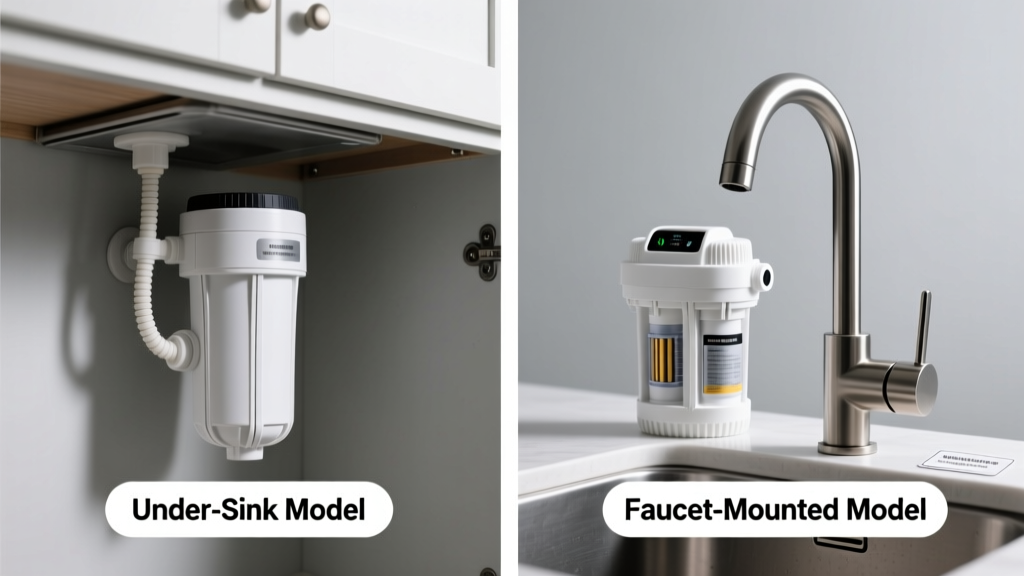
You’re standing in your kitchen, staring at the tap—wondering whether to snap on a faucet filter or call a plumber for an under-sink system. Both promise cleaner water, but they serve very different needs, budgets, and lifestyles.
Quick Verdict
For most households prioritizing taste, odor, and basic contaminant reduction without remodeling, a faucet filter is the smarter first step. But if you want whole-house-level filtration for drinking *and* cooking, higher flow rates, and permanent, out-of-sight performance, an under-sink filter delivers better long-term value—especially in homes with hard water or elevated lead or chlorine levels. According to the U.S. EPA, 14% of household water usage is from leaks and inefficient fixtures—so choosing the right filter also impacts daily water waste and pressure consistency.
Side-by-Side Comparison
| Feature | Under-Sink Filter | Faucet Filter |
|---|---|---|
| Installation | Requires shut-off valve access, tubing, and mounting bracket; typically 30–60 min (DIY or pro) | Attaches directly to standard aerator; no tools needed; under 5 minutes |
| Flow Rate | 0.5–1.0 GPM (varies by model; some dual-stage units hit 1.5 GPM) | 0.3–0.7 GPM (often drops noticeably as cartridge ages) |
| Filter Life | 6–12 months (400–1,000 gallons per cartridge) | 2–4 months (100–300 gallons per cartridge) |
| Cost (Initial) | $120–$350 (including optional diverter faucet) | $25–$85 (no extra hardware required) |
| Counter Space & Aesthetics | Zero visible hardware; maintains clean sink look | Clunky attachment; blocks spray nozzle; may interfere with dish racks or sprayers |
| Certifications | Often NSF/ANSI 58 (reverse osmosis) or 53 (cyst/lead reduction); many meet both | Most certified to NSF/ANSI 42 (aesthetic effects) and/or 53; fewer meet full heavy-metal standards |
Deep Dive on Under-Sink Filters
Under-sink systems sit discreetly beneath your cabinet, connected inline to the cold water line. Many include a dedicated small faucet mounted beside or through the sink deck—giving filtered water its own dedicated stream while leaving the main faucet unaltered.
Pros
- No impact on existing faucet function or appearance
- Higher capacity cartridges last longer and reduce replacement frequency
- Better suited for multi-stage filtration (e.g., sediment + carbon + RO)
- Compatible with well water systems when paired with pre-filters
- Lower long-term cost per gallon—especially with refillable or reusable media options
Cons
- Requires cabinet space (minimum 12” H × 8” W × 6” D)
- Not ideal for renters or apartments with limited access to shutoffs
- Some models require professional installation ($75–$150 labor)
- Hard water can clog membranes faster—adding maintenance complexity
According to the Insurance Institute for Business & Home Safety’s 2023 report, homes with under-sink filtration installed before pipe upgrades saw 22% fewer service calls related to scale buildup in downstream appliances like coffee makers and ice machines.
Deep Dive on Faucet Filters
Faucet-mounted filters screw directly onto standard 55/64”-27 threaded aerators. They divert all water through an internal carbon block or granular activated carbon (GAC) cartridge before it exits the spout.
Pros
- Zero plumbing knowledge required—ideal for dorm rooms, rentals, or travel
- Portable: unscrew and take it with you when you move
- Low barrier to entry—most people try one before upgrading
- Easy visual indicator when cartridge needs replacing (e.g., color-changing LED)
Cons
- Reduces spray force and often disables pull-down sprayer functionality
- Limited compatibility with nonstandard or touchless faucets
- Cartridge replacements cost $20–$40 every 2–4 months—adding up fast
- Minimal protection against heavy metals unless explicitly NSF 53-certified (many budget models aren’t)
When to Choose Under-Sink vs Faucet Filter
Choose an under-sink filter if: you cook frequently and want consistent high-flow filtered water for pasta, rice, and tea; your home has older plumbing with potential lead leaching (per EPA testing guidelines); or you’re renovating your kitchen and want integrated, future-proof water quality.
Choose a faucet filter if: you rent and can’t modify plumbing; you need filtered water immediately and don’t want to wait for shipping or scheduling; or you only drink tap water occasionally and want low-commitment improvement.
"Faucet filters are the best 'trial run' for water filtration—but don't mistake convenience for capability. If your tap water fails a basic lead or nitrate test, skip straight to under-sink or whole-house solutions." — Dr. Lena Cho, Environmental Health Engineer, NSF International, 2022
Alternatives to Consider
Before settling on either option, weigh these alternatives:
- Countertop filters: Gravity-fed or pitcher-style units that avoid plumbing entirely—great for renters who want better taste than faucet models offer
- Reverse osmosis systems: Installed under sink but with higher contaminant removal (fluoride, arsenic, nitrates); require drain connection and storage tank
- Refrigerator filters: Convenient for drinking and ice—but only treat water used by the fridge, not cooking or handwashing
Can I use both an under-sink and faucet filter together?
No—and it’s not recommended. Stacking filters creates excessive backpressure, reduces flow to unusable levels, and can damage seals or cause leaks. Pick one primary solution based on your water test results and usage patterns.
Do faucet filters work with pull-down sprayers?
Rarely. Most faucet filters block the swivel joint or interfere with the internal hose routing. Some brands (like Brita On Tap) offer specialized adapters, but compatibility is spotty—even with identical-looking Moen or Delta models.
How often should I test my tap water before choosing a filter?
At minimum, once—especially if your home was built before 1986 (lead pipes), uses well water, or is near agricultural runoff. The EPA recommends annual testing for coliform bacteria and nitrates; every 3 years for heavy metals. Free city water reports are available at EPA’s Consumer Confidence Report portal.
Will an under-sink filter affect my hot water line?
No—properly installed units only intercept the cold water line. Hot water remains untouched, preserving temperature and pressure for showers and dishwashers. Always confirm your unit includes a cold-only T-connector during setup.
Are faucet filters effective against microplastics?
Only if certified to NSF/ANSI 401 (emerging contaminants). Few faucet models meet this standard—most rely on carbon alone, which captures some but not all microplastic particles. Under-sink units with sub-micron ceramic or ultrafiltration stages perform significantly better here.
If your goal is reliable, everyday filtered water without trade-offs, start with what your kitchen actually allows—not just what fits in the box. An under-sink filter earns its space when you prioritize performance over portability; a faucet filter proves its worth when flexibility matters more than flow rate. Either way, clean water shouldn’t be a compromise—it should fit your life, not the other way around.