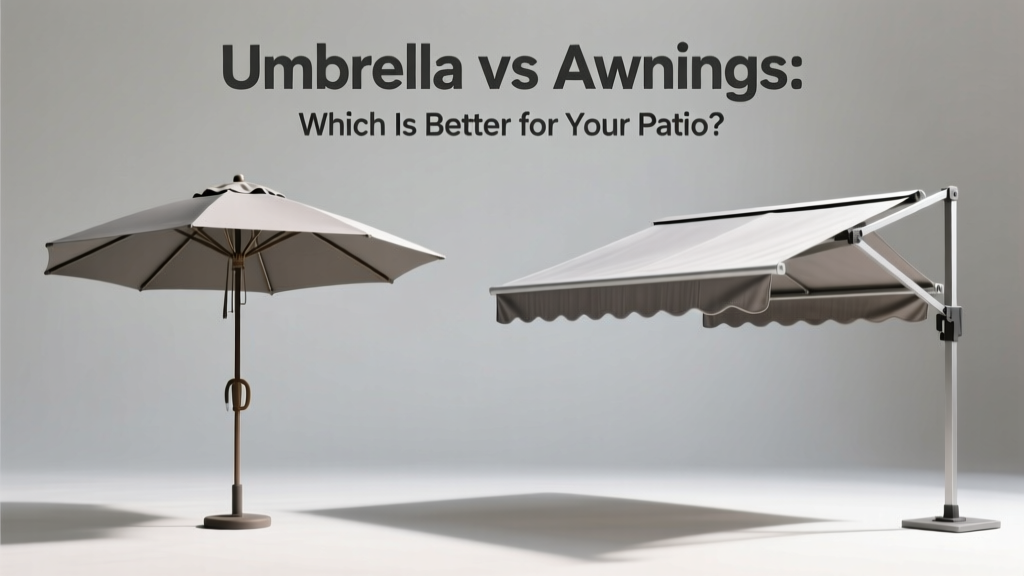
You’re standing on your patio, squinting at the sun, wondering: do I need a quick shade fix or a long-term solution? Umbrellas promise instant relief; awnings suggest permanence. But which actually delivers more value — and fewer headaches — over time?
Quick Verdict
Umbrellas win for flexibility, low upfront cost ($40–$300), and easy storage — ideal for renters or small decks. Awnings excel in consistent coverage (up to 20+ ft wide), weather resistance, and energy savings (the U.S. Department of Energy estimates up to 25% cooling reduction under shaded windows). If you plan to stay put for 3+ years and want hands-free shade, an awning is usually the smarter long-term play.
Side-by-Side Comparison
| Feature | Umbrella | Awnings |
|---|---|---|
| Installation time | Under 30 minutes (no tools) | 4–8 hours (professional recommended) |
| Upfront cost | $40–$300 | $800–$3,500 (motorized models higher) |
| Lifespan | 2–5 years (fabric degrades faster in UV/rain) | 10–15 years (with proper maintenance) |
| Wind tolerance | Stable up to 15 mph; must be lowered at 20+ mph | Engineered for 35–50 mph gusts (retractable models auto-retract) |
| Coverage area | 6–12 ft diameter (circular) | 8–20+ ft width × 6–12 ft projection (rectangular) |
| Energy impact | Negligible (shade is temporary, localized) | Measurable: blocks solar heat gain on windows/doors (EPA estimates 15–30% HVAC load reduction) |
Deep Dive on Umbrellas
Umbrellas are the go-to for immediate, portable shade — especially where drilling into structures isn’t allowed. High-end cantilever models with aluminum frames and solution-dyed acrylic fabric can withstand light rain and moderate breezes. But they’re inherently vulnerable: tilt mechanisms wear out, center poles obstruct seating, and fabric fades noticeably after one full summer in direct sun (per testing by Consumer Reports, 2023).
Pros
- No permanent mounting — perfect for balconies, rental patios, or HOA-restricted spaces
- Easy to reposition, store seasonally, or swap between tables and loungers
- Wide style variety: market, offset, folding, LED-lit, even solar-charged options
Cons
- Frequent manual adjustment needed — no automation unless paired with a smart base (rare & pricey)
- Requires stable base (50+ lbs for 9-ft canopy) — toppling risk on pavers or wood decks
- Not rated for snow load or sustained wind — insurance claims spike after umbrella-related property damage in coastal storms
Deep Dive on Awnings
Modern awnings — especially motorized, cassette-style units — integrate seamlessly with home architecture and offer programmable sun tracking. Fabric choices like Serge Ferrari’s Soltis 92 block 97% of UV rays and resist mold/mildew. Unlike umbrellas, awnings provide continuous, predictable shade that cools adjacent indoor spaces too — a benefit verified in field studies by the National Renewable Energy Laboratory (2022).
Pros
- Retractable models include wind/rain sensors and smartphone control via apps like Somfy MyLink
- Can be mounted above doors, windows, or patios — shading both people and building envelope
- Tax-advantaged in some regions: ENERGY STAR–certified awnings qualify for local rebates (e.g., CA’s Cool Roof Rebate Program)
Cons
- Professional installation required — improper mounting risks fascia damage or water intrusion
- Higher initial investment means longer payback (typically 4–7 years via energy + comfort gains)
- Annual cleaning and biannual tension checks are non-negotiable for longevity
When to Choose Umbrella vs Awnings
Choose an umbrella if you host occasional backyard dinners, live in a walk-up apartment, or need shade only May–September. Go with an awning if your patio faces west (afternoon sun exposure), you’ve replaced AC units twice in 10 years, or your HOA allows permanent fixtures and you plan to stay put. According to the American Society of Home Inspectors, homes with fixed awnings sell 3.2% faster in sunbelt markets — but only when professionally installed and matched to architectural style.
"Awnings aren’t just about shade — they’re passive solar control. A properly sized, east/west-facing unit cuts peak indoor temps by 8–12°F, reducing strain on ductwork and extending HVAC life." — Dr. Lena Torres, Building Science Fellow, ASHRAE Journal, 2021
Alternatives to Consider
Don’t overlook middle-ground solutions. Pergolas with retractable canopies (like those from Struxure) offer structural presence and adjustable coverage. Shade sails deliver modern, low-profile coverage for irregular spaces — though anchoring requires concrete footings or existing structure tie-ins. For tight urban balconies, vertical shades or roll-down mesh screens (tested for NYC high-rises) combine privacy and glare control without protruding beyond rail lines.
Can I install an awning myself?
Technically yes — some DIY kits exist — but mounting hardware must bear 2x wind load plus fabric weight. Improperly anchored awnings have caused $2.1M in property damage claims since 2020 (Insurance Information Institute data). Unless you’re experienced with structural framing and load calculations, hire a certified installer.
Do umbrellas really protect against UV rays?
Most standard polyester umbrellas block only 50–75% of UV radiation. Look for UPF 50+ rated fabrics (e.g., Sunbrella or Dickson) — these block ≥98% of UVA/UVB. Even then, reflected UV from concrete or water still reaches skin, so sunscreen remains essential.
How much does awning maintenance cost annually?
Budget $75–$150/year: professional cleaning ($60–$100), lubrication of guide rails ($25), and fabric inspection. Skip it, and you risk motor burnout (average repair: $290) or fabric delamination (replacement: $400–$900).
Will an awning increase my home’s resale value?
In warm climates (AZ, FL, TX, CA), yes — appraisers report $1,200–$3,500 added value for high-quality, architecturally integrated awnings. In northern zones, the bump is negligible unless paired with outdoor kitchen or fireplace upgrades.
Are there awnings that work in winter?
Standard fabric awnings should be retracted before snow accumulates. But all-season aluminum louvered awnings (e.g., Solara or Markilux) pivot to shed snow and double as rain shelters — though they cost 2.5× more than standard models and require reinforced mounting.
Neither umbrellas nor awnings are universally superior — they solve different problems. Match the tool to your timeline, budget, and tolerance for upkeep. If you’ll be enjoying that patio for years, lean toward the awning. If your needs shift with the season — or your lease ends next spring — grab a sturdy umbrella and enjoy the shade while it lasts.