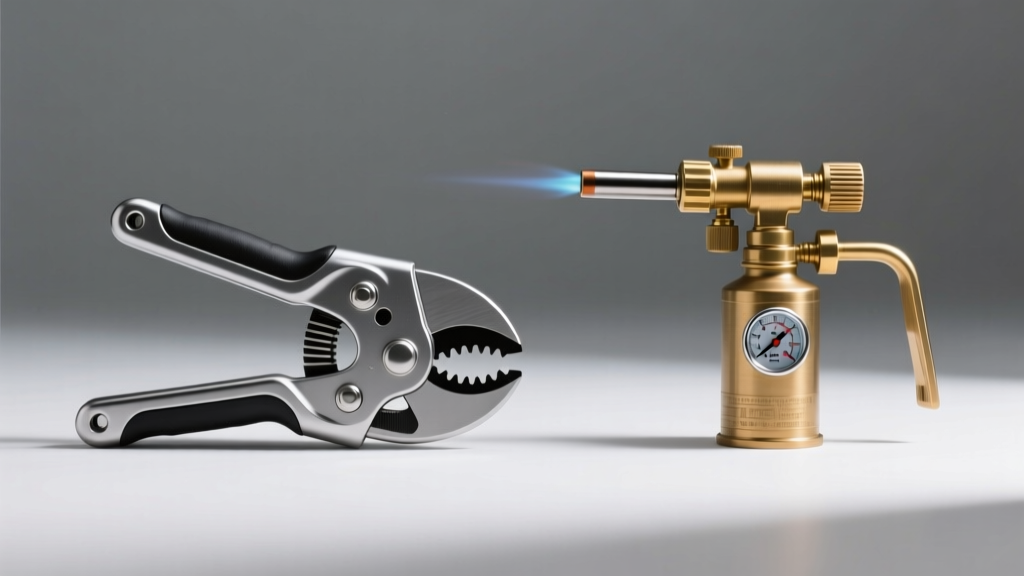
You’re standing in front of a bundle of ½-inch copper tubing, a fitting in one hand, and two very different tools on the bench: a ratcheting tubing cutter and a propane torch. One promises clean, cold cuts; the other, fast, heat-assisted soldering prep. But which actually gets the job done right — without leaks, rework, or singed eyebrows?
Quick Verdict
A tubing cutter is safer, more precise, and ideal for cutting and deburring copper pipe before soldering — especially in tight spaces or for beginners. A propane torch excels at heating joints for soldering and bending soft copper, but it’s not a cutting tool. They serve fundamentally different jobs: one cuts, the other heats. Using a torch to ‘cut’ copper isn’t safe or effective — and doing so risks fire, oxidation, and compromised tube integrity.
Side-by-Side Comparison
| Feature | Tubing Cutter | Propane Torch |
|---|---|---|
| Primary function | Cutting and deburring copper, aluminum, or thin-walled steel tubing | Heating joints for soldering, brazing, or annealing; bending soft copper |
| Typical time per ½" cut | 15–25 seconds (including deburring) | Not applicable — torch does not cut |
| Safety risk level | Low (no open flame, minimal pinch hazard) | High (open flame, CO risk, flash burns, fire hazard near combustibles) |
| Required skill level | Beginner-friendly; minimal training needed | Moderate to advanced; requires flame control, flux application, and joint prep knowledge |
| Cost range (new) | $12–$45 (e.g., Ridgid 107 or Wheeler-Rex 40000) | $25–$85 (e.g., BernzOmatic TS8000 or Worthington LP-10) |
Deep Dive on Tubing Cutter
Tubing cutters use a hardened-steel rotating wheel to score and gradually sever tubing with a ratcheting or adjustable screw mechanism. They leave a clean, square, burr-free edge when used correctly — critical for leak-free solder joints. Most models include an integrated deburring blade, eliminating the need for separate tools.
Pros
- Produces dimensionally accurate, square cuts — essential for proper fitting alignment
- No heat-affected zone; preserves copper’s temper and internal diameter integrity
- Works indoors, in confined spaces (e.g., under sinks or inside wall cavities), and near flammables
- Minimal cleanup: no flux residue, no oxide scale, no ventilation required
Cons
- Cannot cut thick-walled Type L or K copper without excessive effort or wheel wear
- Struggles with heavily corroded or ovalized tubing
- Requires periodic wheel replacement ($3–$8 per wheel)
According to the Copper Development Association’s Guide to Copper Tube Installation (2022), “Mechanical cutting methods are preferred for field installation because they avoid thermal distortion and ensure consistent joint geometry.”
Deep Dive on Propane Torch
A propane torch delivers a focused, adjustable flame (up to ~3,600°F) to heat copper rapidly. It’s indispensable for sweat-soldering joints — melting solder into capillary gaps — and for annealing copper to make it malleable for bending. But it doesn’t cut tubing. Attempting to ‘melt through’ copper invites dangerous spatter, uneven bevels, and carbon buildup that blocks solder flow.
Pros
- Enables strong, code-compliant soldered joints when paired with proper flux and technique
- Allows controlled bending of soft-drawn copper (Type M or DWV) without kinking
- Portable, refillable, and widely available at hardware stores
Cons
- Creates oxide scale on heated surfaces — must be cleaned with emery cloth before soldering
- Requires fire safety prep: non-combustible surface, flame guard, working clearance (minimum 36" from walls/ceilings per NFPA 51B-2023)
- Overheating causes flux burn-off and solder balling — leading to cold joints and leaks
When to Choose Tubing Cutter vs Propane Torch
Choose a tubing cutter when you need to:
- Make multiple precise cuts during rough-in plumbing (e.g., installing 12 sink supply lines)
- Work in occupied homes where open flame is prohibited or impractical
- Prepare tubing for compression or push-fit fittings (which require smooth, burr-free ends)
Choose a propane torch when you need to:
- Solder copper joints in new construction or major repairs
- Repair a leaking joint by reheating and reflowing solder
- Shape copper for custom HVAC or refrigeration line sets
Alternatives to Consider
If your work involves both cutting and joining, consider pairing tools — not choosing one over the other. A tubing cutter handles prep; a torch handles assembly. For specialized needs, look at:
- Copper tube saws: For irregular angles or large-diameter cuts where rotary cutters slip
- Solderless compression fittings: Eliminate torch use entirely for DIY repairs
- Dedicated deburring tools: Improve finish on cut ends for high-pressure systems
Can I use a propane torch to cut copper tubing?
No — and it’s strongly discouraged. The U.S. EPA estimates that improper torch use contributes to 7% of residential fire incidents involving plumbing work (NFPA Fire Analysis & Research, 2022). Copper melts at 1,984°F, but localized overheating creates weak, oxidized zones prone to pinhole leaks.
Do I need both tools for a home plumbing project?
Yes — if you’re soldering. Cutting and joining are distinct phases. You’ll cut with the tubing cutter, clean and flux the joint, then heat and solder with the torch. Skipping either step compromises reliability.
Is a tubing cutter safe for PEX or CPVC?
No. Tubing cutters designed for metal can crush or deform plastic tubing. Use a dedicated PEX cutter or ratchet-style plastic pipe cutter instead.
Why does my tubing cutter leave a ridge inside the pipe?
That’s the burr — and it’s normal. Always use the built-in or separate deburring tool to remove it. A ridge left inside restricts flow and traps debris, increasing corrosion risk over time (per ASSE 1061-2021 standards).
Can I solder without a propane torch?
Yes — with alternatives like butane micro-torches (for small repairs), induction heaters (for commercial HVAC), or solderless push-fit systems like SharkBite. But propane remains the most accessible, economical option for full-scale copper work.
How often should I replace the cutting wheel?
Every 50–100 cuts on standard ½" Type M copper — or sooner if scoring becomes inconsistent or requires excessive turns. Dull wheels deform rather than cut, creating ovality and poor fit.
“A good cut is 80% of a successful solder joint. Heat fixes nothing if the tube doesn’t seat fully in the fitting.” — Master Plumber Elena Ruiz, Plumbing Contractor Licensing Board of California, 2023
Neither tool replaces the other — they’re teammates in copper work. Your success hinges less on picking one ‘winner’ and more on using each for what it does best: cold precision first, controlled heat second.