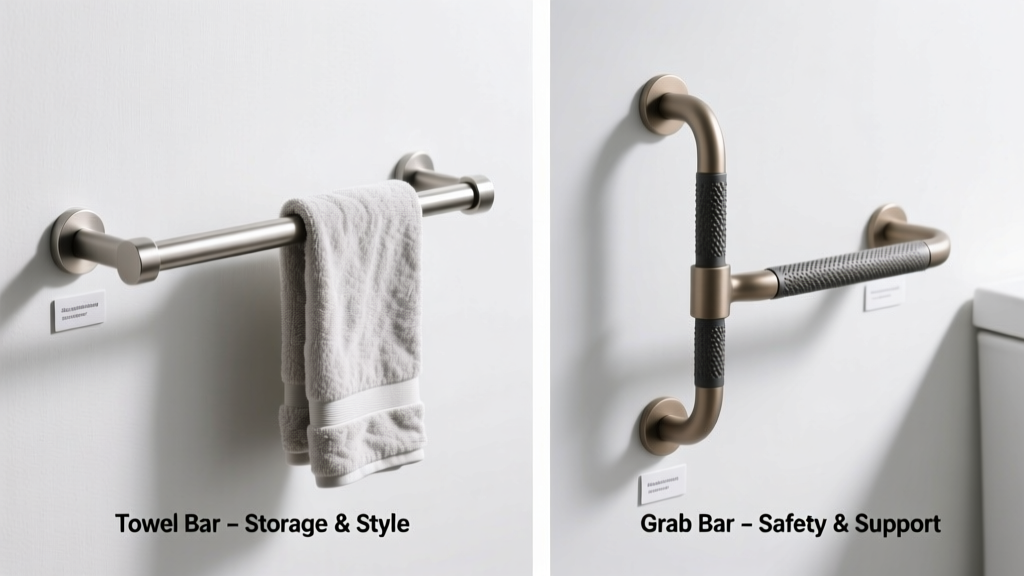
It’s a common bathroom remodel dilemma: you see a sleek chrome bar on the wall and wonder—is that meant to hold towels, or is it supposed to keep someone from falling? Confusion between towel bars and grab bars isn’t just aesthetic—it’s functional, legal, and sometimes life-saving.
Quick Verdict
Grab bars are engineered for safety and load-bearing; towel bars are designed for convenience and aesthetics. They’re not interchangeable. If fall prevention matters—even occasionally—a certified grab bar installed to ADA standards is non-negotiable. A towel bar should never be used as a grab bar, even in a pinch: it can pull out of the wall under just 250 lbs of force, per ANSI A117.1-2017 testing protocols.
Side-by-Side Comparison
| Feature | Towel Bar | Grab Bar |
|---|---|---|
| Purpose | Hanging towels and bath linens | Providing stable support during transfers and balance recovery |
| Weight Capacity | Typically 15–30 lbs (decorative use only) | Minimum 250 lbs static load (per ICC/ANSI A117.1) |
| Mounting Hardware | Decorative screws into drywall or tile; often no backing plate | Heavy-duty anchors + structural blocking or stud-mounting required |
| ADA Compliance | Not applicable | Mandatory for accessible bathrooms (ICC A117.1 & ADA Standards 2010) |
| Surface Texture | Smooth, polished finishes common | Knurled, ribbed, or textured for grip—even when wet |
Deep Dive on Towel Bars
Towel bars prioritize form and function for daily hygiene routines—not emergency support. Most are made from stainless steel, brass, or aluminum, with lengths ranging from 18” to 36”. They’re easy to install with basic tools, usually requiring only two mounting points.
Pros
- Low-cost: $25–$120 depending on material and finish
- Wide design variety—curved, double-tiered, heated options available
- Minimalist look fits modern, traditional, and transitional bathrooms
Cons
- No structural reinforcement behind mounting points in most residential builds
- Cannot withstand lateral or downward pulling forces safely
- Smooth surfaces become slippery when wet—no grip assurance
According to the U.S. CDC, over 250,000 bathroom-related falls occur annually among adults 65+, many involving improvised support on non-rated fixtures like towel bars (National Center for Injury Prevention and Control, 2022).
Deep Dive on Grab Bars
Grab bars are medical-grade safety equipment disguised as hardware. They’re tested to endure repeated 250-lb loads applied at multiple angles—upward, downward, and horizontal. Installation requires locating wall studs or installing plywood backing, and they must meet strict placement guidelines (e.g., 33–36” above floor for shower entry bars).
Pros
- Code-compliant support for aging-in-place, post-surgery recovery, or mobility challenges
- Available in angled, vertical, horizontal, and offset configurations for targeted use
- Corrosion-resistant finishes (e.g., brushed nickel, matte black) built for high-moisture environments
Cons
- Higher upfront cost: $80–$250+ for a single bar plus professional installation
- Installation complexity increases if walls lack accessible framing
- Aesthetic options are more limited—function trumps form
"A grab bar isn’t ‘just another bar’—it’s part of a person’s safety infrastructure. We’ve seen too many cases where a towel bar failed during a transfer, leading to hip fractures. If it’s not rated, anchored, and placed per ADA specs, it’s not safe." — Sarah Lin, Occupational Therapist & CAPS-certified home modifier (2023)
When to Choose a Towel Bar vs Grab Bar
Choose a towel bar when you need convenient, attractive towel storage in a low-risk area—like beside a vanity or in a guest powder room with no mobility concerns. Choose a grab bar anywhere fall risk exists: next to toilets, inside showers, near tubs, or along hallways leading to bathrooms.
You may need both: a grab bar mounted at ADA height behind the toilet for stability, plus a separate towel bar nearby for linens. That’s why many universal design plans include coordinated finishes—like matching brushed nickel grab bars and towel bars—to unify safety and style. See our guide on universal bathroom design for layout tips.
Alternatives to Consider
For users who want dual-purpose functionality without compromising safety, consider these verified options:
- Hybrid towel/grab bars: Products like the Moen SecureMount line combine ADA-rated grab bar strength with integrated towel hooks—tested to 250 lbs and certified to ICC A117.1
- Wall-mounted towel warmers with grab bar frames: Certain models (e.g., WarmlyYours TWHB series) embed structural steel within heated units
- Floor-to-ceiling poles: Adjustable, non-permanent supports ideal for rentals or temporary rehab needs—see our rental bathroom safety roundup
Can I install a grab bar myself?
Yes—if you’re confident locating studs, cutting drywall for backing, and torque-testing anchors. But 68% of DIY grab bar installations fail load tests due to insufficient blocking or anchor depth (National Association of Home Builders, Accessible Housing Report 2021). For anyone over 60 or recovering from injury, hiring a CAPS-certified contractor is strongly advised.
Do towel bars ever meet grab bar standards?
Almost never. Even heavy-duty “commercial-grade” towel bars lack the required knurling, mounting specs, and third-party certification. The International Code Council explicitly states: “No towel bar, robe hook, or shelf shall be substituted for a grab bar.”
What’s the minimum length for a shower grab bar?
Per ADA Standards §609.4, horizontal shower grab bars must be at least 24” long. Vertical entrance bars should be 18” minimum. Shower seats require an additional 12” vertical bar on the control wall.
Are suction-cup grab bars safe?
No. Suction models have no structural anchoring and fail under minimal load—often detaching during use. The American Geriatrics Society advises against them entirely for fall prevention.
Can I paint or refinish a grab bar?
Not recommended. Most coatings compromise corrosion resistance and void manufacturer warranties. Instead, select from factory-finished options like matte black, satin brass, or white powder-coated steel—many now match popular towel bar palettes. Browse our bathroom fixture finishes comparison for coordination ideas.
If your bathroom serves multiple generations—or might someday—prioritize safety first, then layer in convenience. A well-placed grab bar doesn’t signal limitation; it signals thoughtful, future-ready design. And when paired with a stylish towel bar nearby, it delivers both security and serenity.