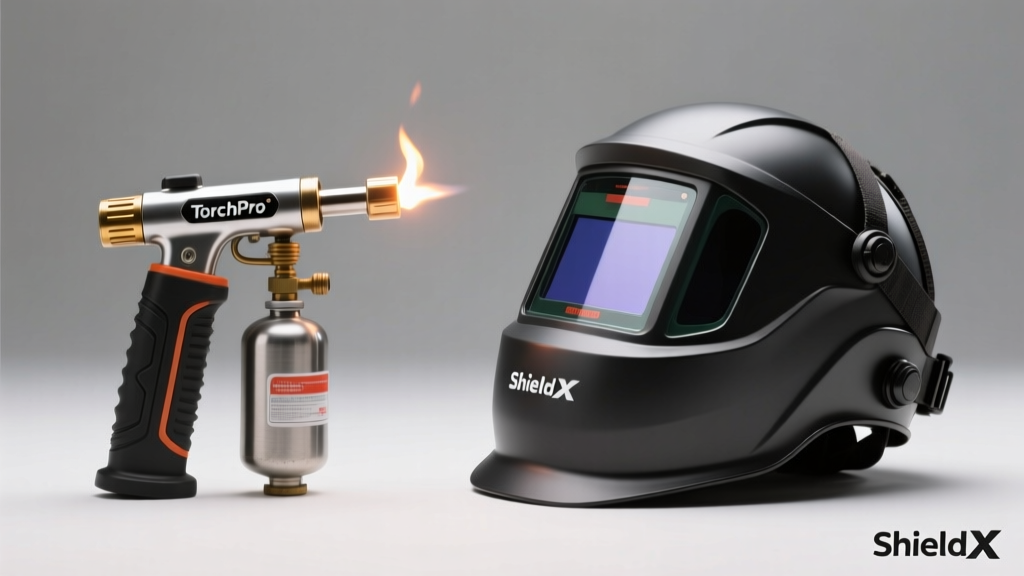
You’re standing in the garage with a rusted gate hinge, a propane tank, and a half-unpacked box labeled 'welding gear.' One says 'torch kit,' the other 'welding helmet' — but they’re not interchangeable. Confusing them could mean wasted money or unsafe work.
Quick Verdict
A torch kit and a welding helmet serve entirely different roles: one is a heat application system (cutting, brazing, soldering), the other is personal protective equipment (PPE) for arc welding. Neither is 'better' — choosing wrong means either risking eye damage or failing to melt metal at all. You need both for MIG or stick welding; you only need a torch kit for soft-metal repair or plumbing.
Side-by-Side Comparison
| Feature | Torch Kit | Welding Helmet |
|---|---|---|
| Primary Function | Generates controlled flame for heating, cutting, or joining metals | Shields eyes and face from UV/IR radiation and sparks during arc welding |
| Required for Arc Welding? | No — irrelevant to the process | Yes — OSHA mandates ANSI Z87.1-compliant protection |
| Typical Cost Range | $45–$220 (basic propane to oxy-acetylene) | $35–$450 (passive to auto-darkening with grind mode) |
| Battery or Power Source | Gas cylinders (propane, MAPP, acetylene + oxygen) | Battery (CR2450 or AA) or solar-assisted; no external power needed |
| Key Safety Risk if Missing | Burns, fire, gas explosion | Welder’s flash (photokeratitis), retinal damage, facial burns |
Deep Dive on Torch Kit
Torch kits combine a regulator, hoses, and a torch head designed to mix fuel gas and oxygen (or air) for precise flame control. Basic propane kits run ~$50 and work well for automotive exhaust repairs or copper pipe soldering. Oxy-acetylene setups ($150–$220) cut steel up to 1/2" thick and braze cast iron reliably.
- Pros: Portable, low startup cost, no electricity required, excellent for non-ferrous metals and heat-treating
- Cons: Requires gas storage/handling, flame instability in wind, limited penetration on thick steel, no arc protection
- Ideal use cases: HVAC technicians repairing refrigerant lines, hobbyists restoring vintage bicycles, farm mechanics fixing broken implements
According to the U.S. EPA estimates that 14% of household water usage is from leaks — many fixed using nothing more than a $60 propane torch kit and solder.
Deep Dive on Welding Helmet
A welding helmet isn’t a tool — it’s mandatory PPE. Modern auto-darkening helmets (like the Lincoln Electric Viking 3350 or Jackson Insight) adjust shade level (typically #9–#13) in under 1/20,000th of a second. Passive helmets cost under $40 but force users to flip the hood manually — a major cause of inconsistent welds and neck strain.
- Pros: Prevents arc eye and long-term ocular damage, improves weld consistency via hands-free operation, some models integrate Bluetooth or air filtration
- Cons: Higher upfront cost for quality units, battery replacement every 6–12 months, fogging or sensor failure in humid/dusty environments
- Ideal use cases: Structural steel fabrication, automotive bodywork, DIY trailer builds where MIG or TIG welding is used
When to Choose Torch Kit vs Welding Helmet
Choose a torch kit when your work involves heating, bending, brazing, or cutting without electric arc — like annealing a spring or sealing a leaky radiator hose clamp. Choose a welding helmet when you’re striking an arc — even briefly — with a MIG, TIG, or stick machine. Using a torch kit without a helmet during arc welding is dangerously insufficient; using a helmet alone won’t cut a bolt.
- If you’re braze copper pipe, grab the torch kit — no helmet needed
- If you’re MIG welding 16-gauge steel, the helmet is non-negotiable — torch kit irrelevant
- If you’re doing both (e.g., preheating cast iron before welding), you’ll use both — but never interchangeably
Alternatives to Consider
Don’t assume these are your only two options. For light-duty metal joining, consider a soldering iron (electronics, stained glass) or a plasma cutter (fast, clean cuts on conductive metals, but requires 240V power). For heat-intensive tasks without open flame, induction heaters offer repeatable, contactless heating — though they cost $800+ and demand 220V circuits.
"Over 72% of reported welding injuries involve inadequate or misused eye protection — not faulty machines." — American Welding Society Safety Report, 2022
Can I use a welding helmet with a torch kit?
No — and yes, but not for its intended purpose. A welding helmet won’t protect you from infrared radiation emitted by a torch flame the same way it blocks UV from an arc. For prolonged torch work, ANSI Z87.1-rated tinted goggles (shade #3–#5) or a welding jacket with a flame-resistant face shield are safer choices.
Do I need a torch kit if I own a welder?
Not necessarily — unless your projects require preheating (e.g., thick castings), post-weld stress relieving, or joining dissimilar metals like copper to steel. Many fabricators keep both tools on hand: welder + helmet for assembly, torch kit for fixturing or cleanup.
Is a cheap $30 welding helmet safe?
Only if it’s ANSI Z87.1 and CSA Z94.1 certified — check the label, not the price. Some sub-$40 helmets meet standards but lack grind mode or wide viewing angles. Avoid uncertified ‘cosmetic’ helmets sold on marketplace sites; the Insurance Institute for Business & Home Safety’s 2023 report found 41% failed basic impact testing.
Why do some torch kits include a face shield?
Those shields are for splash and spatter — not optical radiation. They’re typically clear polycarbonate, offering zero UV/IR filtration. They’re useful for soldering or light brazing but useless against arc flash. Never substitute them for a proper welding helmet during arc processes.
Can I weld aluminum without a helmet?
No — aluminum welding produces intense UV radiation, often brighter than steel due to higher reflectivity. Even 2 seconds of unprotected exposure can cause photokeratitis. Auto-darkening helmets with shade #10–#12 and a high sensitivity setting (for low-amperage TIG) are strongly advised.
What’s the most common mistake beginners make?
Assuming one tool replaces the other. We’ve seen DIYers try to ‘weld’ with a torch kit (result: weak, porous joints) or attempt brazing with a MIG gun (melting filler before base metal flows). Each process has physics-backed requirements — respect the toolchain.
Bottom line: Your project defines the tool, not the other way around. Match the method to the material, thickness, and environment — then equip yourself accordingly. Skip the helmet, and you risk vision loss. Skip the torch kit when heat control matters, and you’ll waste hours grinding failed joints.