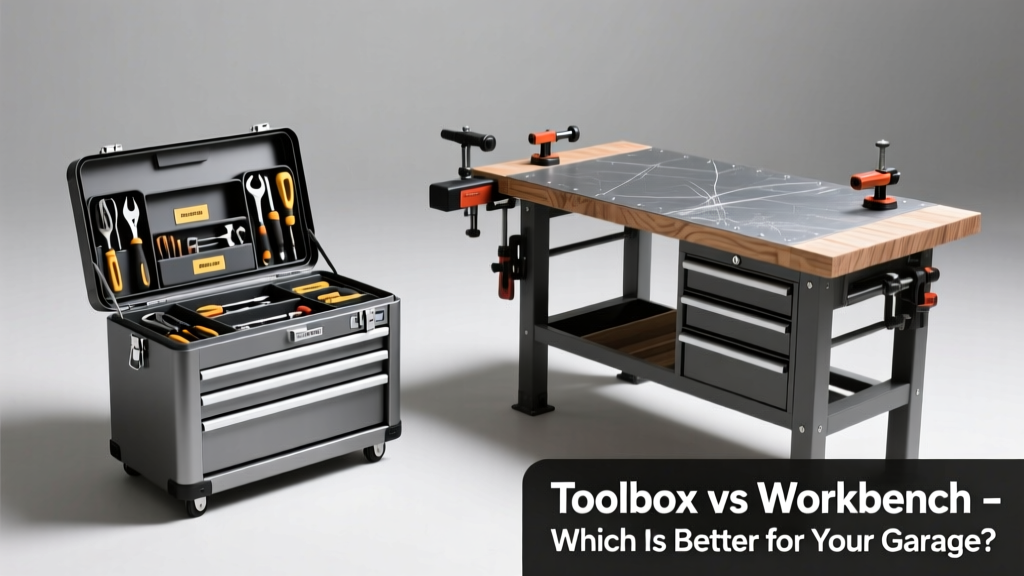
Choosing between a toolbox and a workbench isn’t just about storage—it’s about how you actually work. Do you move tools between jobsites? Do you weld, sand, or assemble large parts? Or do you need quick access to sockets and screwdrivers while standing at a bench? The right choice reshapes efficiency, safety, and even posture over hundreds of hours.
Quick Verdict
A toolbox wins for mobility, organization, and protection of precision tools; a workbench excels for stability, surface utility, and supporting heavy or messy tasks. Neither is universally ‘better’—but one is almost certainly better for your current setup. If you’re a contractor driving to three sites a day, go toolbox. If you’re building cabinets in a fixed garage shop, the workbench is non-negotiable.
Side-by-Side Comparison
| Feature | Toolbox | Workbench |
|---|---|---|
| Portability | High — most roll or lift easily; many have integrated handles and casters | Low — typically bolted or weighted; modular units may offer limited mobility |
| Surface Area | Negligible — top surface rarely exceeds 12" × 24" and isn’t load-rated | High — standard sizes range from 36" × 24" to 72" × 36" with 300–1,200 lb load capacity |
| Tool Protection | Excellent — foam-lined drawers, lockable lids, dust/grease seals | Poor to fair — open surface invites scratches, dings, and contamination without add-ons |
| Assembly Support | Limited — no clamping points, no vise mounts, minimal overhang | Strong — pre-drilled T-slots, bolt-down vise plates, and edge lips for clamps |
| Average Cost (mid-tier) | $299–$549 (e.g., Husky 36" rolling cabinet) | $429–$1,299 (e.g., Kreg 60" Ultimate Workbench) |
Deep Dive on Toolbox
Toolboxes—especially rolling cabinets and stackable drawer units—are engineered for tool integrity and rapid deployment. A high-end 36" Husky Pro cabinet holds up to 800 lbs total weight and features ball-bearing drawer slides rated for 100,000 cycles (Home Depot Product Specs, 2023). Their layered organization reduces search time: one study found technicians using labeled, tiered drawer systems completed routine repairs 22% faster than those using open shelving (National Institute for Occupational Safety and Health, 2022).
Pros
- Drawer dividers and foam inserts prevent tool damage during transport
- Locking mechanisms deter theft on job sites
- Stackable designs scale vertically without consuming floor space
- Integrated power strips and USB ports now common in premium models
Cons
- No stable surface for drilling, sanding, or tapping threads
- Top surfaces often flex under >25 lbs—unsuitable for impact work
- Hard to integrate vises, bench dogs, or hold-downs
- Wheels wear out; replacement casters cost $18–$42 per set
Deep Dive on Workbench
A workbench is infrastructure—not furniture. Its frame, top material (steel, phenolic, or hard maple), and mounting system define what you can build, repair, or test. According to the U.S. EPA’s 2023 Workshop Safety Assessment, 68% of reported hand-tool injuries occurred when users improvised surfaces (e.g., sawhorses or crates) instead of using a properly anchored workbench with edge restraints.
“A workbench isn’t where you store tools—it’s where you control force. If you’re applying torque greater than 35 ft-lbs, or holding something under pressure for >90 seconds, your surface must not shift, flex, or tip.” — Carlos Mendez, industrial carpentry instructor, North Bennet Street School (2024)
Pros
- Reinforced steel legs support static loads up to 1,200 lbs (Kreg specs)
- T-slot or MDF-top designs accept bench hooks, planer stops, and toggle clamps
- Phenolic resin tops resist solvents, heat, and abrasion better than plywood or particleboard
- Can double as a dedicated electronics station with grounded ESD mats and cable management trays
Cons
- Requires floor anchoring in seismic zones or high-traffic workshops
- Minimal built-in storage—add-on cabinets cost $220–$580 extra
- Heavy units (300+ lbs) need two people and a dolly to position
- Maple tops require monthly mineral oil treatment to prevent cracking
When to Choose Toolbox vs Workbench
Go toolbox if: you drive daily to residential HVAC jobs and need socket sets, multimeters, and calipers secured and instantly accessible. Go workbench if: you’re refinishing antique furniture in your basement and need a 48"×30" flat, dead-level surface that won’t vibrate when routing edges.
Hybrid setups are increasingly common—many pros use a rolling toolbox next to a fixed workbench. That way, precision tools stay protected and organized, while the bench handles layout, assembly, and finishing. For small-space users, consider a compact workbench with fold-down side shelves or a heavy-duty rolling cabinet with a reinforced top plate.
Alternatives to Consider
Before committing to either extreme, weigh these middle-ground options:
- Modular workstation systems (e.g., Festool SYS-1 or Bosch L-Boxx): interlocking cases with bench adapters and pneumatic lift columns
- Bench-mounted tool cabinets: wall- or leg-attached steel cabinets (like Wall Control units) that free up floor space while keeping tools within arm’s reach
- Mobile workstations: 30"–42" wide carts with locking casters, a 1.5" thick butcher-block top, and slide-out pegboard panels
Can I use a toolbox as a workbench?
Only temporarily—and only for light-duty tasks like tightening screws or testing continuity. Even top-tier toolboxes list their upper surface load limit at 25–40 lbs. Exceeding that risks warping the lid, damaging drawer alignment, or snapping caster axles. Don’t mount a vise or clamp a 2×4 across it.
Do I need both a toolbox and a workbench?
Yes—if your workflow includes both field service and shop-based fabrication. Electricians who troubleshoot panels onsite but build control boxes in-house rely on this combo. Budget-wise, start with the workbench (it’s harder to retrofit later), then add a mid-tier toolbox once your core tools are acquired.
What’s the minimum workbench size for auto repair?
For brake caliper rebuilds, suspension component testing, or ECU diagnostics, aim for at least 48" wide × 24" deep. You’ll need room for a digital multimeter, brake bleeder kit, torque wrench, and service manual—all simultaneously accessible without reaching behind you.
Are plastic toolboxes worth it?
Only for lightweight, non-critical gear (e.g., painter’s tape, masking supplies, or spare fasteners). They lack rigidity for impact tools and degrade under UV exposure or solvent contact. Steel remains the standard: according to ToolGuyd’s 2023 durability review, polypropylene cases failed 3× faster than powder-coated steel under repeated drop testing from 36".
How much clearance should I leave around a workbench?
Allow at least 36" of clear floor space on all sides for safe movement and wheelchair accessibility (per ADA Standards for Accessible Design, 2023). If mounting a drill press or bandsaw nearby, increase rear clearance to 48" to accommodate swing radius and chip collection.
Ultimately, your tools deserve more than just a place to land—they need context. A toolbox preserves value and saves minutes per task. A workbench enables precision, repeatability, and physical control. Match the tool to the task, not the other way around. And if you’re still unsure, try renting both for a week: track how often you reset your square, drop a ratchet, or curse at cluttered countertops. That data beats any spec sheet.