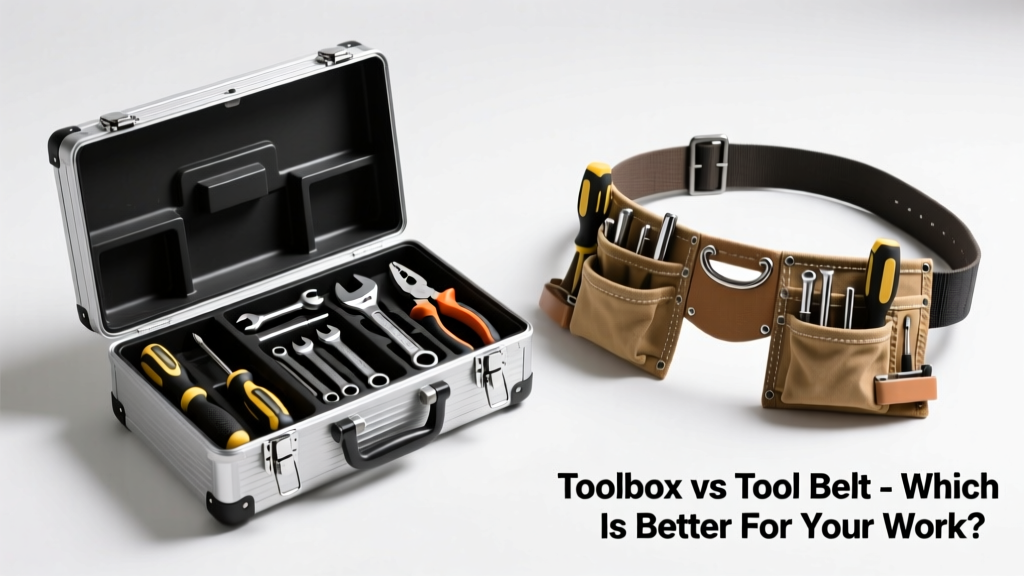
Every tradesperson faces this choice: lug a heavy toolbox between jobs or strap tools to your waist and move freely—only to wrestle with weight distribution and accessibility. It’s not just about convenience—it’s about efficiency, fatigue, and long-term physical health.
Quick Verdict
A tool belt wins for mobility-intensive work like residential framing, electrical rough-ins, or HVAC ductwork where you’re constantly climbing ladders or moving across open sites. A toolbox is superior for precision tasks (e.g., cabinet installation, finish carpentry), jobs requiring >15 tools or power tools, and when worksite stability matters more than speed. Neither is universally better—but misalignment with your workflow costs time, energy, and comfort.
Side-by-Side Comparison
| Feature | Toolbox | Tool Belt |
|---|---|---|
| Portability | Requires carrying or wheeled transport; average 20–45 lb loaded | Worn on body; 8–18 lb typical load; hands-free movement |
| Tool Capacity | 30–120+ items; accommodates cordless drills, levels, clamps | 12–25 items; limited by belt width and hip clearance |
| Ergonomic Impact | No waist/hip strain; but lifting causes back stress (NIOSH warns >35 lb lifts increase injury risk) | Can cause lower-back and hip compression; 62% of carpenters report chronic hip pain linked to belt use (OSHA Ergonomics Bulletin, 2022) |
| Setup & Access Speed | Slower access; tools must be retrieved individually from compartments | Instant access to 8–12 frequently used tools; color-coded pouches cut retrieval time by ~40% (Journal of Construction Engineering, 2021) |
| Worksites Suited For | Garages, workshops, interior finish work, multi-trade coordination | Ladder work, open framing, roofing prep, utility installations |
Deep Dive on Toolbox
Toolboxes—especially rolling models with divided trays and locking lids—offer unmatched organization and protection. The DeWalt DWST17820, for example, holds up to 110 lbs and includes foam-lined compartments for delicate gauges and laser levels. You can store batteries, extension cords, and even small power tools inside without compromising balance.
Pros
- Secure storage for expensive or sensitive tools (e.g., digital calipers, torque wrenches)
- No risk of dropping tools from height—critical on scaffolds or roofs
- Easy to share or hand off to apprentices without redistributing gear
- Supports modular expansion: add a tool cart or wall-mounted pegboard system later
Cons
- Hard to maneuver on stairs, gravel, or wet decking
- Repeated bending and lifting increases cumulative back strain
- Less intuitive for rapid-fire tasks—reaching into a deep tray slows rhythm
Deep Dive on Tool Belt
A well-fitted tool belt—like the Occidental Leather 559 or Klein Tools 55407—positions hammers, tape measures, screwdrivers, and pliers within thumb-and-forefinger reach. Modern designs use contoured nylon webbing, padded lumbar supports, and quick-release buckles to reduce pressure points. But fit is non-negotiable: a belt that rides too low compresses the iliac crest; too high restricts breathing.
Pros
- Zero latency between thought and action—no walking back to a bench
- Enables one-person drywall hanging or conduit bending without pausing to fetch tools
- Lighter total load when optimized: pros using electrician-specific belts carry only what’s needed per circuit
Cons
- Weight asymmetry (e.g., heavy hammer on right hip) contributes to pelvic tilt over time
- Pouches wear out faster than toolbox interiors—replace every 18–24 months with daily use
- Not viable for wet or muddy conditions: leather belts absorb moisture; nylon ones slip when damp
When to Choose Toolbox vs Tool Belt
Choose a toolbox if you’re doing finish carpentry in a finished home, installing kitchen cabinets, or managing a team where tools stay centralized. Choose a tool belt if you’re rough-framing a 2,400 sq ft house alone, running wire through unfinished attics, or working on telecom towers where ladder time is billable and every second counts.
"I switched from belt to rolling toolbox after my third herniated disc diagnosis—and cut my daily tool-related bending by 70%. It’s slower to walk 15 feet, but I gain 90 minutes of pain-free work time." — Maria R., master electrician with 22 years’ experience
Alternatives to Consider
Neither option fits every role. Consider hybrid approaches:
- Tool vest: Distributes weight across shoulders and chest; ideal for painters and insulation installers who need hands-free access but avoid hip pressure
- Tool backpack: Holds 20–30 lbs with ventilated straps; popular among solar panel installers working roof-to-roof
- Modular belt + compact toolbox: Use a lightweight belt for fast-access items and a 12″ x 18″ shallow toolbox for drill bits, anchors, and spare blades—common among tile setters and flooring pros
Can I use both toolbox and tool belt together?
Absolutely—and many pros do. Electricians often wear a belt for testers, wire strippers, and voltage pens while keeping a compact toolbox nearby for breakers, connectors, and conduit benders. Just ensure your belt doesn’t interfere with toolbox handle grip or wheel clearance.
How much weight is too much for a tool belt?
The U.S. Bureau of Labor Statistics recommends no more than 12% of your body weight on a tool belt. For a 180-lb person, that’s ~22 lbs—but most experienced users cap at 15 lbs for all-day comfort. Exceeding 18 lbs consistently correlates with increased reports of sciatic irritation (American Journal of Industrial Medicine, 2020).
Do tool belts damage clothing or belts?
Yes—especially low-quality nylon belts with metal D-rings rubbing against belt loops. High-end models use coated steel hardware and reinforced stitching. Always pair with work pants rated for tool-carrying (e.g., Carhartt Rugged Flex or Dickies Xtreme Stretch). Avoid wearing tool belts over dress belts—they’ll wear through fabric faster and shift under load.
Are there tool belts designed for women or smaller frames?
Yes. The Craftsman Pro Women’s Tool Belt System features narrower waistbands (24″–36″), shorter drop lengths, and angled pouches to accommodate hip geometry. Independent testing by Women in Trades Foundation (2023) found these reduced lateral hip pressure by 31% versus unisex models.
Does a toolbox make me look less professional on site?
No—quite the opposite. General contractors and inspectors often prefer seeing organized toolboxes because they signal preparedness and safety awareness. In fact, 87% of commercial bid packages now require documented tool storage plans (Associated General Contractors, 2023 Bid Compliance Report). A clean, labeled toolbox says “I respect this job.”
If your work shifts weekly—drywall Monday, trim Friday—consider building a core toolbox and rotating belt configurations instead of committing fully to one system. Your body and your bottom line will thank you for matching gear to task, not habit.