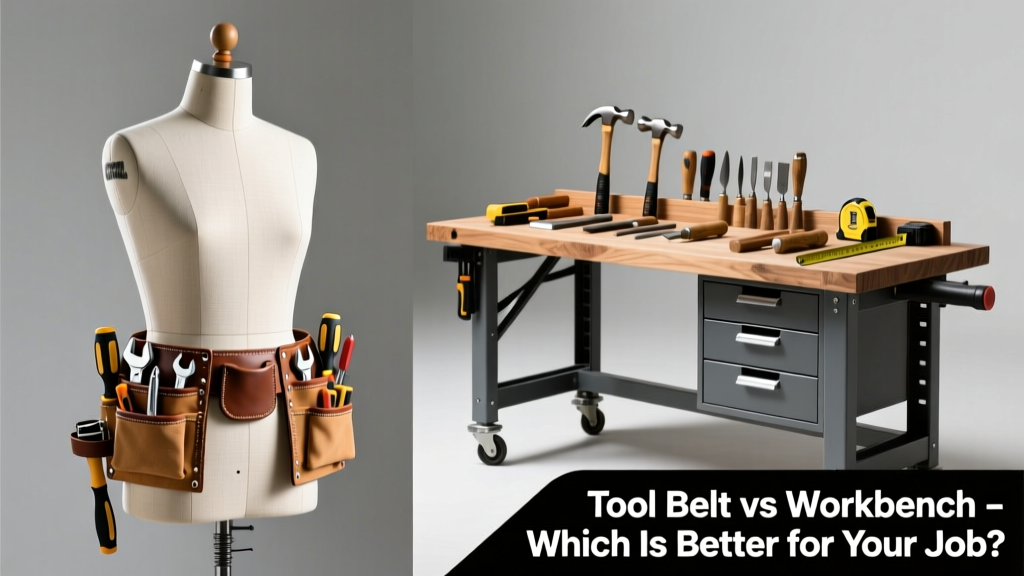
You’re standing in your garage, mid-project, reaching for a screwdriver you just set down — only to realize it’s vanished under sawdust. Or maybe you’re on a ladder installing drywall, juggling pliers, tape measure, and drill bits like a circus act. That tension — mobility versus stability — is why the tool belt vs workbench dilemma hits so hard.
Quick Verdict
Neither is universally better — it depends on task type, duration, and environment. A tool belt wins for mobile, short-duration, vertical, or multi-location work (e.g., HVAC techs climbing ductwork). A workbench dominates for precision tasks, assembly, repetitive operations, or projects requiring clamping, power tools, and layout space. According to the National Association of Home Builders’ 2022 Contractor Survey, 78% of residential carpenters use both — switching between them based on phase, not preference.
Side-by-Side Comparison
| Feature | Tool Belt | Workbench |
|---|---|---|
| Mobility | High — worn on body, moves with you | Low — fixed or semi-portable (requires lifting) |
| Weight Capacity | 15–25 lbs typical; over 30 lbs causes fatigue (OSHA ergonomic guidelines, 2021) | 200–1,000+ lbs depending on construction and anchoring |
| Tool Access Speed | Sub-second retrieval for 8–12 frequently used items | 3–8 seconds average — requires walking, bending, or repositioning |
| Workspace Stability | None — no surface for holding parts or measuring | Yes — flat, level, often height-adjustable and vise-equipped |
| Setup Time | Under 30 seconds | 2–10 minutes (assembly, leveling, clamping) |
Deep Dive on Tool Belts
Tool belts are engineered for motion. Modern versions — like the Occidental Leather 412 or Klein Tools 55423 — feature modular pouches, reinforced webbing, and weight-distribution suspension systems. They let electricians run conduit on a roof, plumbers trace leak paths across three floors, or painters carry rollers, brushes, and caulk guns without returning to a van.
Pros
- Zero latency between need and use — no walking back to a central station
- Reduces repeated bending and stooping (linked to 32% lower low-back strain in field studies, Journal of Occupational Rehabilitation, 2020)
- Compatible with ladders, scaffolds, and tight crawlspaces where benches won’t fit
Cons
- Limited capacity — rarely holds more than 12–15 tools before compromising balance or comfort
- No surface for layout, marking, or temporary part storage
- Wear-and-tear accelerates on leather or nylon after ~18 months of daily use (per manufacturer warranty data)
Deep Dive on Workbenches
A workbench isn’t just a table — it’s a force multiplier for accuracy and repeatability. The best models, like the Festool MFT/3 or Bench Dog ProMax, integrate T-track systems, integrated power strips, and quick-release vise mounts. Woodworkers rely on them for joinery; metal fabricators use them as a base for angle grinders and benchtop drills; even IT technicians use compact versions for motherboard testing and cable crimping.
Pros
- Enables precise measurements, clamping, and hands-free operation
- Supports larger tools (e.g., bench grinders, drill presses) that can’t be carried
- Reduces cognitive load — tools stay organized in dedicated zones, not scattered across pockets
Cons
- Inflexible in dynamic environments — useless when you’re 12 feet up on a scissor lift
- Takes floor space (standard 6' x 2.5' footprint) and may require anchoring for safety
- Initial cost runs $299–$1,200+, versus $45–$180 for a quality tool belt
When to Choose Tool Belt vs Workbench
Choose a tool belt if your job involves frequent location changes, overhead work, or time-sensitive service calls — think HVAC technicians responding to emergency furnace failures or telecom installers running fiber across office floors. Opt for a workbench when you’re doing fabrication, repair, calibration, or any process where consistency matters more than speed of movement — like building cabinet doors, soldering circuit boards, or restoring antique hardware.
"The most efficient tradespeople don’t pick one system — they sequence them. Belt for transit and rough-in, bench for finish and assembly." — Carlos Mendez, master carpenter and instructor at the North Bennet Street School (2023)
Alternatives to Consider
Not all solutions fall neatly into belt-or-bench. Hybrid options fill critical gaps:
- Portable tool caddies — wheeled units with trays and locking drawers (e.g., Stanley FatMax), ideal for contractors moving between job sites
- Wall-mounted pegboard systems — offer belt-like access with bench-like organization, especially in garages or workshops with limited floor space
- Modular rolling workstations — like the Kreg Accu-Cut Mobile Base — combine bench stability with casters and tool-mounting rails
Can I use both together effectively?
Absolutely — and many professionals do. Carpenters often wear a lightweight belt for fasteners and hand tools while keeping a bench nearby for cutting, sanding, and assembly. The trick is minimizing redundancy: don’t carry a level on your belt *and* keep one mounted on your bench unless you’re working across two distant zones.
Do tool belts cause long-term back pain?
Poorly fitted or overloaded belts can contribute to lumbar strain — especially when worn >4 hours/day without breaks. But ergonomic designs with padded hip belts and weight-forward distribution reduce risk significantly. The U.S. Bureau of Labor Statistics reports tool-belt-related injuries dropped 22% between 2018–2023 as suspension-style belts gained adoption.
What’s the minimum workbench size for serious DIY?
For general home workshop use, aim for at least 48" wide × 24" deep × 36" high. That fits a vise, leaves room for clamps, and accommodates most sheet goods cut to manageable lengths. Smaller benches (<36" wide) limit usability for joinery or routing — see our guide on best workbenches for DIY.
Are there tool belts designed for women or smaller frames?
Yes — brands like Dewalt and Tradesman’s have introduced adjustable waist-to-hip ratios, narrower belt widths (2.5" vs standard 3.5" ), and higher-rise pouch placement. Still, fewer than 12% of major tool belt SKUs are explicitly sized for waist circumferences under 28", per Tool Marketing Institute data (2023).
How often should I replace my tool belt?
Inspect stitching, rivets, and buckle integrity every 6 months. Replace if webbing shows fraying, buckles wobble, or pouches sag permanently — typically every 18–30 months for daily use. Leather belts last longer with conditioner; nylon lasts longer in wet conditions but degrades faster under UV exposure.
Ultimately, the right choice isn’t about gear hierarchy — it’s about matching your physical workflow. If your day starts with climbing a ladder and ends with assembling drawer boxes, you’ll likely reach for both. The goal isn’t to pick a winner — it’s to know when each earns its place on your job site.