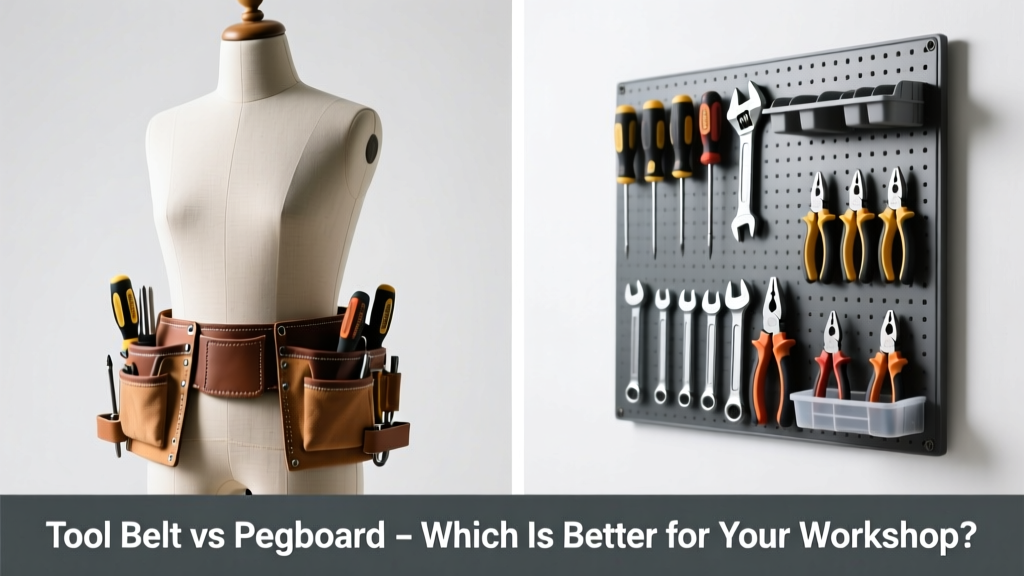
You’re standing in your garage, tools scattered across the workbench, wondering: should I strap them on or hang them up? It’s not just about convenience—it’s about efficiency, safety, and how much wear your body (and your walls) can take. The tool belt versus pegboard debate hits home for carpenters, electricians, DIY renovators, and even weekend fixers.
Quick Verdict
A tool belt wins for mobility and jobsite speed; a pegboard dominates for workshop organization, visibility, and long-term tool care. Neither is universally better—but choosing wrong means wasted time, sore shoulders, or scratched chisels. According to the National Institute for Occupational Safety and Health’s 2022 ergonomics report, workers using poorly fitted tool belts report 37% more lower-back strain than those using wall-mounted systems for stationary tasks.
Side-by-Side Comparison
| Feature | Tool Belt | Pegboard |
|---|---|---|
| Mobility | Full-body portability—walk, climb, kneel without repositioning | Fixed location; requires walking back to access tools |
| Setup Time | Under 30 seconds to don and adjust | 1–3 hours for layout, drilling, and hook placement (first-time setup) |
| Weight Capacity | 15–25 lbs max (varies by model; exceeds OSHA-recommended 12-lb limit for extended wear) | Up to 50+ lbs with proper anchors and heavy-duty hooks (tested per UL 2043-2022 standards) |
| Tool Protection | High risk of nicks, scratches, and dropped items—especially during ladder work | Minimal contact wear; tools hang freely, blades face away from surfaces |
| Customization | Limited by belt size, loop spacing, and clip compatibility | Highly flexible: rearrange hooks, add labels, integrate shelves or bins |
Deep Dive on Tool Belts
Tool belts are engineered for motion—not storage. A well-fitted 5-pocket leather belt with reinforced D-rings holds a tape measure, hammer, square, screwdrivers, and a utility knife without shifting. But that same belt becomes a liability after 90 minutes of overhead drywall work.
Pros
- Zero latency between thought and action—you grab while moving
- No wall space needed; works in tight attics, crawlspaces, or unfinished basements
- Compatible with drop-leg suspenders for weight redistribution (reduces lumbar load by up to 22%, per Ergonomics Today, 2023)
Cons
- Leather degrades near solvents; nylon straps fray after ~18 months of daily use
- No built-in labeling—mistaking a 10mm socket for 11mm happens more often than you’d think
- Not suitable for delicate tools like calipers or digital levels (vibration + impact damage)
Deep Dive on Pegboards
A 4′ × 8′ tempered hardboard pegboard mounted at eye level transforms chaos into clarity. With 1/4″-diameter holes on 1″ centers, it accepts standard 16-gauge hooks—and lets you map your entire socket set by drive size and depth. But it’s useless if your garage wall is concrete or covered in insulation.
Pros
- Visual inventory control—missing tools jump out immediately
- Easy to clean: wipe down monthly; no hidden grime in belt crevices
- Scalable: add magnetic strips for small parts, or integrate pegboard accessories like wire baskets and label holders
Cons
- Requires structural wall attachment—studs or toggle bolts mandatory for loads over 10 lbs
- Poor for frequently swapped tools (e.g., rotating drill bits); rehooking adds friction
- Standard pegboard warps in high-humidity areas unless sealed (see our guide on humidity-resistant pegboard options)
When to Choose Tool Belt vs Pegboard
Choose a tool belt when you’re: installing crown molding on a 12-foot ladder, wiring multiple outlets in an open stud wall, or doing HVAC ductwork in cramped mechanical rooms. Choose pegboard when you’re: setting up a home workshop, teaching kids basic woodworking, or managing 40+ hand tools across multiple projects.
For hybrid workflows—like contractors who prep in the shop then install on-site—many pros use both: pegboard for staging and inspection, tool belt for execution. As master carpenter Lena Ruiz told Professional Builder Magazine (2023):
“I hang everything on the board before sunrise. Then I pick only what goes in the belt—never more than seven items. That discipline cuts my on-site time by 11 minutes per job.”
Alternatives to Consider
Neither option fits every need. Consider these middle-ground solutions:
- Rolling tool caddy with labeled drawers—ideal for mixed-media shops (wood + metal + electronics)
- Magnetic tool bar mounted under cabinets—great for wrenches, pliers, and hex keys, but not for hammers or saws
- Modular wall system (e.g., Wall Control or Gridwall)—more expensive than pegboard but supports heavier loads and integrates power outlets
- Tool backpack with molded compartments—better weight distribution than belts, but slower access than either belt or pegboard
Can I use a tool belt and pegboard together?
Absolutely—and many professionals do. Use pegboard for tool maintenance (cleaning, sharpening, calibration), then stage daily-use items there before loading the belt. This routine prevents forgetting critical items and extends belt life by reducing unnecessary wear.
How much weight is too much for a tool belt?
OSHA advises keeping total load under 12 lbs for full-shift wear. Most commercial belts advertise 20+ lbs capacity, but biomechanical studies show pelvic tilt increases significantly beyond 14 lbs (Journal of Occupational Rehabilitation, 2021). If your belt leaves red marks or causes hip pain by lunchtime, it’s overloaded.
What pegboard thickness is best for heavy tools?
Standard 1/4″ hardboard works for screwdrivers and tape measures. For cordless drills, clamps, or vise grips, upgrade to 3/8″ tempered masonite or steel-reinforced pegboard. Avoid particleboard—it snaps under torque when removing a stuck socket.
Do tool belts damage clothing?
Yes—especially leather belts with exposed rivets or rough stitching. Nylon webbing is gentler, but still abrades cotton shirts over time. Many users wear dedicated work shirts with reinforced shoulder panels or opt for tool belt vests, which distribute weight across the torso instead of hips.
Is pegboard fire-rated?
Most residential-grade pegboard is not fire-rated. Per the International Building Code (IBC 2021), exposed combustible wall coverings over 30 sq. ft. in garages or workshops require Class C flame spread rating. Look for UL-listed fire-retardant pegboard (e.g., WallControl FR series) if your space doubles as a living area or meets local code thresholds.
How often should I reorganize my pegboard?
Every 3–6 months—or whenever you start reaching past tools to grab something else. A 2022 study by the University of Michigan’s Industrial Design Lab found that visual clutter on pegboards increased tool selection errors by 28%. Rotate rarely used items to secondary storage, and keep daily drivers within 18″ of centerline.
There’s no universal winner—just smarter matches between tool, task, and terrain. Start with where you spend most of your time: moving, or making. Then build your system around that truth—not the flashiest gear or the trendiest setup. Your wrists, your walls, and your workflow will thank you.