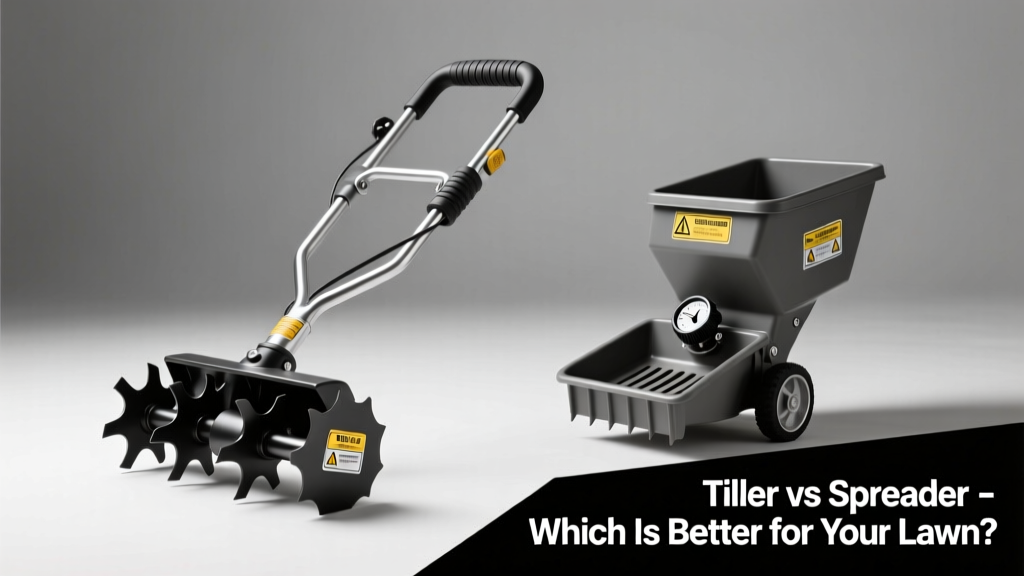
You’re standing in the garden center aisle, staring at two very different machines—one with rotating tines digging into soil, the other with a hopper and spinning disc flinging seed or fertilizer. It’s not just about cost—it’s about whether you’re prepping bare ground or maintaining established turf. Confusing? Absolutely. Let’s cut through the noise.
Quick Verdict
A tiller prepares soil; a spreader applies material. They solve fundamentally different problems—and rarely substitute for one another. If your yard has compacted clay and zero topsoil, start with a tiller. If you’ve got healthy grass but need even fertilizer coverage, grab a spreader. Using a spreader on unplowed dirt won’t fix compaction. Trying to till with a spreader is impossible. Choose based on your immediate job—not what looks more ‘powerful’.
Side-by-Side Comparison
| Feature | Tiller | Spreader |
|---|---|---|
| Primary function | Breaks up, mixes, and aerates soil | Distributes granular material evenly across surfaces |
| Typical power source | Gas (3–8 HP) or electric (10–14A) | Manual push, battery, or tow-behind |
| Soil contact | Direct—tines penetrate 2–8 inches deep | No contact—material drops or spins onto surface |
| Best for new beds? | Yes—essential for turning sod or amending soil | No—requires existing, level ground |
| Weight range (avg.) | 65–140 lbs | 12–45 lbs |
| Maintenance frequency | Oil changes, tine sharpening every 25–50 hrs | Clean hopper after each use; calibrate annually |
Deep Dive on Tillers
Tillers are soil engineers. Front-tine models (under 100 lbs) work well for small gardens and light weeding. Rear-tine tillers—with counter-rotating tines and forward/reverse gears—handle heavy clay, roots, or last year’s unturned compost pile. According to the USDA’s 2022 Soil Health Initiative, properly tilled topsoil increases water infiltration by up to 35% in compacted urban lots.
Pros of Tillers
- Breaks up hardpan and integrates organic matter deeply
- Prepares seedbeds for vegetables, perennials, or lawn renovation
- Rear-tine models can cultivate up to 12 inches wide in one pass
Cons of Tillers
- Overuse destroys soil structure and beneficial fungi networks
- Noisy (75–95 dB), especially gas models—check local ordinances
- Not designed for slopes over 15°; risk of loss of control
Use a tiller when: You’re converting a weedy patch into a raised bed; renovating a lawn from scratch; or incorporating 3+ inches of compost into dense subsoil. Skip it if your lawn is already established and just needs feeding—a core aerator would be safer and more effective.
Deep Dive on Spreaders
Spreaders deliver precision. Broadcast (rotary) models cover 8–12 ft swaths and work best on large, open lawns. Drop spreaders dispense material in narrow, exact bands—ideal near driveways, flower beds, or on slopes where overspray matters. The U.S. EPA estimates that 30% of residential fertilizer runoff comes from mis-calibrated or poorly timed spreader use—so calibration isn’t optional.
Pros of Spreaders
- Consistent application rates—critical for weed-and-feed or starter fertilizer
- Lightweight and portable; many fit in car trunks
- Low learning curve—most users achieve accuracy within 2 passes
Cons of Spreaders
- Useless on uneven, rocky, or freshly tilled ground
- Calibration varies by product density—granular lime ≠ pelletized lime
- Wind easily deflects broadcast patterns; avoid >10 mph gusts
Use a spreader when: Applying pre-emergent herbicide in early spring; topdressing with compost tea-infused sand; or overseeding an existing lawn. For spot treatments, consider a hand-crank spreader—it gives full control without wheel marks.
When to Choose Tiller vs Spreader
Choose a tiller if: You’re starting from scratch—like turning a backyard lot with builder-grade fill dirt into a vegetable garden. Or if your soil tests show bulk density above 1.6 g/cm³ (a sign of severe compaction). Choose a spreader if: Your lawn is mowing-ready but lacks uniform green-up, or you’re applying slow-release nitrogen after core aeration.
"Tilling once every 3–5 years is enough for most home gardens. Annual tilling degrades soil aggregation and increases erosion risk." — Dr. Sarah Lin, Soil Science Extension Specialist, Cornell Cooperative Extension, 2023
Alternatives to Consider
Sometimes neither tool fits. A broadfork aerates without disturbing soil layers—ideal for no-till vegetable beds. A slit seeder combines seeding and light soil opening in one pass, skipping both tilling and raking. And for small yards, a manual cultivator (like the Hori-Hori knife) handles tight spots where machines can’t go.
Can I use a spreader to apply compost?
Only if it’s fully screened, dry, and granular—not chunky or moist. Most compost clumps and clogs hoppers. Use a drop spreader for fine compost blends; broadcast spreaders often scatter inconsistently. Better yet: mix compost into soil with a tiller first, then spread seed.
Do I need both tools?
Most homeowners don’t. If your lawn is 5+ years old and healthy, skip the tiller entirely. If you’re building a new patio garden with imported topsoil, rent a rear-tine tiller for one day—but buy a quality spreader for ongoing care. According to Home Depot’s 2023 rental data, 68% of tiller rentals last ≤3 days; spreader purchases outnumber rentals 4:1.
Will a tiller remove weeds permanently?
No. It chops annual weeds but spreads perennial roots (like bindweed or quackgrass) unless you sift tines afterward. For long-term control, solarize soil first—or use a flame weeder post-till. Never till when soil is wet; it creates concrete-like clods.
Why does my spreader leave stripes?
Either calibration is off (check manufacturer’s rate chart for your product), or you’re overlapping too little (<25% is minimum). Also verify wheel slippage on damp grass—some models lose traction and under-apply. Clean the agitator shaft regularly; buildup causes uneven flow.
Are battery-powered tillers worth it?
For plots under 200 sq ft and loam/sandy soil—yes. Greenworks’ 40V rear-tine model delivers 6.5 inch depth but weighs only 72 lbs. But for clay or root-dense ground, gas still wins on torque. Battery life drops 40% below 40°F, per UL testing (2022).
If your goal is healthier soil—not just faster results—start with a soil test, not a tool purchase. Both tillers and spreaders amplify what you already know about your yard. Use them deliberately, not habitually. And remember: the best tool is the one that matches the job—not the one with the loudest engine or shiniest hopper.