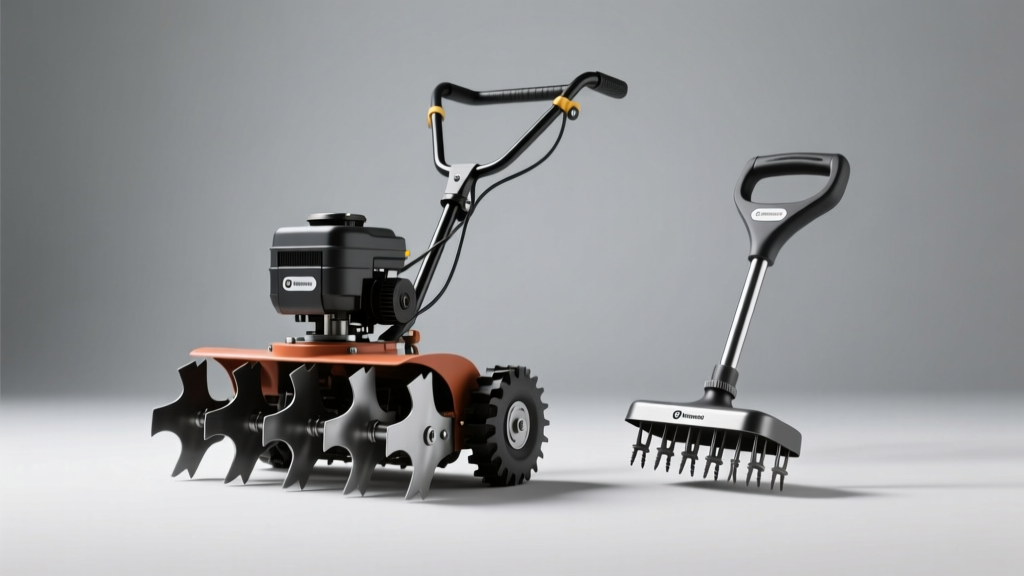
It’s spring. Your lawn looks patchy, compacted, and stubbornly resistant to seed or fertilizer—and you’re staring at two bulky tools in the rental yard: a tiller and an aerator. They both poke holes in soil, but they serve wildly different purposes. Confusing them could mean wasted time, damaged turf, or even soil degradation.
Quick Verdict
A tiller breaks up soil—deeply and aggressively—to prepare bare ground for planting or renovation. An aerator relieves compaction in established lawns by removing small soil plugs, without disturbing grass roots or surface integrity. Neither is "better" universally; choosing depends on whether your soil is bare (tiller) or covered (aerator). According to the University of Minnesota Extension’s 2022 Turfgrass Management Handbook, using a tiller on a healthy lawn reduces turf density by up to 65% within two weeks—making it the wrong tool for maintenance.
Side-by-Side Comparison
| Feature | Tiller | Aerator |
|---|---|---|
| Primary purpose | Soil disruption & seedbed prep | Compaction relief & root-zone oxygenation |
| Soil depth affected | 4–8 inches (rotary), up to 12" (rear-tine) | 2–3 inches (core), 1–2" (spike) |
| Ideal soil condition | Dry to slightly moist, unplanted | Moist but not saturated, actively growing turf |
| Grass survival rate | Near zero—destroys existing sod | 95%+ retention (core type); minimal disruption |
| Average rental cost (daily) | $65–$110 (Home Depot, 2024) | $45–$75 (Lowe’s, 2024) |
Deep Dive on Tiller
A tiller is a soil pulverizer—not a lawn conditioner. It uses rotating tines to churn, mix, and invert topsoil, breaking up clods, incorporating amendments, and eliminating weeds or old roots. Rear-tine models offer forward/reverse drive and handle clay-heavy soils better than front-tine versions.
Pros
- Creates uniform, fine-textured seedbeds ideal for new lawns or garden beds
- Effective at mixing in compost, lime, or topsoil to depths unreachable by rakes or spreaders
- Removes persistent perennial weeds (e.g., bindweed, quackgrass) when tilled deeply and repeatedly
Cons
- Destroys existing grass, sod, and shallow-rooted perennials instantly
- Can worsen compaction if used on wet soil—creating cement-like layers beneath the surface
- High fuel consumption and noise; rear-tine units weigh 200–300 lbs and require two people to load
Best for: Converting a weedy backyard into a new lawn, prepping vegetable garden rows, or renovating severely degraded soil where no vegetation remains. Not for use on lawns with >30% live grass cover.
Deep Dive on Aerator
An aerator improves soil structure without tearing up turf. Core (plug) aerators extract cylindrical soil samples, creating vertical channels that let air, water, and nutrients reach roots. Spike aerators press into soil—but often compact surrounding areas, making them less effective for heavy clay or high-traffic lawns.
Pros
- Boosts drought resilience: Lawns aerated annually show 22% greater water infiltration (Penn State Extension, 2023)
- Reduces thatch buildup by stimulating microbial activity in the root zone
- Safe to use during active growth periods—ideal for cool-season grasses in early fall or warm-season types in late spring
Cons
- Core aerators leave soil plugs on the surface that take 1–2 weeks to decompose
- Less effective on slopes >15% due to machine stability issues
- Does not correct severe grading problems or add organic matter—requires follow-up topdressing
Best for: Established lawns showing signs of compaction (water pooling, thinning turf, spongy feel), especially under trees or near driveways. Also essential before overseeding overseeding or applying slow-release fertilizer.
When to Choose Tiller vs Aerator
Choose a tiller only when starting over: replacing dead sod, clearing invasive ground covers like English ivy, or converting a gravel lot into a garden. Choose an aerator when your grass is alive but struggling—especially if you’ve noticed increased runoff after rain or fertilizer failing to green up patches evenly. The U.S. EPA estimates that 14% of household water usage is from leaks—including irrigation inefficiencies caused by compacted soil, which aerating can reduce by up to 30% (EPA WaterSense, 2023).
"If your lawn has more than five bare spots larger than 6 inches across, skip the aerator and consider full renovation—with a tiller, then reseeding. But if it’s mostly green with just poor response to care, aerating is almost always the smarter, faster fix." — Dr. Nick Christians, Iowa State University Turfgrass Science, 2021
Alternatives to Consider
For light-duty tasks, manual tools may suffice—and avoid rental hassles entirely. A manual core aerator works well for small yards (<1,000 sq ft), while a broadfork offers low-impact soil loosening without inversion. For heavily compacted clay, consider liquid aeration (surfactant-based solutions), though research from Purdue University (2022) shows it provides only ~40% of the physical pore-space improvement achieved by mechanical core aeration.
Can I use a tiller as an aerator?
No. Tillers cut horizontally and churn soil laterally, destroying root systems and leaving no vertical channels. Their tines don’t extract plugs or create consistent, spaced holes—critical for gas exchange and root penetration.
Do I need both tools?
Rarely. Most homeowners need only one. If you maintain an established lawn, rent an aerator yearly. If you manage a large garden or frequently install new landscape beds, a tiller becomes more valuable—but still not for lawn upkeep.
Is spike aeration ever better than core aeration?
Only in very sandy, non-compacted soils—or for temporary cosmetic relief on small, low-traffic areas. Spike aerators compress soil around each hole, worsening compaction over time in clay or loam. Core aeration is recommended for >90% of residential lawns (University of Wisconsin–Madison, 2020).
How often should I aerate?
Cool-season grasses (Kentucky bluegrass, fescue): once per year, ideally in early fall. Warm-season grasses (bermudagrass, zoysia): once in late spring to early summer. Skip if rainfall exceeds 2 inches/week for two weeks prior—the soil must be moist but not soggy.
Can I aerate right after seeding?
No—wait until seedlings are at least 3 inches tall and have developed shallow roots (typically 4–6 weeks). Aerating too soon pulls up newly germinated grass. Instead, aerate before overseeding, then lightly rake in seed and apply straw mulch.
If your goal is healthy grass—not raw soil prep—you’ll get stronger results, faster recovery, and longer-lasting benefits from proper aeration. Tillers belong in renovation, not routine care. Match the tool to the job, not the label on the box.