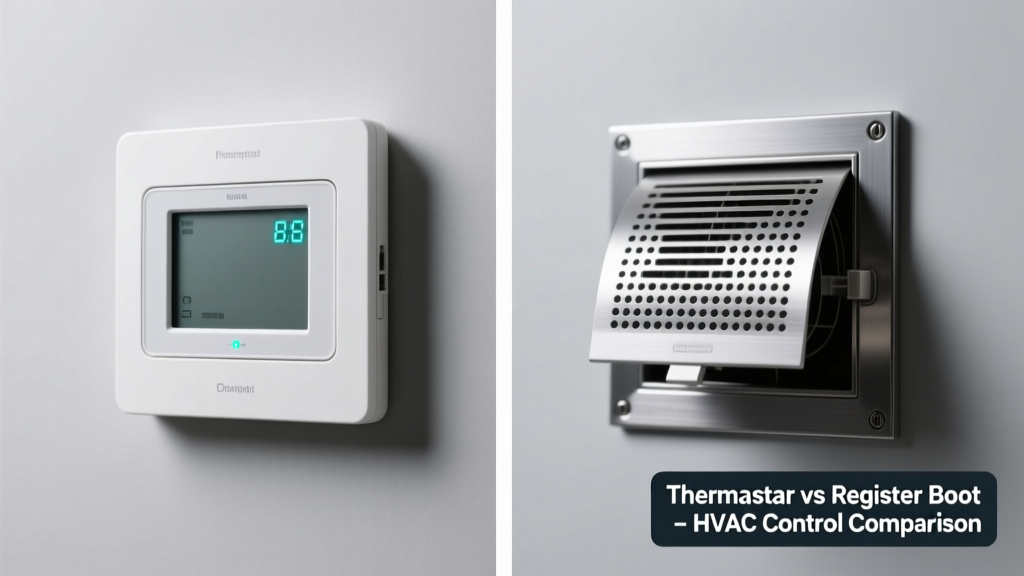
You’re troubleshooting uneven room temperatures or high energy bills—and you’ve heard two fixes: upgrade your thermostat or install a register boot. But these aren’t interchangeable solutions. One is a control device; the other is an airflow management component. Confusing them leads to wasted time, money, and still-uncomfortable rooms.
Quick Verdict
A thermostat regulates when and how long your HVAC system runs; a register boot directs where conditioned air goes inside a ducted space. Neither is 'better' overall—but choosing wrong causes real problems. If your living room stays cold while the bedroom overheats, a smart thermostat may balance cycles—but if air never reaches the hallway vent, you need a properly sized, insulated register boot. According to the U.S. EPA, 30% of HVAC inefficiency stems from duct leakage and poor airflow distribution—not faulty controls (EPA Energy Star Guide, 2022).
Side-by-Side Comparison
| Feature | Thermostat | Register Boot |
|---|---|---|
| Primary Function | Measures ambient temperature and signals HVAC to start/stop | Connects floor/wall register to ductwork; shapes and directs airflow |
| Installation Location | Wall-mounted, typically at eye level in central living area | Inside wall cavity or floor joist space, behind registers |
| Impact on Energy Use | High—smart models can cut heating/cooling costs by up to 12% (DOE, 2023) | Moderate—poorly sealed boots leak up to 20% of delivered air (IBHS Duct Study, 2021) |
| Lifespan | 5–10 years (smart models often replaced every 7) | 20+ years (if metal and undamaged) |
| DIY-Friendly? | Yes—with basic wiring knowledge (line-voltage models require electrician) | Yes for retrofit kits; full replacement needs drywall repair skills |
Deep Dive on Thermostat
Modern thermostats—especially Wi-Fi or learning models like the Nest Learning Thermostat or ecobee with room sensors—adjust based on occupancy, weather forecasts, and historical usage. They interface directly with your furnace, heat pump, or AC condenser.
Pros
- Enables zoning via schedule or remote adjustment
- Integrates with home automation (Alexa, Apple Home, Matter)
- Provides energy usage reports and maintenance alerts
- Can reduce runtime without sacrificing comfort—e.g., pre-cooling before peak rates
Cons
- Won’t fix drafts, whistling vents, or rooms with zero airflow
- Placement matters: mounting near windows, lamps, or exterior walls causes false readings
- Multi-stage or heat-pump systems require compatible wiring (C-wire often needed)
Deep Dive on Register Boot
A register boot is the sheet-metal (or sometimes fiberglass) transition piece that connects your duct trunk to the visible register grille. It’s not decorative—it seals the gap, prevents insulation compression, and minimizes turbulence. Insulated boots—like the Rectorseal QuietBoot—also reduce noise and condensation in humid climates.
Pros
- Stops air leakage at the register—up to 15 CFM loss per unsealed boot (ASHRAE Journal, 2020)
- Improves throw pattern: angled or tapered boots direct air farther into rooms
- Reduces duct noise and vibration transfer through floors/walls
- No power, no firmware updates, no subscription fees
Cons
- Does nothing for cycling frequency or temperature setpoints
- Retrofitting requires cutting drywall or flooring—messy without experience
- Low-cost plastic boots degrade, warp, or crack over time
When to Choose Thermostat vs Register Boot
Choose a thermostat upgrade if:
- Your HVAC runs constantly but rooms stay uneven—suggesting poor scheduling or sensor placement
- You want remote control, geofencing, or utility demand-response compatibility
- Energy bills spiked after replacing equipment (indicates mismatched control logic)
Choose a register boot replacement or upgrade if:
- A specific room gets no airflow—even with the register fully open
- You hear rattling, whistling, or hissing at vents
- Insulation around ducts is compressed or missing behind registers
Alternatives to Consider
Before committing to either, rule out simpler fixes. A dirty air filter reduces static pressure and starves downstream registers—replace it every 60–90 days. Duct sealing with mastic (not duct tape) addresses leaks upstream. And balancing dampers—located inside main supply trunks—let you manually restrict flow to strong zones and boost weaker ones.
For whole-home coordination, consider a zoned HVAC system with motorized dampers and multiple thermostats. It combines control (thermostat function) with targeted delivery (boot-level precision)—but starts at $2,800 installed.
Can a register boot affect thermostat readings?
No—unless the boot is so poorly installed it creates a draft across the thermostat’s location. Thermostats read ambient air, not duct pressure or velocity. But if a leaky boot in the same room pulls in attic air (in summer) or basement air (in winter), localized temperature swings might confuse a poorly placed thermostat.
Do smart thermostats work with older furnaces?
Most do—but verify compatibility first. Older millivolt or pneumatic systems often lack a C-wire and 24VAC transformer. The Honeywell RTH9580WF lists 98% compatibility, but units built before 1990 may need a power extender kit or professional assessment.
How do I know if my register boot is leaking?
Hold a lit incense stick near the register frame while the system runs. If smoke wobbles or gets sucked sideways, air is escaping behind the boot. Also check for dust buildup around the register perimeter—leaking boots pull in drywall dust and insulation fibers.
Is insulation inside the boot worth it?
Yes—if you’re running cooled air through a hot attic or heated air through an unconditioned crawlspace. The U.S. Department of Energy recommends R-6 minimum insulation for boots in extreme temperature zones (DOE Building America Report, 2021). Uninsulated boots in attics can sweat, drip, and promote mold.
Can I install a register boot myself?
You can—but success depends on access. Retrofit kits like the Kohler FlexBoot snap into existing drywall openings. Full replacement requires cutting sheetrock, measuring duct collar depth, and sealing seams with foil tape + mastic. If you’re uncomfortable patching drywall or working in tight joist spaces, hire an HVAC tech ($120–$180 per boot installed).
Will upgrading both help?
Only if both issues exist. Installing a $250 smart thermostat won’t fix a collapsed boot starving your home office. Likewise, new boots won’t prevent your furnace from short-cycling every 4 minutes. Diagnose first: log runtime with a simple thermometer app, then inspect airflow path from duct trunk to register.
"A thermostat tells the system what to do—but a register boot determines whether the command actually reaches the room. You can have perfect control logic and still lose 30% of your conditioned air before it leaves the duct." — HVAC Design Specialist Maria Chen, ASHRAE Journal, Vol. 62, Issue 4, 2020
If your goal is consistent comfort, start with airflow integrity—then layer on intelligent control. Fix the leaky boot first. Then let the thermostat optimize what’s already working well.