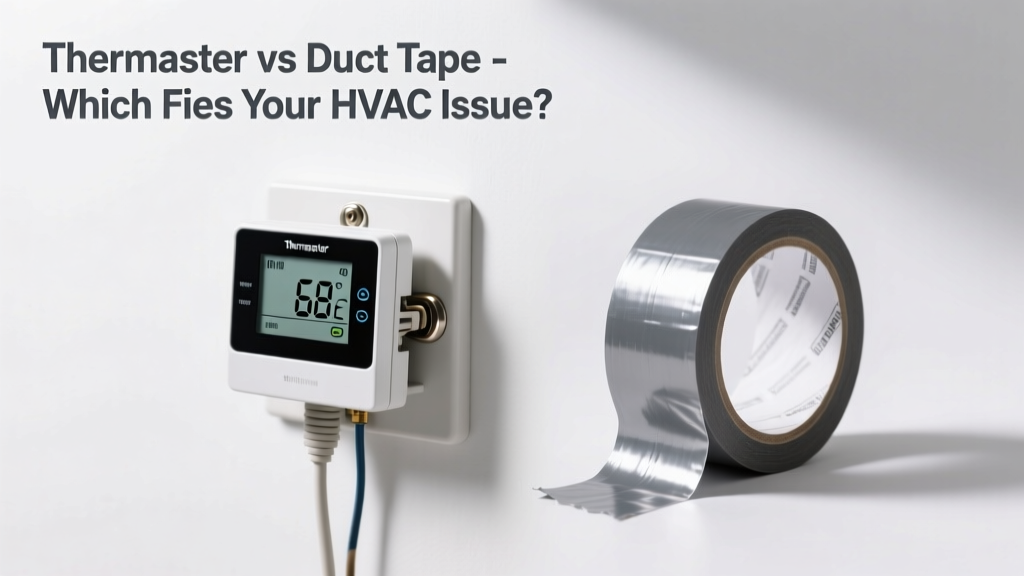
You’ve noticed uneven heating, a furnace cycling too often, or a room that never warms up — and someone suggested ‘just tape the thermostat’ or ‘wrap the duct with tape.’ That’s when confusion sets in: are these interchangeable fixes? They’re not. One is a precision control device; the other is a temporary adhesive. Mixing them up can cost hundreds in repairs.
Quick Verdict
A thermostat regulates your HVAC system’s operation based on temperature feedback; duct tape is a short-term sealant for duct joints — but it’s not rated for HVAC use. Choosing one over the other isn’t about preference — it’s about function. Using duct tape to ‘fix’ a faulty thermostat won’t lower your energy bill. Installing a smart thermostat won’t stop air leakage from a torn flex duct. According to the U.S. EPA, 20–30% of conditioned air escapes through poorly sealed ducts — yet duct tape fails under heat and humidity, worsening the problem (EPA ENERGY STAR Guide, 2022).
Side-by-Side Comparison
| Feature | Thermostat | Duct Tape |
|---|---|---|
| Purpose | Measures ambient temperature and signals HVAC equipment to turn on/off | Adhesive-backed cloth tape marketed for temporary bundling, sealing, and patching |
| Operating Temperature Range | Typically -10°F to 140°F (varies by model) | Not rated for sustained heat; adhesive softens above 140°F |
| Code Compliance | Required by IRC M1403.1 for all forced-air systems | Prohibited by IMC 603.5 and SMACNA guidelines for duct sealing |
| Lifespan | 5–15 years (smart models average 8–10) | 3–12 months before drying, cracking, or losing adhesion |
| Energy Impact | Up to 12% HVAC energy savings with programmable/smart models (DOE, 2023) | No energy impact — may increase losses if used improperly on ducts |
Deep Dive on Thermostat
Modern thermostats — especially Wi-Fi-enabled or learning models like the Nest Learning Thermostat or Ecobee — use sensors, algorithms, and occupancy detection to optimize runtime. They interface directly with your furnace, heat pump, or AC compressor via low-voltage wiring (typically 24V AC).
Pros
- Reduces heating/cooling runtime by up to 10–12% annually (U.S. Department of Energy, 2023)
- Enables zoning when paired with dampers and compatible HVAC systems
- Provides diagnostics — e.g., detecting short cycling or sensor drift
Cons
- Requires correct wiring; miswiring can damage control boards
- Poor placement (near windows, lamps, or drafts) causes inaccurate readings
- Smart models need stable Wi-Fi and may raise privacy concerns
Best for: Homeowners seeking long-term comfort control, energy savings, or integration with home automation. Not a fix for duct leaks, airflow blockages, or refrigerant issues.
Deep Dive on Duct Tape
Duct tape was never designed for ductwork — despite the name. Its rubber-based adhesive degrades under HVAC temperatures and humidity. Real duct sealing requires mastic, foil tape (UL 181A-P certified), or aerosol sealants tested for air-impermeability.
“Duct tape fails within months on supply ducts — especially near furnaces where surface temps exceed 160°F. It’s the #1 cause of re-sealing callbacks in HVAC retrofits.” — HVAC Excellence Certified Trainer, 2021 Field Survey
Pros
- Readily available at hardware stores and dollar stores
- Useful for bundling wires, temporary pipe wraps, or securing insulation during installation
- Strong initial tack for non-thermal, low-stress applications
Cons
- Adhesive dries out and cracks, creating new gaps
- Not UL-listed for HVAC use — violates building codes in 47 states
- Can leave sticky residue that impedes proper mastic application later
Best for: Emergency field repairs on non-duct items (e.g., holding a filter frame), arts-and-crafts, or labeling. Never for sealing duct seams, insulating registers, or modifying thermostat wiring.
When to Choose Thermostat vs Duct Tape
Choose a thermostat upgrade if your home has inconsistent temperatures, high bills despite regular maintenance, or outdated manual controls. Choose proper duct sealing (not duct tape) if you hear whistling at vents, feel drafts near registers, or notice dust buildup from leaky return ducts.
- Choose thermostat: When your AC runs constantly but never reaches setpoint — points to control or calibration issue
- Choose mastic + UL 181A-P tape: When airflow drops in one zone and duct inspection reveals visible gaps at joints
- Avoid both: If your furnace won’t ignite — that’s likely a pressure switch, flame sensor, or gas valve issue (see our furnace troubleshooting guide)
Alternatives to Consider
Neither tool solves every HVAC issue. For precise temperature management, consider zoning systems with motorized dampers. For duct integrity, use water-based mastic brushed into seams or UL-certified foil tape. For quick diagnostics, an infrared thermometer helps verify actual register output versus thermostat reading.
Can duct tape fix a broken thermostat?
No. Taping over a thermostat’s sensor blocks airflow and causes false readings. Covering terminals risks short circuits. If your thermostat screen is blank, check breaker and furnace power first — then test voltage at the R and C terminals with a multimeter.
Will a new thermostat stop cold spots?
Only if the cold spot stems from poor scheduling or delayed response. If it’s due to undersized ducts, closed dampers, or insufficient insulation, no thermostat — even a $300 smart model — will warm that room without airflow or envelope fixes.
Is there any HVAC use for duct tape?
Yes — but narrowly. Technicians sometimes use it to temporarily hold fiberglass duct liner in place during retrofitting, or to mark duct sections pre-insulation. It is never applied over seams or joints intended to carry air.
What tape *should* I use on ducts?
Look for UL 181A-P (for rigid ducts) or UL 181B-FX (for flexible ducts) certification. These tapes withstand 200+ hours at 250°F and resist mold, UV, and humidity. Brands like Nashua 324 and Shurtape FSK-200 meet this standard.
How do I know if my thermostat is bad?
Signs include unresponsive buttons, blank display with power confirmed, mismatched room temp vs. reading (>3°F variance), or failure to trigger HVAC after hold settings. Test by bypassing it: jump R to W (heat) or Y (cool) at the furnace control board — if system starts, the thermostat is likely faulty.
Does duct tape cause fire hazards?
Not directly — but degraded tape near hot flue pipes or furnace cabinets can ignite if exposed to sustained >300°F surfaces. More commonly, it contributes to overheating by restricting airflow across heat exchangers, increasing risk of cracks and CO leaks.
If your HVAC issue started after applying duct tape to a thermostat or duct — remove it carefully and inspect for residue or damage. Then diagnose the root cause: control, airflow, refrigerant, or combustion. Confusing tools leads to compounding problems — and higher repair bills.