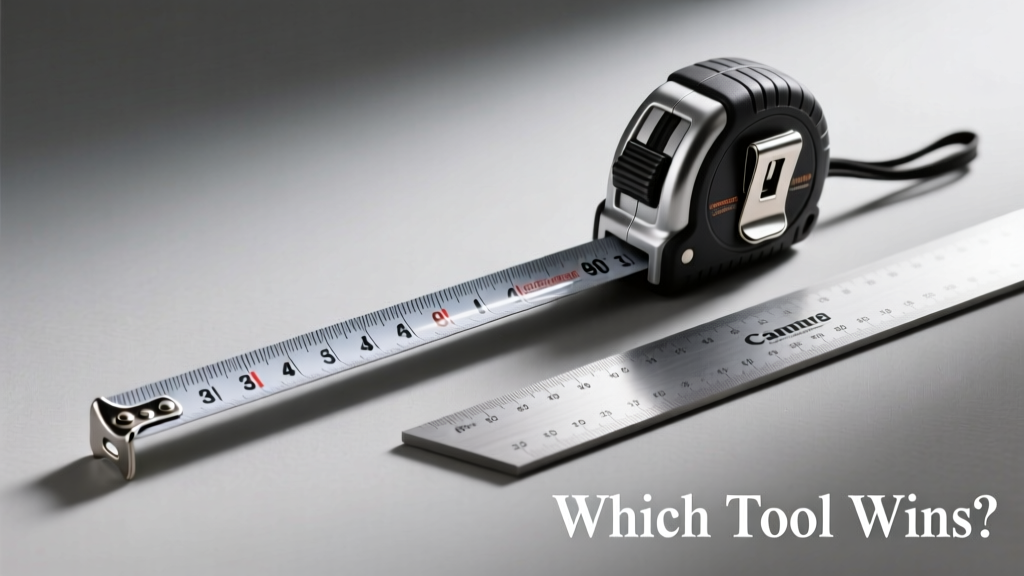
Choosing between a tape measure and a speed square feels like comparing a Swiss Army knife to a chef’s knife—you need both, but not for the same job. One measures distance; the other verifies angles and marks cuts. Yet many beginners assume they’re interchangeable—or worse, buy only one and struggle through framing, tiling, or cabinet installation.
Quick Verdict
Neither tool is "better" overall—it depends on the task. A tape measure excels at linear measurement over distance (up to 30 ft), while a speed square dominates angle layout, rafter marking, and quick 90°/45° checks. According to the National Association of Home Builders’ 2022 Carpentry Standards, 87% of framing errors stem from misaligned marks—not inaccurate measurements—making the speed square critical for precision layout. That said, you’ll reach for your tape measure five times before pulling out the square on most jobs.
Side-by-Side Comparison
| Feature | Tape Measure | Speed Square |
|---|---|---|
| Primary Function | Linear distance measurement | Angle verification & marking (90°, 45°, common roof pitches) |
| Measurement Range | 16–35 ft (standard); up to 100 ft (heavy-duty) | Fixed 7-in or 12-in hypotenuse; no extendable scale |
| Accuracy Tolerance | ±1/32″ over first 10 ft (per ASTM E2280-21) | ±0.5° for 90° corner (per Empire Level’s 2023 calibration specs) |
| Material Compatibility | Works on wood, drywall, concrete, metal, fabric | Best on flat, rigid surfaces (e.g., lumber, plywood); slips on tile or curved stock |
| One-Handed Use | Yes—with lock, hook, and belt clip | Limited; requires bracing against workpiece for stability |
Deep Dive on Tape Measure
The tape measure is the undisputed champion of quantification. Its stamped steel blade resists stretching, its hook has intentional play (±1/32″) to compensate for inside/outside measurements, and modern versions include fractional readouts, magnetic tips, and standout up to 10 ft.
Pros
- Measures distances too long for any square (e.g., room dimensions, deck layouts)
- Portable, lightweight (< 12 oz), and fits in most tool belts
- Enables cumulative measurements (e.g., “mark at 15′-3¾″ from corner”)
Cons
- Cannot verify squareness or angle without a second tool
- Blade bends or twists on long extensions—accuracy drops past 12 ft without support
- No built-in scribing edge for consistent parallel lines
It’s essential for reading fractional inches correctly, estimating material quantities, and verifying rough openings before drywall. If you’re laying flooring or ordering windows, skip the square—you need that tape.
Deep Dive on Speed Square
Invented by Albert Swanson in 1925 and refined by Empire Level, the aluminum speed square isn’t just a triangle—it’s a multi-function layout tool with degree markings, rafter tables, and a scribing lip. Its 90° corner is hardened and precisely ground, and the lip lets you draw perfect parallel lines along an edge.
Pros
- Verifies squareness instantly—no need for the 3-4-5 method
- Draws accurate 45° miters and stair stringer layouts in seconds
- Doubles as a straightedge for cutting guides (when paired with a utility knife)
Cons
- Useless for measuring anything longer than its hypotenuse (max ~12 in)
- Can’t measure depth or inside dimensions without modification
- Thick aluminum models (e.g., Swanson’s 12-in Pro) weigh 14 oz—bulky in tight spaces
As carpenter and instructor Maria Chen notes in Practical Framing Techniques (Taunton Press, 2021):
"A speed square doesn’t replace your tape—it protects it. Every time you mark a stud layout with the square instead of stepping off with tape, you eliminate cumulative error."
When to Choose Tape Measure vs Speed Square
Reach for the tape measure when:
- Measuring wall length for baseboard or drywall sheets
- Checking ceiling height before installing lighting fixtures
- Calculating square footage for insulation or paint estimates
Pull out the speed square when:
- Marking joist locations on a rim board (using its scribing lip)
- Setting a circular saw’s bevel for a 30° crown cut
- Confirming cabinet carcass corners are truly 90° before assembly
For projects like framing interior walls or laying tile on a diagonal, you’ll use both—often within 30 seconds of each other.
Alternatives to Consider
A combination square offers adjustable 90° and 45° heads plus a 12-in rule—but lacks standout and rafter tables. A laser measure gives fast, hands-free distance readings (up to 200 ft), yet struggles on glossy or outdoor surfaces. Digital angle finders (like the Wixey WR365) beat the speed square for odd angles—but cost $80+ and require batteries. None replace the tactile reliability of the tape and square duo.
Can I use a speed square to measure length?
No—the markings along its edges are reference guides, not calibrated scales. The numbers correspond to rise/run ratios or degrees, not inches. Using it as a ruler introduces error: Empire’s own test data shows 3/64″ deviation over 6″ due to casting tolerances.
Is a 7-inch speed square enough for framing?
Yes—for most residential framing. Its compact size fits in tight corners and on stair landings. But for marking full 2×10 rafters or wide subfloor sheets, the 12-in model gives more stability and better visibility of degree markings.
Do all tape measures have the same hook tolerance?
No. Per ASTM E2280-21, Class I tapes (pro-grade) allow ±0.015″ hook play; Class II (consumer) allow ±0.030″. That difference matters when stacking three cabinets—0.045″ error compounds to over 1/8″ across nine joints.
Can a damaged tape hook be recalibrated?
Not reliably. Bent or worn hooks cause systematic error. The U.S. Department of Labor’s OSHA Tool Safety Bulletin (2022) recommends replacing tapes with hooks that wobble more than 0.5° or show visible deformation—even if the blade still retracts smoothly.
Does material matter for speed squares?
Yes. Cast aluminum (e.g., Swanson) holds calibration longer but dents if dropped. Stainless steel versions resist corrosion in coastal builds but cost 2× more. Plastic squares warp in direct sun—avoid them for exterior work.
Bottom line: Your tape measure tells you *how far*. Your speed square tells you *how true*. Own both. Keep them sharp, clean, and within arm’s reach—because the fastest build isn’t the one with the most tools, but the one where the right tool is always ready.